When engineers, procurement managers, and buyers search for industrial rubber components, the challenge is rarely finding a manufacturer, it’s identifying the right material, hardness, design profile, and performance characteristics for the intended application.
This guide is designed to simplify that decision-making process. Backed by more than 45 years of experience in manufacturing rubber components for automotive, electrical, construction, heavy machinery, and FMCG industries, the information presented here is derived from real-world manufacturing, product development, and industrial application experience.
What Are Industrial Rubber Components?
Industrial rubber components are precision-engineered parts made from vulcanised rubber or rubber compounds,designed to seal, damp, insulate, protect or connect mechanical assemblies.
They appear in virtually every industry where machinery, vehicles or equipment is used,which is to say, almost everywhere.
The Six Major Types of Rubber Components
1. Seals and O-Rings
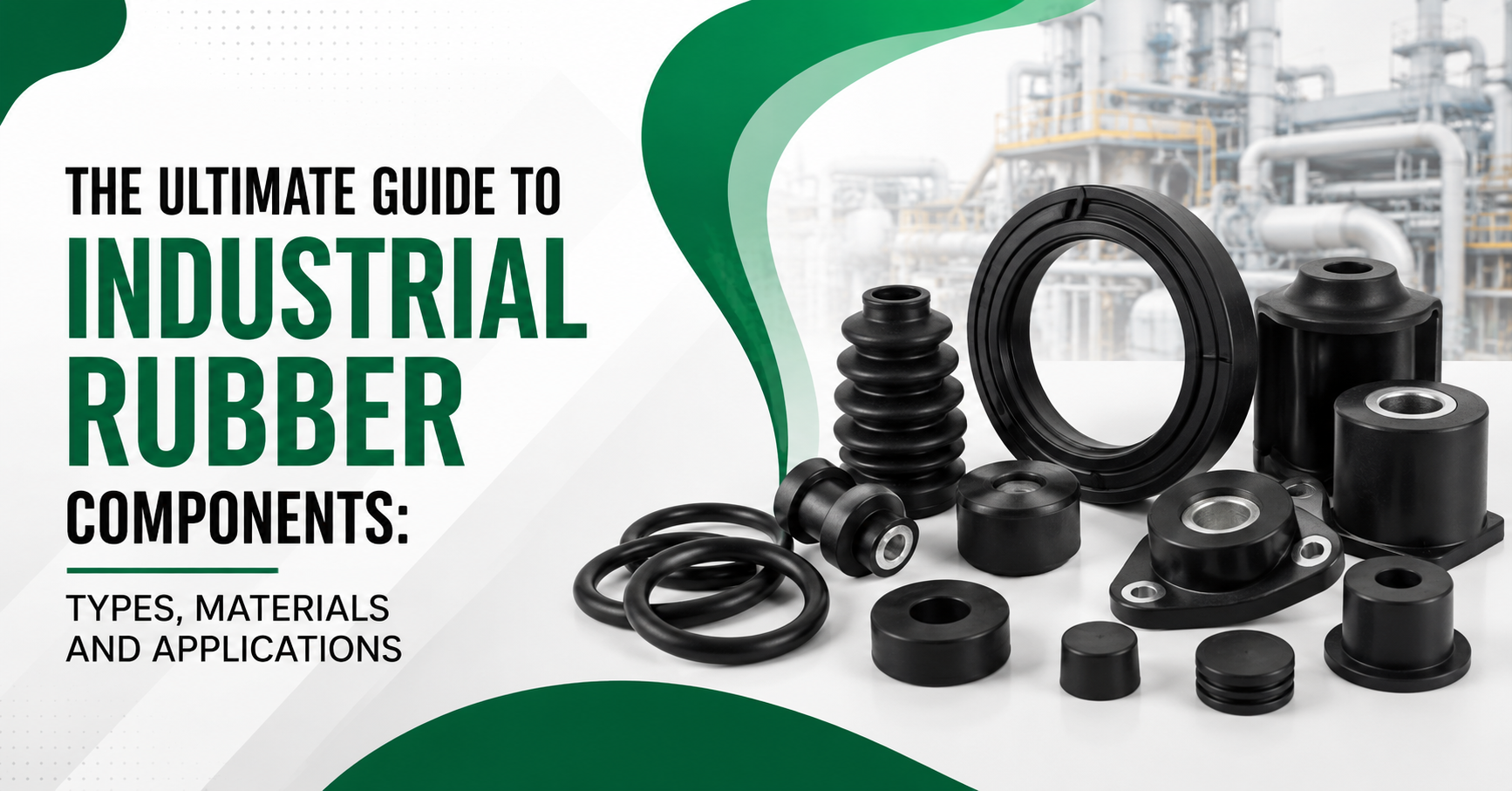
The most widely used rubber component in industrial settings. O-rings are circular cross-section rings that create a seal between two mating surfaces, typically under compression. Used in hydraulic systems, pneumatic cylinders, pipe joints, valves and fuel systems.
Key specification: Cross-section diameter and inner diameter. Grade selection depends entirely on the media being sealed,NBR for oil, EPDM for steam, Viton for aggressive chemicals and high temperature applications.
Where they fail: Using the wrong grade. A standard NBR O-ring in contact with brake fluid will swell and fail within weeks. Grade matching is non-negotiable.
2. Gaskets and Washers
Flat sealing components placed between two flanged surfaces to prevent leakage of fluids or gases. Unlike O-rings, gaskets are compressed across their face rather than their cross-section.
Used in engine assemblies, piping flanges, pump housings, compressors and electrical enclosures.
Key specification: Material grade, thickness, inner and outer diameter (or custom profile from drawing). Compression set resistance matters,a gasket that does not recover after compression will leak.
Common mistake: Specifying rubber hardness too low. A soft gasket under bolt torque will extrude into the bore and fail structurally.
3. Bushes and Anti-Vibration Mounts
Rubber-to-metal bonded components designed to absorb vibration, dampen shock and reduce noise transmission between mechanical elements. The rubber element is bonded,vulcanised,to metal inserts during manufacture.
Anti-vibration mounts appear in engine mounts, machine feet, generator bases, compressor isolators and structural isolation systems. Rubber bushes appear in suspension systems, control arm linkages and chassis components.
Key specification: Static load capacity, dynamic stiffness, deflection range. Shore hardness typically 40–70 depending on load requirement.
Grade note: Natural rubber gives the best dynamic properties for anti-vibration. NBR is used where oil contamination is possible.
4. Grommets
Rubber rings or sleeves inserted into holes in panels, walls or enclosures to protect cables, pipes or rods from chafing on sharp edges. A simple component with a highly specific dimensional requirement,the grommet must fit the panel hole precisely and grip the cable tightly.
Used extensively in electrical wiring harnesses, automotive cable routing, panel assemblies and switchgear.
Key specification: Panel hole diameter, cable/tube OD, panel thickness. EPDM and silicone are common grades for outdoor or high-temperature applications.
5. Rubber Sheets and Profiles
Flat sheets and extruded profiles used for lining, insulation, flooring, vibration damping and gasketing material. Sheets are typically cut to size and used as raw material for further fabrication.
Common in industrial flooring (anti-fatigue, anti-slip), tank linings, conveyor skirting, door seals and industrial flooring.
Grade selection:
Natural rubber: general purpose, good mechanical properties
EPDM: outdoor, weathering, roofing
Neoprene: oil and weathering resistance combined
Silicone: high temperature, food processing
6. Custom Moulded Rubber Parts
Components manufactured to specific customer drawings or samples,shapes that do not exist as standard catalogue items. This covers a vast range: from small rubber feet and protective caps to complex multi-shore moulded seals combining different rubber grades.
Custom moulding uses compression, transfer or injection moulding depending on complexity and volume.
When to specify custom: When no standard component achieves the required fit, function or appearance. Custom tooling cost is typically recovered within 2–3 production runs for any meaningful quantity.
Rubber Grades and When to Use Each
This is where most procurement errors happen. The word “rubber” on a specification is not sufficient,grade determines chemical compatibility, temperature range, mechanical properties and service life.
Grade | Full Name | Key Strength | Avoid When |
NBR | Nitrile Butadiene Rubber | Oil and fuel resistance | Ozone, weathering, aromatic solvents |
EPDM | Ethylene Propylene Diene Monomer | Weather, steam, hot water | Petroleum oils, fuels |
Silicone | Polydimethylsiloxane | Extreme temperature range (-60°C to 230°C), food grade | Concentrated acids, fuels, abrasion |
Viton | Fluoroelastomer | Aggressive chemicals, fuels, high temp | Low-temperature flexibility |
Neoprene | Polychloroprene | Oil + weather combined, moderate chemical resistance | Strong oxidising acids |
Natural Rubber | Polyisoprene | Superior mechanical, anti-vibration properties | Oils, fuels, ozone |
Hardness: The Specification Most People Skip
Rubber hardness is measured in Shore A (soft to medium) or Shore D (hard). Most industrial rubber components fall in the 40–80 Shore A range.
Why it matters:
Too soft: under compression load, the component extrudes, loses dimensional stability, may fail structurally
Too hard: poor sealing, high compression load required, noise transmitted rather than absorbed
Correct hardness: balances sealing effectiveness, compression set resistance and durability
Typical hardness by application:
Application | Typical Shore A |
Anti-vibration mounts | 40–60 |
O-rings and seals | 60–80 |
Conveyor skirting | 50–75 |
Rubber gaskets | 55–75 |
Grommets | 50–70 |
Automotive bushes | 50–70 |
How to Read a Rubber Component Drawing
For purchase managers working with engineers to source components, understanding what a drawing communicates is useful.
Critical dimensions:
Overall geometry: length, width, diameter, cross-section
Critical clearances: tolerances on sealing surfaces, bore diameters
Material grade and hardness
Surface finish requirements
Metal insert specifications (for bonded components)
Standard tolerances for moulded rubber are typically ±0.3–0.5mm for dimensions under 50mm, ±0.5–1mm for larger dimensions,broader than metal parts, due to the nature of rubber moulding.
When a drawing is unavailable, a physical sample with dimensional measurements is a working alternative for reverse engineering and replication.
Applications by Industry
Automotive: Anti-vibration mounts, engine bushes, door and window seals, grommets, O-rings in hydraulic and fuel systems, washers. Automotive is the most specification-intensive sector,every component typically requires supplier qualification and dimensional certification.
Electrical and Electronics: Grommets and cable entry seals in switchgear, enclosures and panels. Silicone and EPDM dominate due to temperature and weathering requirements.
Heavy Machinery: Hydraulic seals, gaskets for high-pressure flanges, conveyor idler roller components, vibration isolation mounts for compressors and generators.
Construction: EPDM expansion joint seals, waterproofing membranes, glazing gaskets, structural isolation pads.
FMCG and Food Processing: Food-grade silicone seals, conveyor components, protective pads. FDA compliance and material traceability are requirements in this sector.
The Free Sample Conversation Worth Having
For a manufactured rubber part, a sample:
Confirms dimensional fit in the actual assembly
Confirms grade compatibility with the media it contacts
Allows hardness verification against requirement
Flags any tolerance issues before tooling is committed to production
The sample conversation usually happens before the purchase order, not after a failed first batch. Most manufacturers worth working with will supply samples against a drawing or specification,at Easkay India, we do this routinely because a mismatch found at one piece is infinitely better than one found at 10,000.
Selecting a Rubber Parts Manufacturer: What to Check
Beyond price and lead time, these factors determine whether a rubber manufacturer will be a reliable long-term supply partner:
In-house compounding: The manufacturer who compounds their own rubber can control grade accuracy, batch consistency and material traceability. Buying from a moulder who sources compound externally adds a dependency and a quality variable.
Tooling capability: For custom components, the manufacturer who builds and owns tooling in-house can make modifications quickly. A moulder dependent on an external toolmaker adds lead time to every iteration.
Testing: Hardness testing, tensile strength, compression set,these should be routine, not exceptional. Ask to see test results for a recent batch.
Certifications: ISO 9001:2015 is the baseline quality management standard. For specific sectors, additional certifications may be relevant.
Track record: A manufacturer supplying OEMs and established industrial companies carries implicit third-party validation of their quality systems.
Summary
Rubber components are among the most specification-sensitive items in industrial procurement. The right component in the wrong grade, or the correct grade at the wrong hardness, will fail in service,sometimes quickly, sometimes unpredictably.
The investment in getting the specification right at the sourcing stage,including the grade conversation, the hardness conversation and the sample evaluation,pays back many times over in reduced failure rates, lower replacement costs and fewer production interruptions.
Easkay India has manufactured industrial rubber parts from Gurgaon since 1977. ISO 9001:2015 certified. Supplying automotive OEMs, electrical manufacturers, heavy machinery companies and FMCG brands across India. Send your drawing or requirement to sales@easkayindia.com or call +91 96174 44417. Free sample against specification,no commitment required.