High Quality Plastics vs Standard Plastics: Key Differences and Benefits
Plastics are used across almost every industry, from automotive and electrical systems to medical devices and heavy machinery. However, not all plastics offer the same level of performance. The difference between high-quality plastics and standard plastics becomes critical when applications involve heat, load, chemicals, friction, or long operational cycles.
Industries today increasingly rely on engineering plastics and advanced industrial plastic materials because conventional plastics often fail under demanding operating conditions. Understanding the differences between these material categories helps businesses choose the right solution for durability, safety, and long-term performance.
What Are Standard Plastics?
Standard plastics are commonly used materials designed primarily for low-cost and general-purpose applications. These plastics are widely available and suitable for products that do not require high mechanical strength or thermal resistance.
Examples include:
- Polyethylene (PE)
- Polypropylene (PP)
- LDPE (Low-Density Polyethylene)
- Basic PVC grades
These materials are often used in:
- Packaging
- Household products
- Low-load consumer goods
- Basic storage containers
What Are High-Quality Plastics?
High-quality plastics are advanced polymer materials designed for demanding industrial and engineering applications. These materials offer superior mechanical strength, dimensional stability, wear resistance, and thermal performance compared to standard plastics.
They are commonly referred to as:
- Engineering plastics
- Performance plastics
- Industrial plastic materials
Examples include:
- Nylon (PA6 / PA66)
- PTFE (Teflon)
- UHMWPE
- PEEK
- Delrin (POM)
- Polycarbonate
- ABS engineering grades
These materials are designed to withstand harsh operating conditions while maintaining long-term reliability.
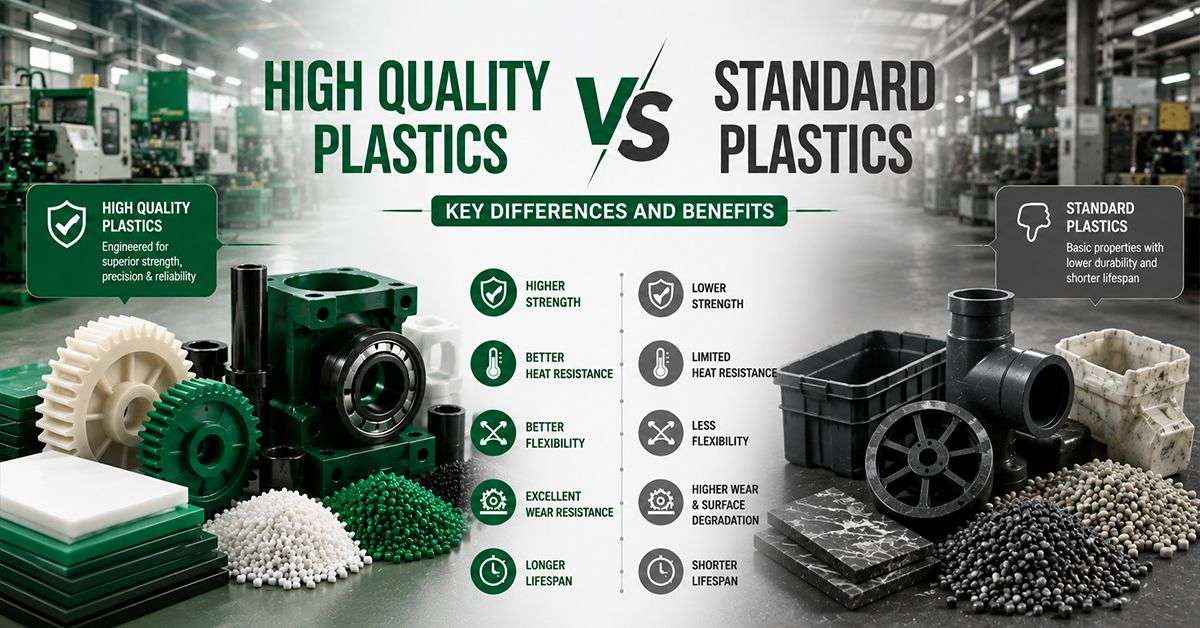
Key Differences Between High-Quality Plastics and Standard Plastics
| Feature | High-Quality Plastics | Standard Plastics |
| Strength | High mechanical strength | Moderate to low strength |
| Heat Resistance | Suitable for elevated temperatures | Limited temperature resistance |
| Chemical Resistance | Better resistance to oils, solvents, and chemicals | May degrade in chemical exposure |
| Wear Resistance | Excellent for moving applications | Faster wear under friction |
| Lifespan | Longer operational life | Shorter service life |
| Dimensional Stability | Maintains shape under stress | Can deform under load |
| Cost | Higher initial cost | Lower upfront cost |
| Industrial Use | Heavy-duty and precision applications | General-purpose applications |
Industries Using Advanced Plastics
Modern industries increasingly use engineering plastics because metal components are often heavier, more expensive, or susceptible to corrosion. Advanced plastics help improve efficiency, reduce maintenance, and enhance operational reliability.
Industries using advanced plastics include:
Automotive Industry
Used in:
- Bushes
- Wear pads
- Interior components
- Under-hood applications
- Washer
- Dust Caps
Advanced plastics reduce weight while maintaining strength and durability.
Electrical & Electronics
Used in:
- Insulation systems
- Cable management
- Connectors
- Switchgear components
- Port Caps
These applications require excellent electrical insulation and heat resistance.
Food Processing Industry
Industrial plastic materials are widely used because they resist moisture, corrosion, and repeated cleaning cycles.
Applications include:
- Conveyor guides
- Rollers
- Wear strips
- Food-safe machine components
Packaging & Material Handling
Engineering plastics are commonly used in:
- Conveyor systems
- Guide rails
- Rollers
- Machine liners
Their low-friction properties improve machine efficiency and reduce downtime.
Benefits of High Quality Plastics in Industrial Applications
Improved Wear Resistance
Advanced plastics perform better in applications involving friction, sliding, or repeated movement. This helps extend equipment life and reduce replacement frequency.
Better Chemical Resistance
Many industrial environments involve oils, solvents, fuels, and cleaning chemicals. High-quality plastics maintain stability in these conditions.
Reduced Weight
Compared to metal, engineering plastics significantly reduce component weight without sacrificing functionality.
Corrosion Resistance
Unlike metal components, plastics do not rust, making them suitable for humid, wet, or chemical environments.
Lower Maintenance Costs
Durable industrial plastic materials reduce machine downtime and maintenance frequency, improving operational efficiency.
Noise & Vibration Reduction
Engineering plastics absorb vibration better than many metal components, helping reduce operating noise and mechanical stress.
Dimensional Stability
High-quality plastics retain their shape and tolerances even under varying temperatures and mechanical loads.
Why Material Selection Matters
Choosing between standard plastics and high-quality plastics should depend on:
- Operating temperature
- Mechanical load
- Chemical exposure
- Working conditions
- Lifespan requirements
- Industry standards
Using low-grade materials in demanding environments may initially reduce costs but often leads to:
- Premature failures
- Higher maintenance costs
- Frequent replacements
- Production downtime
For industrial systems operating continuously, advanced engineering plastics usually provide better long-term value.
Future of Industrial Plastic Materials
The demand for advanced plastic manufacturing materials continues to grow because industries require:
- Lightweight alternatives to metal
- Improved energy efficiency
- Corrosion-resistant components
- Longer-lasting machine parts
Modern engineering plastics are now capable of handling applications once dominated entirely by metals, making them increasingly important in manufacturing and industrial design.
FAQs
What is the difference between high-quality plastics and standard plastics?
High-quality plastics offer better strength, heat resistance, chemical resistance, and durability compared to standard plastics. They are designed for demanding industrial applications, while standard plastics are generally used for basic or low-load products.
Which industries use engineering plastics?
Engineering plastics are widely used in automotive, electrical, aerospace, packaging, food processing, medical, oil & gas, and industrial machinery applications.
Are high-quality plastics worth the cost?
Yes. Although they have a higher upfront cost, high-quality plastics typically last longer, reduce maintenance, improve performance, and minimize downtime in industrial applications.
What are the strongest industrial plastics?
Some of the strongest industrial plastics include PEEK, Nylon (PA66), Polycarbonate, UHMWPE, and Delrin (POM), depending on the application requirements.
Which plastic is best for high-temperature applications?
PTFE, and certain high-grade engineering plastics are commonly used for high-temperature industrial environments because they maintain stability under heat exposure.