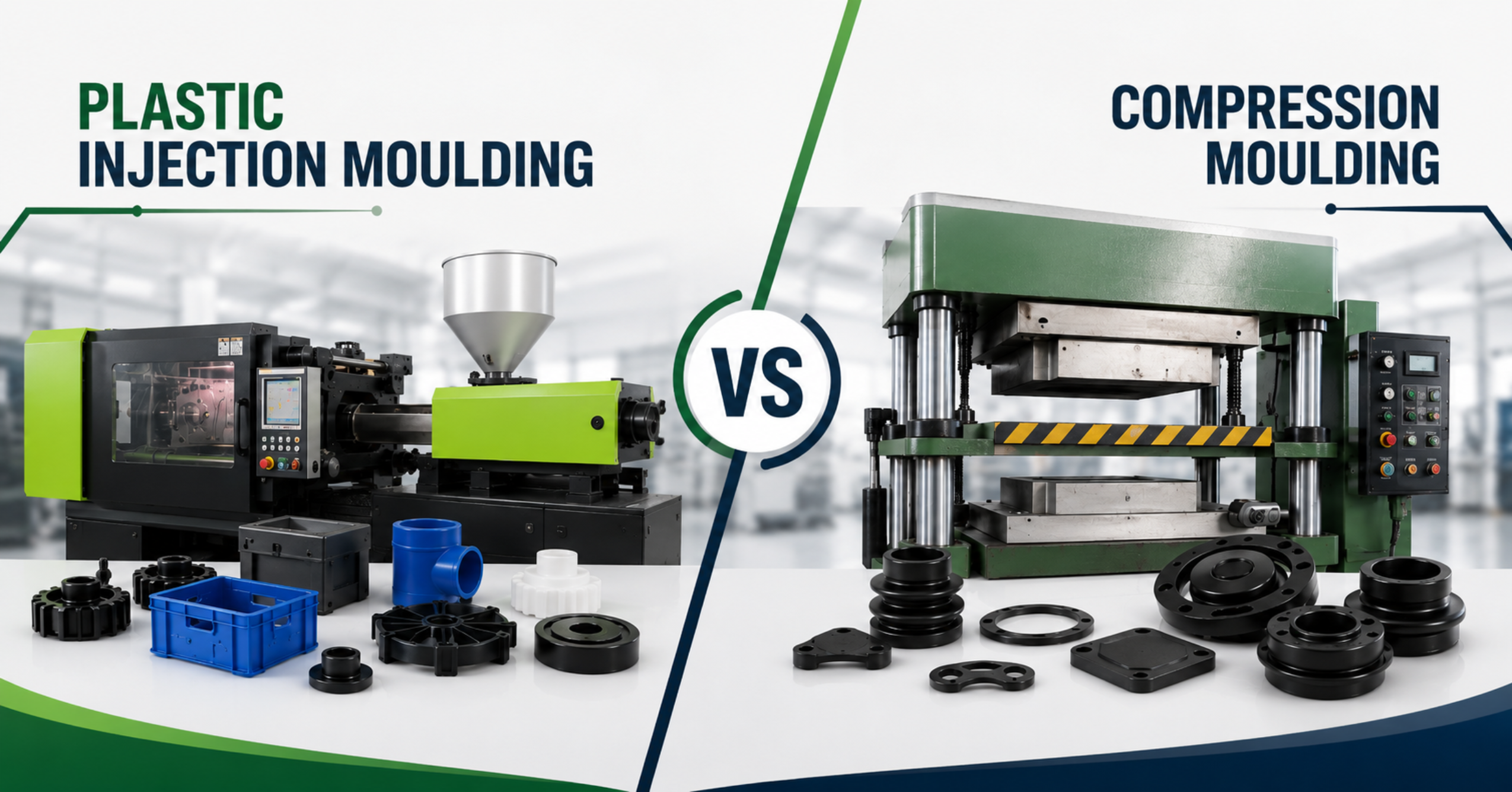
Choosing the right manufacturing process is one of the most important decisions when developing a plastic component. Two commonly used methods are plastic injection moulding and compression moulding. While both processes produce high-quality plastic parts, each has its own advantages depending on the material, design, production volume, and application.
At Easkay India, we manufacture custom plastic components for OEMs and industrial applications. Understanding the difference between these processes helps buyers reduce costs, improve product quality, and achieve better production efficiency.
What is Plastic Injection Moulding?
Plastic injection moulding is a manufacturing process in which molten plastic is injected into a mould under high pressure. Once cooled, the part is ejected and the cycle repeats.
This process is ideal for producing large quantities of plastic components with excellent dimensional accuracy and consistent quality.
Common Applications
- Plastic caps and plugs
- Electrical components
- Automotive plastic parts
- Industrial covers
- Consumer product components
- Medical and packaging parts
What is Compression Moulding?
Compression moulding involves placing a measured amount of material into an open mould cavity. The mould is then closed under heat and pressure, allowing the material to flow and take the desired shape.
This process is commonly used for thermoset plastics and certain engineering materials where high strength and heat resistance are required.
Common Applications
- Electrical insulation parts
- Industrial handles
- Heavy-duty plastic components
- Heat-resistant parts
- Structural moulded products
Injection Moulding vs Compression Moulding
Feature | Injection Moulding | Compression Moulding |
Production Volume | High | Low to Medium |
Cycle Time | Fast | Longer |
Dimensional Accuracy | Excellent | Good |
Surface Finish | Excellent | Good |
Complex Designs | Easily Manufactured | Limited |
Tooling Cost | Higher | Lower |
Material Waste | Minimal | Slightly Higher |
Which Process Should You Choose?
Choose Plastic Injection Moulding if:
- You require high-volume production.
- Parts have complex shapes or fine details.
- Tight dimensional tolerances are important.
- Surface finish and consistency are critical.
- Lower per-piece production cost is required for large quantities.
Choose Compression Moulding if:
- Production quantity is relatively low.
- Components are large or thick.
- Heat-resistant materials are required.
- Initial tooling budget is limited.
- Simple part geometry is sufficient.
Industries Using These Processes
Both manufacturing methods are widely used across industries, including:
- Automotive
- Electrical & Electronics
- Engineering Equipment
- Packaging
- Consumer Appliances
- Railways
- Industrial Machinery
- Medical Equipment
Selecting the appropriate moulding process depends on the product’s design, application, and production requirements.
Why Work with Easkay India?
Easkay India has over 45 years of manufacturing experience in supplying custom plastic and rubber components to OEMs and industrial customers across India.
Our Capabilities
- Custom plastic components
- Prototype and bulk production
- Consistent quality control
- ISO 9001:2015 Certified
- Technical support for product development
- Pan-India supply
Conclusion
Both plastic injection moulding and compression moulding offer unique advantages. Injection moulding is generally preferred for high-volume production and complex plastic parts, while compression moulding is ideal for specific materials and lower-volume applications.
If you are looking for a reliable custom plastic parts manufacturer or need expert guidance in selecting the right moulding process, Easkay India can help. We manufacture custom plastic components according to your drawings, specifications, and application requirements while ensuring consistent quality and competitive pricing.