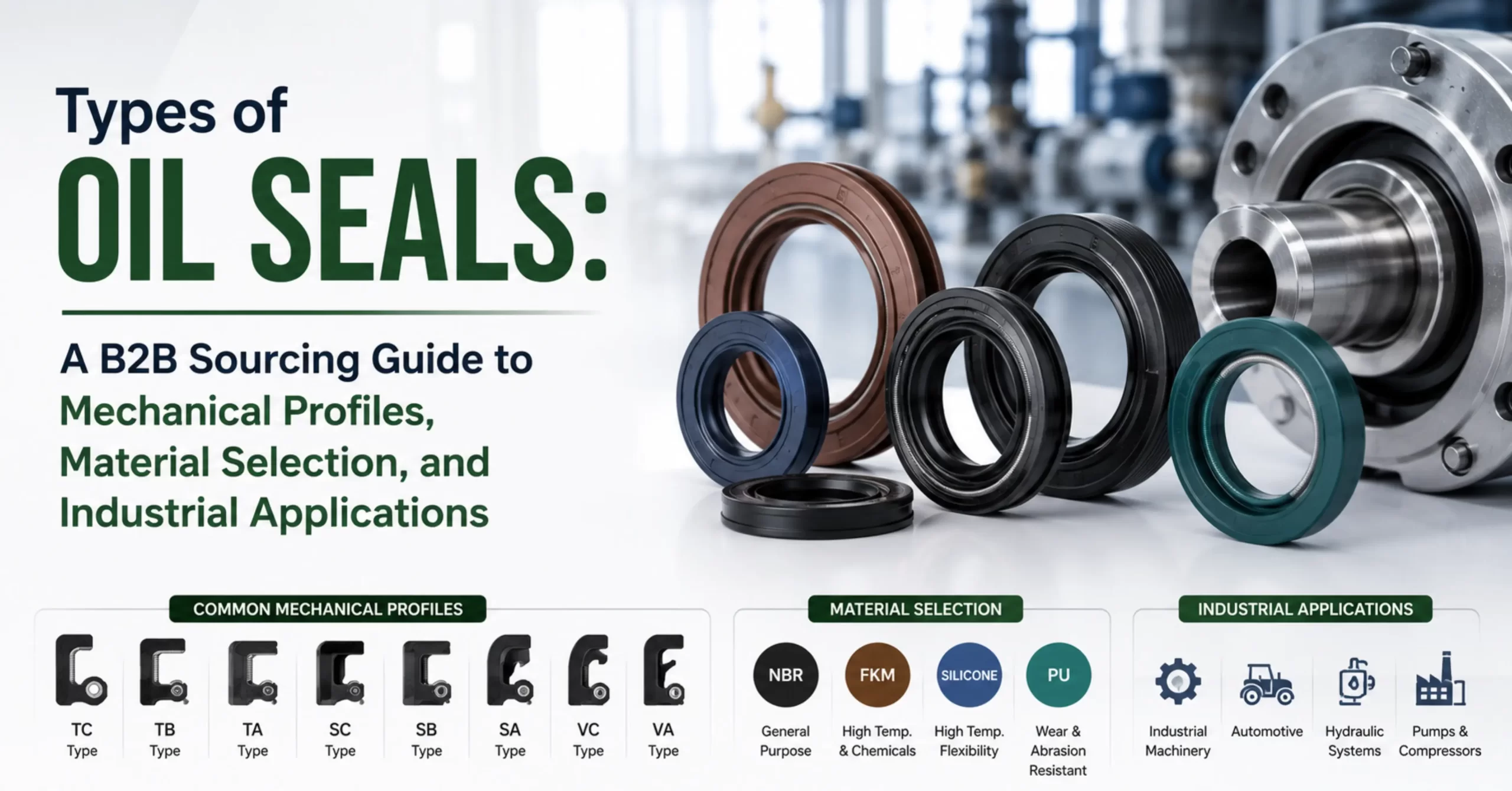
In industrial machinery, automotive assemblies, and rotating shaft systems one item that plays an important role is oil seals that serve as the primary defensive line against fluid leakage and other environmental contamination. This is one engineered elastomeric component that directly dictates the machine uptime, operational efficiency, and overall equipment effectiveness (OEE) in demanding Industrial settings.
For purchase managers, other maintenance engineers, and original equipment manufacturers (OEMs) in India’s automotive, construction, and heavy engineering industries- the process of selecting an oil sea is complex. Anything wrong or a mismatch in elastomer chemistry, lip configuration, or casing design can then lead to rapid mechanical failure, fluid leakage and can cost operational downtime.
This information technical guide breaks down the primary types of oil seals, maps their specific industrial applications, explores the critical role of custom elastomer compounding, and outlines a rigorous blueprint for bulk B2B procurement.
1. Structural Components of an Industrial Oil Seal
An important understanding of a rotary shaft seal’s structural layout is critical for making informed sourcing decisions. Typically, standard industrial oil seals are engineered using three primary components:
- The Metal Casing: This rigid outer ring delivers important structural support and stability, ensuring the tight mechanical interference fit necessary to lock the seal firmly in the housing bore.
- The Elastomeric Sealing Lip: the core functional elements of the assembly, this lip applies continuous radial pressure onto the rotating shaft. The combination of its design geometry and compound chemistry generates the dynamic seal.
- The Garter Spring: just directly behind the sealing lip, this coiled steel spring exerts constant radial force against the shaft to offset material degradation, thermal expansion, and shaft runout over time.
2. Material Selection Matrix: The Science of Elastomer Compounding
Easkay India, an ISO 9001:2015 certified manufacturer, custom-compounds industrial elastomers to satisfy precise thermal, chemical, and pressure requirements.
Nitrile Butadiene Rubber (NBR / Buna-N)
As the standard workhorse of the sealing industry, Nitrile provides an optimal balance between mechanical performance and affordability.
- Chemical Resistance: Highly compatible with petroleum-based oils, grease, hydraulic fluids, and water.
- Primary Sourcing Applications: Standard automotive gearboxes, general machinery parts, and hydraulic pumps.
(FKM / Viton)
When systems run hot or encounter aggressive chemicals, FKM is the mandatory industry upgrade.
- Chemical Compatibility: Superior resistance to synthetic lubricants, aggressive acids, hydrocarbons, and chemical solvents.
- Key Sourcing Use Case: Chemical processing pumps, high-speed industrial engines, and aerospace assemblies.
Silicone (VMQ)
Silicone seals excel in extreme thermal environments where mechanical forces remain relatively low.
- Chemical Compatibility: Highly stable against ozone, ultraviolet light, and weathering.
- Key Sourcing Use Case: Food processing machinery, medical manufacturing packaging, and static high-temperature environments.
Polyurethane (PU)
For extreme mechanical stress and high-pressure fluid dynamics, polyurethane stands out.
- Chemical Compatibility: Excellent resistance to mineral oils and grease.
- Key Sourcing Use Case: Heavy-duty earthmoving equipment, hydraulic cylinders, and high-abrasion material handling systems.
3. Key Engineering Parameters to Prevent Premature Seal Failure
Purchase teams must partner closely with design engineers to evaluate the exact operational environment before placing bulk manufacturing orders.
Three primary parameters govern long-term seal reliability:
Shaft Surface Speed
As a shaft rotates at high revolutions per minute (RPM), friction is created and it localizes the heat at the sealing point. If the surface speed ($\text{m/s}$) exceeds the dissipation threshold of the elastomer, the lip will harden, crack, and eventually fail. That is why high-speed applications demand materials with low friction coefficients and high thermal thresholds, such as FKM.
Pressure Differentials
Regular industrial oil seals are designed specifically for unpressurized or low-pressure applications (up to $0.03\text{ MPa}$). If internal system pressure spikes beyond this, it deforms the sealing lip, increasing friction and causing accelerated wear. High-pressure environments need custom seals with shorter, stiffer lips, backup rings, or reinforced metal casings.
Shaft Eccentricity and Runout
No rotating shaft is perfectly & accurately centered. Shaft runout (wobble) and housing misalignment force the sealing lip to constantly flex to maintain contact. The selected elastomer must have high elasticity and low compression set to track the shaft movements smoothly without creating any momentary gaps that allow fluid leakage.
4. B2B Procurement and Quality Assurance Checklist
When getting the industrial oil seals in high volumes for OEM applications and distribution networks, one must balance the cost along with quality control metrics. Keep this checklist during your next vendor evaluation:
- ISO 9001:2015 Certification: always check the manufacturing facility operates under strict quality management protocols to guarantee uniformity across production batches
- Durometer Consistency: one can evaluate the Shore A hardness of the rubber compounds to match with technical specifications within a \pm5 point tolerance. matches
- Traceability and Shelf-Life Control: Elastomers are sensitive to UV rays, heat, and moisture. Do monoitor & verify that your supplier practices strict inventory rotation and provides clear batch curing dates.
- Compliance Standards: do verify all polymer materials meet international regulatory requirements, including RoHS and REACH guidelines, particularly if the finished assemblies are destined for global export market distribution.