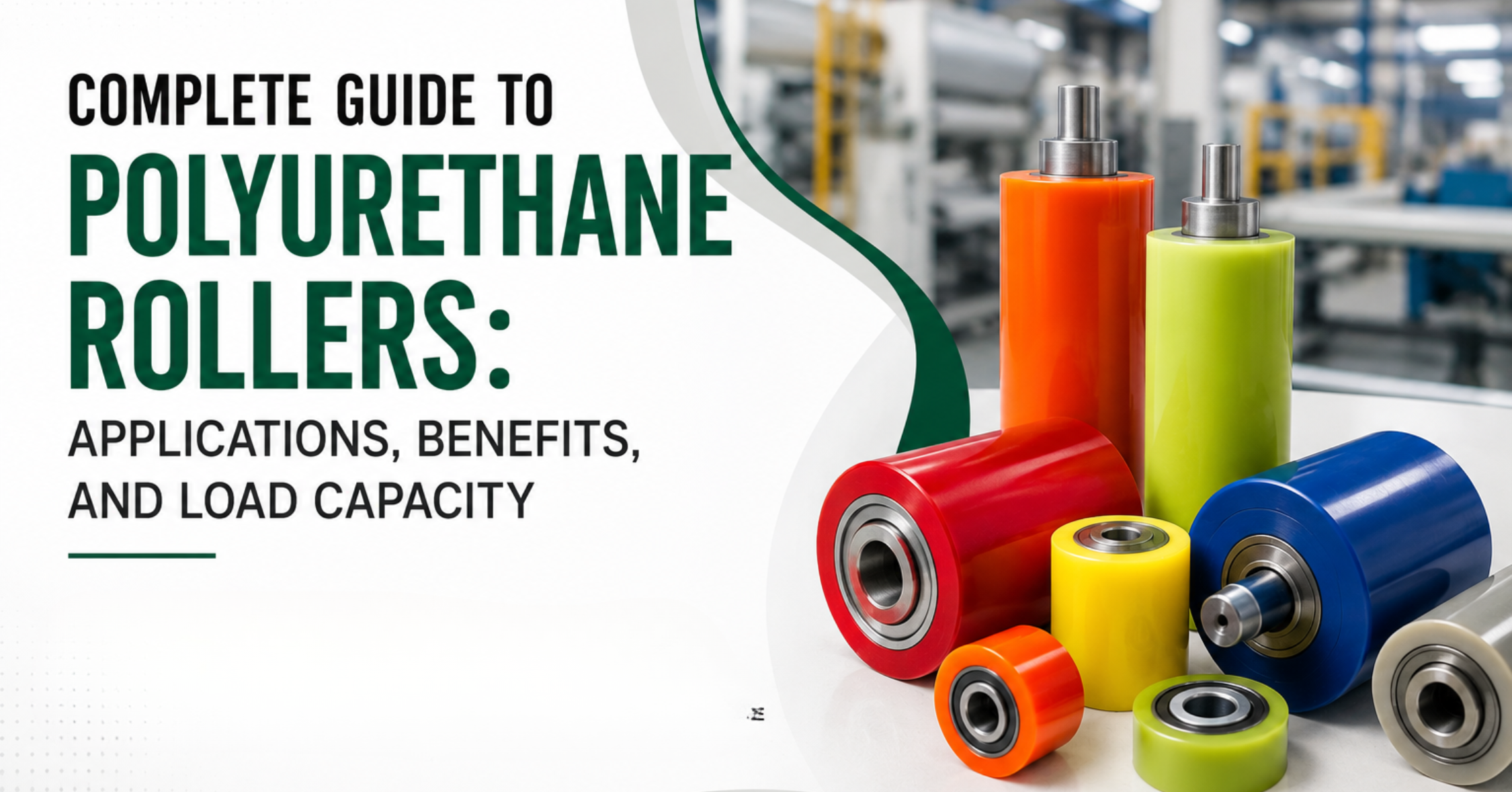
Polyurethane rollers and PU products are used in industrial systems than most buyers realize, conveyor lines, printing presses, steel mills, textile machinery, packaging equipment. What they all have in common is a simple requirement: a roller surface that can handle repeated contact, resist wear, and hold its shape under load, without the noise or marking problems that come with metal, or the wear limitations of standard rubber.
This guide covers what actually determines whether a PU roller performs well in a given application, hardness selection, load behavior, and the application types where PU consistently outperforms the alternative solutions.
What Makes Polyurethane Different From Rubber or Metal Rollers
PU Components have the elasticity to absorb impact and conform to surfaces the way rubber does, but with meaningfully better abrasion resistance and load-bearing capacity.
Compared to metal rollers, PU brings advantages: it doesn’t mark or damage the material it contacts, it dampens noise and vibration rather than transmitting it, and it can be formulated across a wide hardness range to suit very different jobs, from soft, cushioning applications to hard, near-rigid load-bearing use. Compound chemistry, hardness, and additive selection can be adjusted to optimize for abrasion resistance, chemical exposure, or load capacity depending on what the application actually needs, rather than accepting a fixed trade-off.
Hardness Range and What It Actually Changes
PU rollers are typically specified across a Shore A 60 to Shore A 95 range, with harder-duty applications extending into the Shore D scale for near-rigid performance. Where a roller sits on this scale changes its behavior in predictable ways:
Shore A 60–70 (softer): Higher flexibility and shock absorption. Better for cushioning applications, delicate material handling, and situations where the roller needs to conform to an irregular surface or protect a sensitive product from impact.
Shore A 75–85 (mid-range): The most common range for general industrial rollers, conveyor systems, guide rollers, and material handling equipment where a balance of grip, wear resistance, and load capacity is needed.
Shore A 90–95 and Shore D (harder): Higher load-bearing capacity and wear resistance, with less cushioning. Used in heavy-duty applications like steel processing, high-tension web handling, and continuous high-load operation where deformation under load is the primary failure risk to avoid.
Hardness isn’t just durability, it directly affects the grip, noise level, and how the roller behaves under repeated compression. A roller specified too soft for a high-load application will deform permanently over time (a compression set failure); one specified too hard for a delicate-material application can damage the product it’s meant to be handling.
Load Capacity: What Actually Determines It
Load capacity in a PU roller isn’t governed by hardness alone, it’s a combined result of several factors, and buyers who spec only by hardness often end up with a roller that underperforms:
Core material and construction. Most industrial PU rollers are built around a steel or aluminum core with a bonded polyurethane covering, rather than solid PU. The core carries the structural load; the PU layer handles surface contact, grip, and wear. A roller under-specified on core strength will fail structurally even if the polyurethane covering is well-suited to the application.
Cover thickness. Thicker PU coverings offer more cushioning and wear allowance but can reduce dimensional precision under heavy, sustained load. Thinner coverings hold tighter tolerances but wear through faster in high-abrasion use. The right balance depends on whether precision or wear life matters more for the specific application.
Compression set resistance., a Roller’s ability to return to its original shape after sustained compression. Lower compression set means the roller maintains consistent diameter and surface contact over its service life; higher compression set leads to gradual deformation, uneven load distribution, and eventual replacement.
Operating speed and duty cycle. Rollers in continuous high-speed operation generate more internal heat through repeated flexing, which can affect both hardness stability and load tolerance over the period of time. Applications with high duty cycles need compounds formulated for heat resistance in addition to load capacity.
Where Polyurethane Rollers Are Used
Conveyor and material handling systems. PU rollers are widely used as guide rollers, drive rollers, and idler rollers, where their combination of grip, wear resistance, and load tolerance reduces belt slippage and extends service.
Steel and heavy industry. In steel processing lines, PU rollers handle continuous high-load contact with metal stock, where their abrasion resistance significantly outlasts other alternatives, reducing replacement frequency in high-throughput operations.
Printing and converting. Precision tolerances and consistent surface hardness make PU rollers well suited to printing and coating applications, where surface uniformity directly affects print quality and registration accuracy.
Textile machinery. PU rollers are used for guiding, tensioning, and processing all types of textile materials, where the non-marking surface and vibration-dampening properties protect delicate materials through repeated handling.
Packaging equipment. In high-speed packaging lines, PU rollers handle continuous contact cycles reliably, with their wear resistance directly reducing unplanned downtime from roller replacement.
Selecting the Right PU Roller: What to Specify
Choosing the right roller comes down to answering a few questions clearly before requesting a quote:
What load will the roller carry, and how continuously? Peak load and continuous duty-cycle load call for different core and cover specifications.
What’s being handled, abrasive material, delicate products, or something requiring precision surface contact? This determines whether the hardness should prioritize wear resistance or cushioning.
What’s the operating environment? Oil, solvent, or chemical exposure changes which PU formulation is appropriate, similar to compound selection in other components.
What tolerance does the application require? Precision applications like printing need tighter dimensional control than general material handling.
Pu manufacturers in India ask these questions before recommending a hardness grade and core specification is doing the engineering work upfront, the alternative is a roller that looks correct on paper but underperforms once it’s actually running.
Polyurethane rollers earn their place in industrial systems because they solve a specific problem: standard rubber wears too fast, metal is too rigid and noisy, and neither offers the tunable hardness range PU does. But getting the benefit requires matching hardness, core construction, and cover thickness to the actual load and duty cycle, not defaulting to a standard spec because it’s what’s in stock.