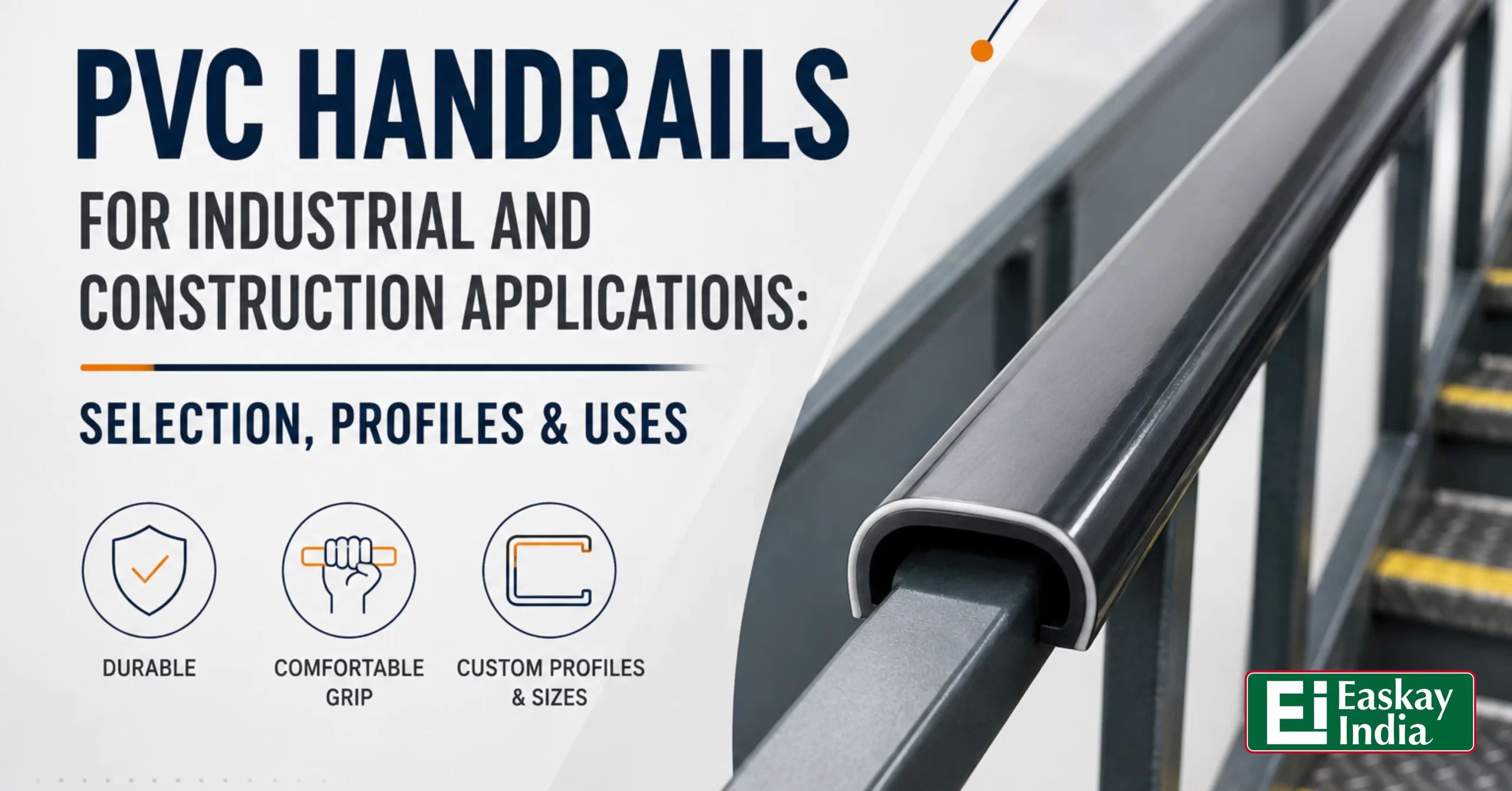
PVC handrails are used as protective and gripping profiles on stairways, walkways, platforms, access structures and railing systems. An industrial PVC handrail must match the supporting rail, maintain a consistent cross-section and provide a practical surface for continuous hand contact.
For manufacturers, fabricators and procurement teams, selecting a PVC handrail involves more than choosing a colour or profile. The cross-sectional dimensions, internal opening, wall thickness, length, joining arrangement and installation method all affect how the finished product fits and performs.
Easkay India manufactures PVC handrail profiles in specified dimensions, colours and configurations for industrial, construction and engineering requirements.
What Is a PVC Handrail?
A PVC handrail is a shaped PVC profile installed over or along a supporting structure to provide a defined hand-contact surface. It can be used on metal railings, stair structures, platforms, access systems and other fabricated assemblies.
The external section is designed for comfortable gripping and an internal section that corresponds to the supporting rail.
For procurement, the important information is therefore not simply the overall handrail width. The internal opening, wall section, profile geometry and supporting rail dimensions also need to be considered.
PVC Handrail Specifications
The specification of a PVC handrail generally includes:
- Material: PVC
- Profile: Standard or custom cross-section
- Overall width and height: As specified
- Internal opening: According to supporting rail
- Wall thickness: As required
- Length: Standard or cut-to-length
- Colour: As specified
- Surface: Smooth or specified finish
- Joining arrangement: According to installation
- End treatment: As required
For a PVC handrail manufacturer in India, the ability to reproduce the required quantity consistently is particularly important when the handrail is being installed across multiple sections of the same railing system.
Choosing the Right PVC Handrail Profile
Should be selected according to the supporting structure rather than as an isolated PVC component.
Supporting rail dimensions
The internal opening of the handrail needs to correspond to the dimensions of the rail underneath it. An incorrect internal profile can make installation difficult or result in inadequate retention.
Wall thickness
Wall thickness also affects the section of the profile and should be specified where the design calls for a particular construction.
External profile
The outside shape determines the hand-contact surface. Round, rounded and application-specific can be developed depending on the intended installation.
Length and joining
Long railing systems may require multiple lengths joined along the installation route. The cutting arrangement should therefore be considered before production.
Colour
PVC handrails can be supplied in specified colours, allowing the profile to match the railing system or project demands. Common project requirements may include black, grey and other specified colours, subject to the available PVC formulation.
Industrial PVC Handrail Applications
An industrial PVC handrail is commonly used where a defined protective and gripping profile is required over a fabricated railing or access structure.
Typical applications include the following:
Industrial stairways
- PVC handrails can be installed over metal stair railings to provide a consistent hand-contact surface along access routes.
Walkways and platforms
- Factories, warehouses and processing facilities may use handrail on elevated walkways and maintenance platforms.
Safety railings
- PVC profiles can be incorporated into railing systems around machinery areas, access points and elevated work zones.
Machinery platforms
- Industrial equipment often includes access stairs and platforms where a PVC handrail profile can form part of the supporting railing system.
Construction and infrastructure
- PVC railing for construction can be used on fabricated access structures, stairways, temporary or permanent railing systems and other applications where a PVC profile is specified as part of the railing assembly.
The actual profile and installation method should always follow the structural and project requirements of the railing system.
PVC Handrail Profile Manufacturing
PVC handrail profiles are manufactured to a defined cross-sectional geometry. For standard requirements, an established requirement can be produced in the specified lengths and colours.
The manufacturing specification can incorporate:
- Overall dimensions
- Internal opening
- Wall thickness
- Curved or rounded sections
- Internal profile geometry
- Cut length
- Colour
- End finishing requirements
For repeat production, the approved cross-section becomes the reference for subsequent batches. This is particularly relevant when a project requires multiple handrail lengths that need to maintain the same profile throughout the installation.
Custom PVC Handrail Profiles
Not every railing system uses a standard section. Fabricators may require a PVC handrail to fit over a specific metal rail, structural section or proprietary railing design.
A custom PVC handrail profile can therefore be developed around the required dimensions rather than forcing the supporting structure to accommodate an available stock.
Custom development may involve:
- Non-standard internal openings
- Defined wall sections
- Specific corner geometry
- Custom colours
- Cut-to-length supply
A physical sample or engineering drawing can be used to establish the required cross-section where the application involves a non-standard handrail.
PVC Handrail for Construction Projects
Construction and infrastructure projects can involve long railing runs, multiple sections and different installation conditions. For these requirements, consistency between lengths is important.
A PVC handrail for construction should therefore be specified with its dimensions, supporting rail size, required length, colour and installation arrangement rather than simply ordering by nominal handrail size.
For project procurement, the following details are useful:
- Handrail profile drawing or section
- Supporting rail dimensions
- Required total length
- Individual cut lengths
- Colour
- Quantity
- Joining method
- End finishing requirements
This gives the manufacturer enough information to produce it, according to the actual railing system.
PVC Handrail Manufacturer in India
Easkay India manufactures PVC handrail profiles for industrial, construction and engineering applications. These can be produced to specified cross-sections, dimensions, lengths and colours, including requirements based on an existing sample or engineering drawing.
The manufacturing capability is suited to both defined recurring demand and custom PVC handrail requirements where the supporting structure has a non-standard geometry.
Key capabilities include:
- Custom PVC handrail development
- Defined internal and external dimensions
- Specified wall thickness
- Custom colours
- Standard or cut-to-length supply
- Drawing and sample-based development
Conclusion
The right PVC handrail is determined by the profile, supporting rail, dimensions, wall section, installation method and project requirements rather than by material name alone. Industrial and construction buyers should define these parameters before selecting a profile, particularly when the handrail is being installed over a non-standard railing section.
Easkay India supplies PVC handrail profiles and custom PVC railing components for industrial, construction and engineering requirements, with profiles developed to specified dimensions and installation conditions.