For purchase managers, supply chain directors, and fleet maintenance engineers across India’s industrial ecosystem, the annual monsoon season brings a predictable spike in many component failures. Heavy rainfall, water-logged transport tracks, and industrial mud accumulation create severe environmental stressors on commercial vehicles, material handling systems, and heavy manufacturing equipment.
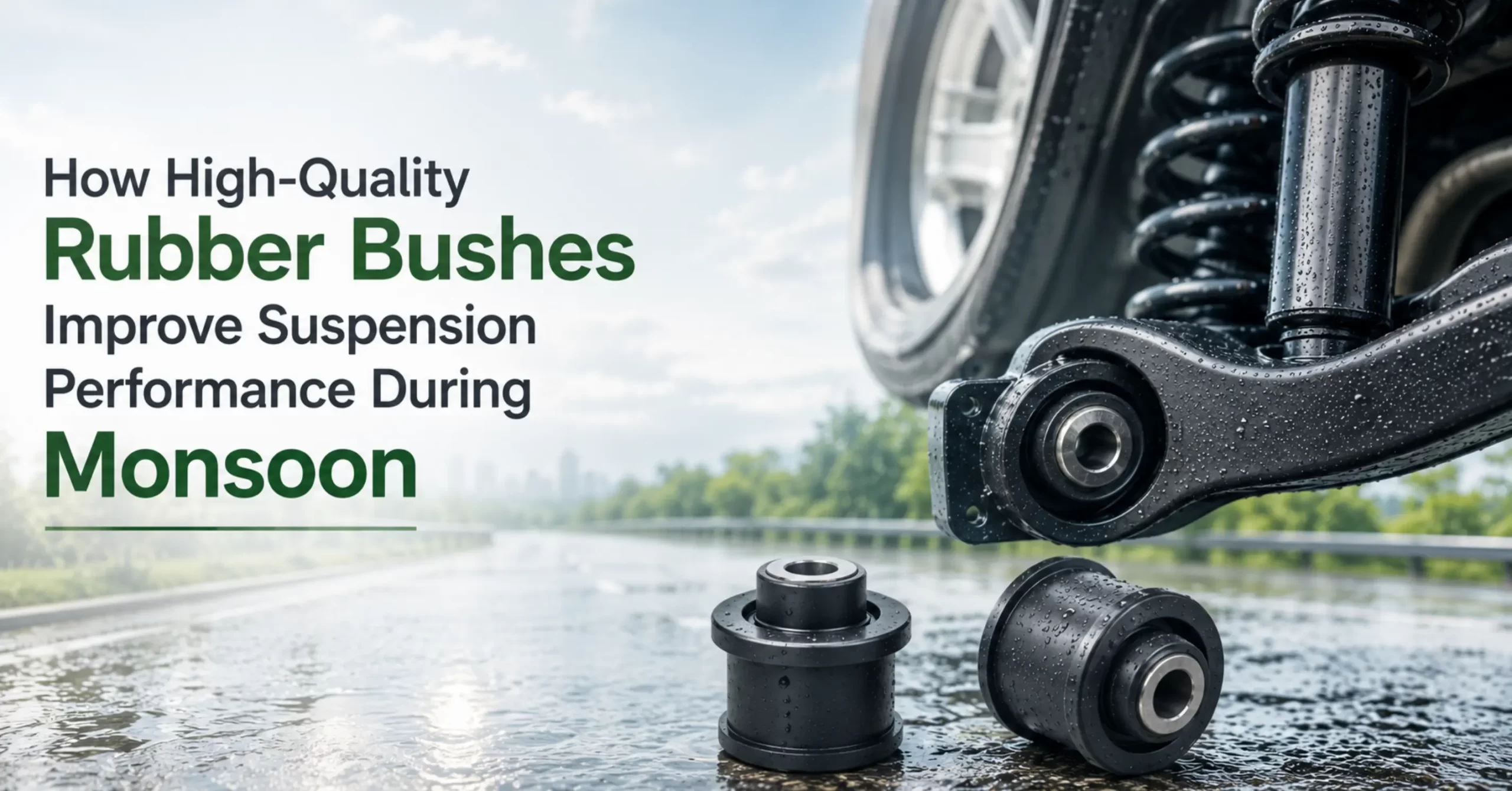
Among these components the most vulnerable to moisture-induced degradation are under-chassis suspension components. Specifically, one item is suspension bushes, which act as the primary dampening interface between moving mechanical joints, they bear the brunt of dynamic shock and environmental contamination because of the weather.
When low-grade or incorrectly specified elastomeric components are deployed, exposure to moisture triggers a rapid deterioration chain. Understanding the exact material science behind high quality rubber bushes and specialized in polyurethane suspension bushes is essential for maintaining equipment and lowering the total cost of ownership (TCO) during the wet season.
1. The Mechanics of Suspension Failure in Monsoon Environments
Suspension systems depend on bushes to absorb high-frequency vibrations, control joint deflection, and isolate metal-on-metal impact points. During our Indian monsoon, these components operate while regularly submerged in water, road grit, and industrial chemical runoff.
When standard industrial components face continuous submersion, a primary vulnerability emerges: hydrolytic vulnerability. Low-tier rubber compounds absorb water over prolonged exposure. This absorption breaks down the internal cross-linked polymer chains which in turn leads to:
- Durometer Softening: The component loses its rated firmness, allowing excessive movement within the suspension assembly.
- Accelerated Tear Sensitivity: Micro-fractures form along stress concentrations as road debris compromises the dampening surface.
- Geometric Deformation: The component expands or shifts, causing wheel misalignment, uneven tire weardown, and increased vibration (NVH).
To counteract these operational threats, many procurement teams must look past basic catalog descriptions and source components engineered by an established rubber parts manufacturer capable of verifying exact mechanical metrics.
2. Technical Material Parameters: Tensile Strength & Shore A Hardness
Evaluating an elastomeric component for harsh environments requires measuring key performance factors: tensile strength and Shore A hardness. These parameters dictate how well a component can withstand structural forces when subjected to heavy rains and uneven infrastructure.
CRITICAL MATERIAL TESTING MATRIX
Metric | Industrial Operational Relevance |
Shore A Hardness (65-80) | Prevents deflection, stabilizes alignment |
Tensile Strength (Min 15PMa) | Resists tearing under high dynamic impacts |
Compression Set (< 25%) | Retains original geometry after high loads |
Optimizing Shore A Hardness for Dynamic Stability
For standard automotive and heavy machinery suspension joints, the components must maintain a strict durometer rating, typically ranging between 65 to 80 Shore A.
If a compound exhibits poor water resistance, its shore hardness drops significantly during prolonged submersion. A softened component cannot adequately resist structural deflection under load, causing control arms to shift from their original setup. This alignment once shifted can accelerate wear of surrounding mechanical assemblies, turning a minor component failure into an expensive vehicle maintenance defect.
The Role of Tensile Strength in Pothole Impact Survival
Monsoon rains regularly degrade road surfaces, creating deep potholes that subject under-chassis parts to sudden impact shocks. All quality components require a minimum tensile strength of 15 to 18 MPa alongside high elongation capabilities. This ensures the elastomer absorbs sudden, violent energy displacement without internal tearing or separating from its outer metal sleeve bonds.
3. Upgrading to Polyurethane: The High-Durability Alternative
While high-grade natural rubber formulations perform well in isolated configurations, heavy commercial applications and fleets operating in high-rainfall zones require an upgrade path. Utilizing a custom pu bush setup provides clear material advantages in extreme environments.
Standard Commercial Rubber | Engineered Polyurethane (PU) |
Water Absorption: Moderate/High | Water Absorption: Negligible |
Abrasion Risk: High under grit | Abrasion Risk: Extremely Low |
Tensile Limits: 10 – 15 MPa | Tensile Limits: 20 – 35 MPa |
Hydrolytic Stability Under Submersion
All standard industrial rubber, polyurethanes formulated for heavy dampening applications offer excellent hydrolytic stability. The polymer chains resist breaking down in standing water, allowing the component to maintain its durability and the durometer rating even through extended monsoon seasons.
Abrasion and Grit Resistance
Rain and Floodwaters carry sand, stones, and industrial particulate matter into suspension joints. Under dynamic compression, this trapped grit acts like sandpaper against standard rubber, wearing down the entire dampening surface. PU provides exceptional tear and abrasion resistance, maintaining structural integrity when exposed to abrasive industrial debris.
4. Preventing Supply Chain Disruptions and High Maintenance Overheads
For procurement teams managing large operations, the purchasing decisions based only on the lowest initial per-unit cost often hide real expenses. A low-tier component that fails mid-season incurs substantial downstream costs:
- Repeated Maintenance Labor: Replacing a worn component multiple times a season increases overall labor costs.
- Extended Asset Downtime: Every hour a commercial delivery vehicle or material handling asset spends in the repair bay impacts the overall operational revenue.
- Surrounding Component Damage: Defective bushes allow metal control arms to scrape against brackets, leading to premature failures in steering racks, struts, and ball joints which can cause damage.
By working with an established industrial rubber components manufacturer that maintains clear raw material batch traceability and adheres to strict ISO 9001:2015 production guidelines, procurement operations can establish a true, predictive maintenance schedule.
5. B2B Sourcing Checklist for Monsoon Reliability
Before finalizing bulk procurement agreements for the upcoming season, request that your component partner provide correct material certification documents verifying these technical parameters:
- Verified Compound Reports: keep in mind the specific rubber or polyurethane formulation contains targeted anti-ozonants and moisture-resistant stabilizing elements.
- Bonding Integrity Verification: For bonded components, request proof of rigorous peel-strength testing to confirm the elastomer will not separate from its steel sleeves under conditions like high hydraulic pressures.
- Production Volume Scalability: always check that the manufacturer has the injection and compression molding capacity to handle large bulk orders without extending delivery times.
Conclusion: Partnering for Long-Term Fleet Reliability
Improving suspension performance during the monsoon requires using components designed for specific operational demands. By focusing on optimal shore A hardness, high tensile strength, and premium raw materials like polyurethane, industrial operations can improve equipment reliability throughout the wet season.
Since 1977, Easkay India has worked alongside manufacturing, automotive, and logistics organizations across India to develop durable, useful custom-engineered components. Our ISO 9001:2015 certified production workflows ensure that every batch matches your precise technical specifications.
Planning to optimize your equipment component life cycles for demanding seasonal environments? Explore our custom molded rubber parts solutions or contact our engineering team directly to submit your technical component drawings for a bulk quote.