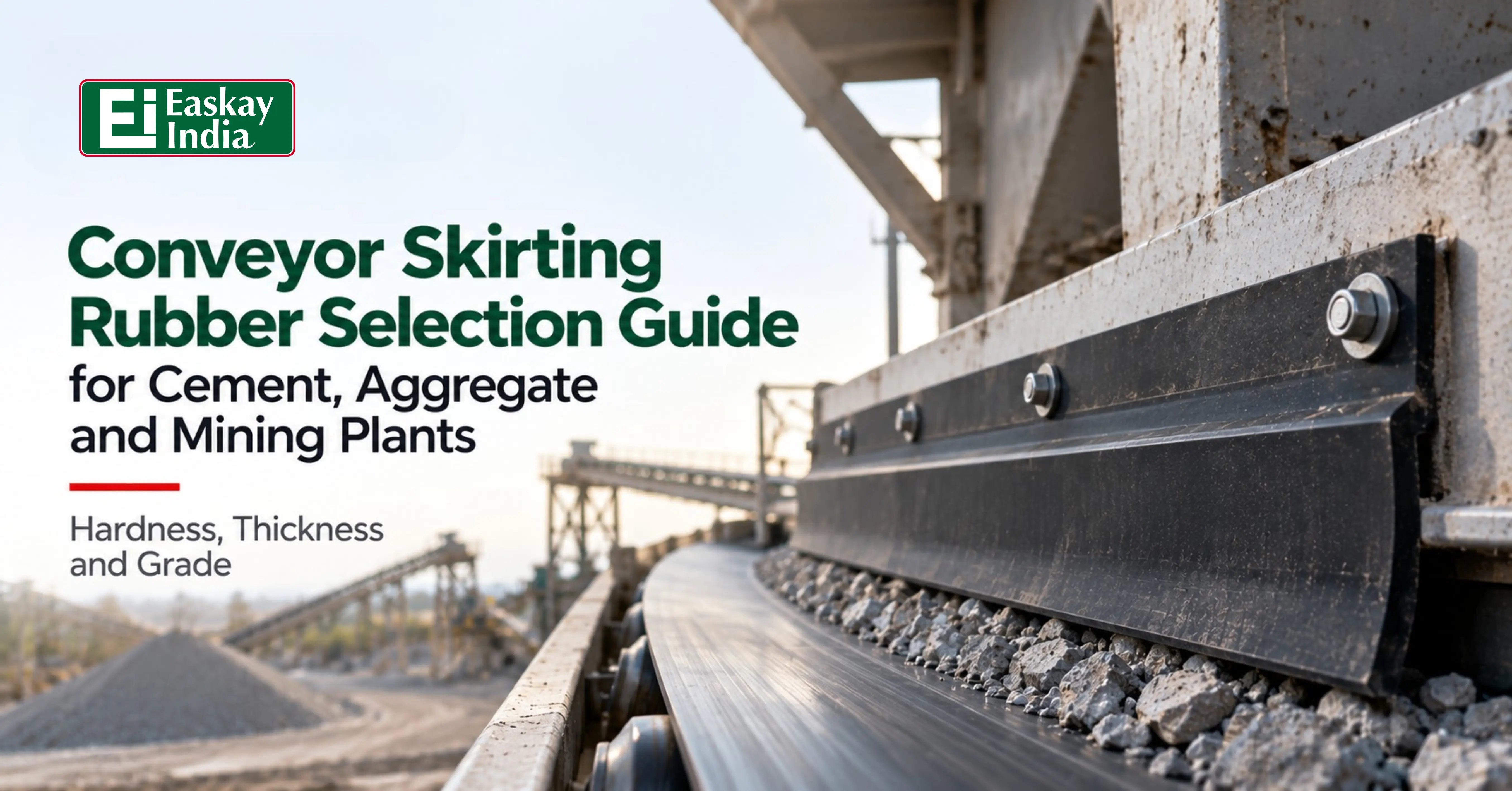
Conveyor Skirting Rubber Selection Guide for Cement, Aggregate and Mining Plants: Hardness, Thickness and Grade
Why Skirting Rubber Decides How Clean Your Conveyor Runs
India is about to add a lot of conveyor capacity. Crisil Ratings expects cement makers to add 160-170 million tonnes of grinding capacity between 2026 and 2028, with a capex of about Rs 1.2 lakh crore. New plants mean new conveyors, new transfer points and a new set of skirting decisions for maintenance engineers, OEMs and EPC contractors.
The post-monsoon months are also when many plants schedule shutdown maintenance and replace worn skirting before the peak dispatch season. If you are choosing skirting for either a new line or a replacement, this guide walks through the decisions that matter most: the right conveyor skirting rubber hardness for your material, the right thickness for your belt, and why spillage sometimes continues even after you fit new rubber.
A good skirting strip does three jobs at the loading zone. It seals the gap between the belt and the chute wall so material stays on the belt. It contains dust, which protects workers and keeps idlers and bearings cleaner. And it wears in a controlled way, so the belt does not. When the wrong grade is fitted, one of those three jobs fails first, usually within weeks.
Easkay India supplies industrial rubber skirting for conveyor belt systems in mining, cement, power and bulk material handling, in a range of thicknesses, widths and hardness levels, and can customize it to your size and shape requirements. Below is how to choose from that range.
What Skirting Rubber Actually Does at a Transfer Point
A transfer point skirting rubber strip is a sacrificial seal. It is fixed along the skirt board on both sides of the loading zone and rests lightly against the moving belt. Everything about its selection comes down to a trade-off:
- Too soft, and it seals well but wears through quickly under abrasive material.
- Too hard, and it lasts longer but leaves gaps on an uneven belt, so fines leak out and dust escapes.
- Too thin, and it flexes or folds under the weight of the material bed.
- Too thick, and it is stiff, hard to clamp evenly and can score the belt.
The goal is not the longest-lasting strip. It is the strip that holds a seal for the whole maintenance interval without damaging the belt. That is why the same belt conveyor skirt board rubber can be a good choice in a cement plant and a poor one in a quarry.
Step 1: Match Shore A Hardness to the Material You Handle
Shore A hardness is the single most important specification on a skirting rubber purchase order. Our detailed explainer on rubber hardness, elasticity and durability covers the scale itself. For skirting, the practical question is simple: how abrasive and how lumpy is your material?
The table below gives common starting points. They are guidance, not a fixed rule. Belt speed, drop height and moisture all change the answer, so confirm on site before you place a large order.
|
|
|
|
|
|
|
|
|
|
|
|
|
|
|
|
|
|
|
|
A Shore A 40 skirting rubber is soft and conforms to belt irregularities, which makes it a good match for fine, dusty material where skirting rubber for dust containment is the priority. A Shore A 60 skirting rubber is firmer and resists cutting and gouging from angular rock, which suits aggregate and mining duties. Between the two sits a wide middle band where many cement plants and coal handling systems land.
If your belt runs through wet or oily conditions, tell your supplier. Base rubber type affects oil and weather behaviour, and it is worth specifying alongside hardness. Our guide to industrial rubber components explains how rubber grades and hardness work together.
Step 2: Choose Thickness by Belt Width and Material Bed
Thickness controls how well a strip holds its shape against the pressure of the material bed. A thin strip on a wide belt folds outward and lets fines escape underneath. A very thick strip is stiff, clamps unevenly and can press too hard on the belt.
Use the bands below as a starting point for skirt board rubber sheeting and strip. Your supplier should confirm the final figure against your belt speed, chute geometry and load.
|
|
|
|
|
|
|
|
|
|
|
|
Two practical points help here. First, wear is not only vertical. The bottom edge of the strip wears against the belt, so buy enough usable height to reach the next planned shutdown. Second, a thicker strip is not automatically a better strip. If a soft grade at high thickness is still leaking, the cause is usually somewhere other than the rubber, which is the subject of the next step.
If you need plain sheet stock to cut your own strips, Easkay India's rubber sheets are available in natural rubber, nitrile (NBR), EPDM and silicone, in rolls or cut-to-size formats.
Step 3: Why a Transfer Point Still Spills After You Fit New Skirting
This is the most common frustration on the plant floor. New chute skirting rubber goes on, and within days there is spillage again. In most cases the rubber is doing its job and the problem is in the system around it. Check these three things first.
1. Missing or worn wear liner
The wear liner protects the skirt board and sets the gap between the chute wall and the belt. Once the liner wears away, the gap grows, and the rubber has to seal a wider opening than it was fitted for. Fines then escape from behind the strip. Replace or adjust the wear liner before you fit new rubber, not after.
2. Belt sag between idlers
If the belt sags between idler sets under the chute, the seal breaks in the low spots, and material escapes in a repeating pattern along the loading zone. New rubber cannot fix a sagging belt. Support the belt with closer idler spacing, or with impact rubber rings for idler rollers, which absorb shock and help the belt keep its shape at the point of impact. See Easkay India's impact rubber rings for idler rollers, designed to absorb impact and reduce wear in heavy-use areas.
3. Uneven or loose clamp bar
Skirting is held against the board by a clamp bar. If the bar is bent, or the fixings are unevenly tightened, the strip presses hard in some places and lifts away in others. The lifted sections leak, and the over-pressed sections wear early and score the belt. Fit the bar straight, tighten evenly, and re-check after the first few days of running, when the rubber settles.
Fix all three, and a correctly graded strip will usually hold its seal for its full service interval. For a wider view of how rubber parts are used across other industries, see our guide to industrial rubber components used across 10 major industries in India.
Step 4: How to Specify Skirting Rubber on a Purchase Order
A vague order such as "skirting rubber, 12 mm" invites a mismatch. A clear specification protects you from a wrong grade and makes reorders simple. Include these details every time, whether you are buying hopper skirting rubber, chute strips or skirting rubber for cement plants:
- Width and thickness of the strip, in millimetres, plus the total length or number of pieces.
- Hardness in Shore A, with the tolerance you can accept.
- Rubber type, if oil, moisture, heat or weather is a factor. Say so plainly if the belt runs outdoors or in wet conditions.
- Clamp type and hole pattern, if the strip is pre-drilled or needs slotted mounting holes.
- Material handled and belt speed, so the supplier can flag a poor match before it ships.
- Belt width and chute size, so the length and profile fit the first time.
- Application details, such as loading zone, drop height and lump size, if you want a recommendation rather than a copy of your last order.
Seven lines on the PO cost a few minutes. A wrong grade costs a shutdown slot. When in doubt, send the supplier a photo of the worn strip you are replacing. Wear patterns show quickly whether the last grade was too soft, too hard or clamped unevenly.
You can see the full range of Easkay India rubber parts on our rubber products manufacturer page. As an industrial rubber skirting manufacturer in India, We can customize skirting to your size, type and shape requirements, based on the details above.
Frequently Asked Questions
1. What Shore hardness is best for conveyor skirting rubber?
There is no single best figure. Softer grades, around 40 to 50 Shore A, seal better on fine and dusty material such as cement. Firmer grades, around 60 and above, resist cutting from angular rock in aggregate and mining. Confirm against your material, belt speed and drop height.
2. How thick should skirting rubber be?
As a starting point, about 10 to 12 mm suits narrow belts with light loads, and around 16 to 25 mm suits wide belts with heavy loads. Thickness depends on belt width, load and chute geometry, so confirm the final figure with your supplier.
3. Why does my chute still spill after fitting new skirting?
Usually the cause is not the rubber. A worn wear liner, a sagging belt between idlers or an uneven clamp bar breaks the seal. Fix these first, then check the strip.
4. How often should skirting rubber be replaced?
It depends on the abrasiveness of the material, belt speed and how well the strip is clamped. Inspect it at every planned shutdown, and replace it when the bottom edge no longer touches the belt evenly or spillage returns.
5. Can skirting rubber be made to a custom size?
Yes. Easkay India can customise skirting to your size, type and shape requirements. Share the belt width, chute dimensions and material handled with your request.
6. Can I cut my own skirting strips from a rubber sheet?
Many plants do, and it works when the sheet has the right hardness and thickness for the duty. Easkay India supplies rubber sheets in rolls or cut-to-size formats. For heavy or high-speed loading zones, purpose-made skirting strips are usually the safer choice.
Conclusion: Choose the Grade for the Duty, Not the Habit
The right conveyor skirting rubber comes down to four decisions: hardness matched to material, thickness matched to belt and load, a system that lets the seal work, and a purchase order that says all of this clearly. Get those right and you spend less on replacement, less on cleanup and less on belt damage.
If you are planning a new line or a post-monsoon shutdown, review your skirting before you order. Share your material, belt width and current problem with the our team, and see our range of industrial rubber skirting for conveyor belt systems.
Recent Posts