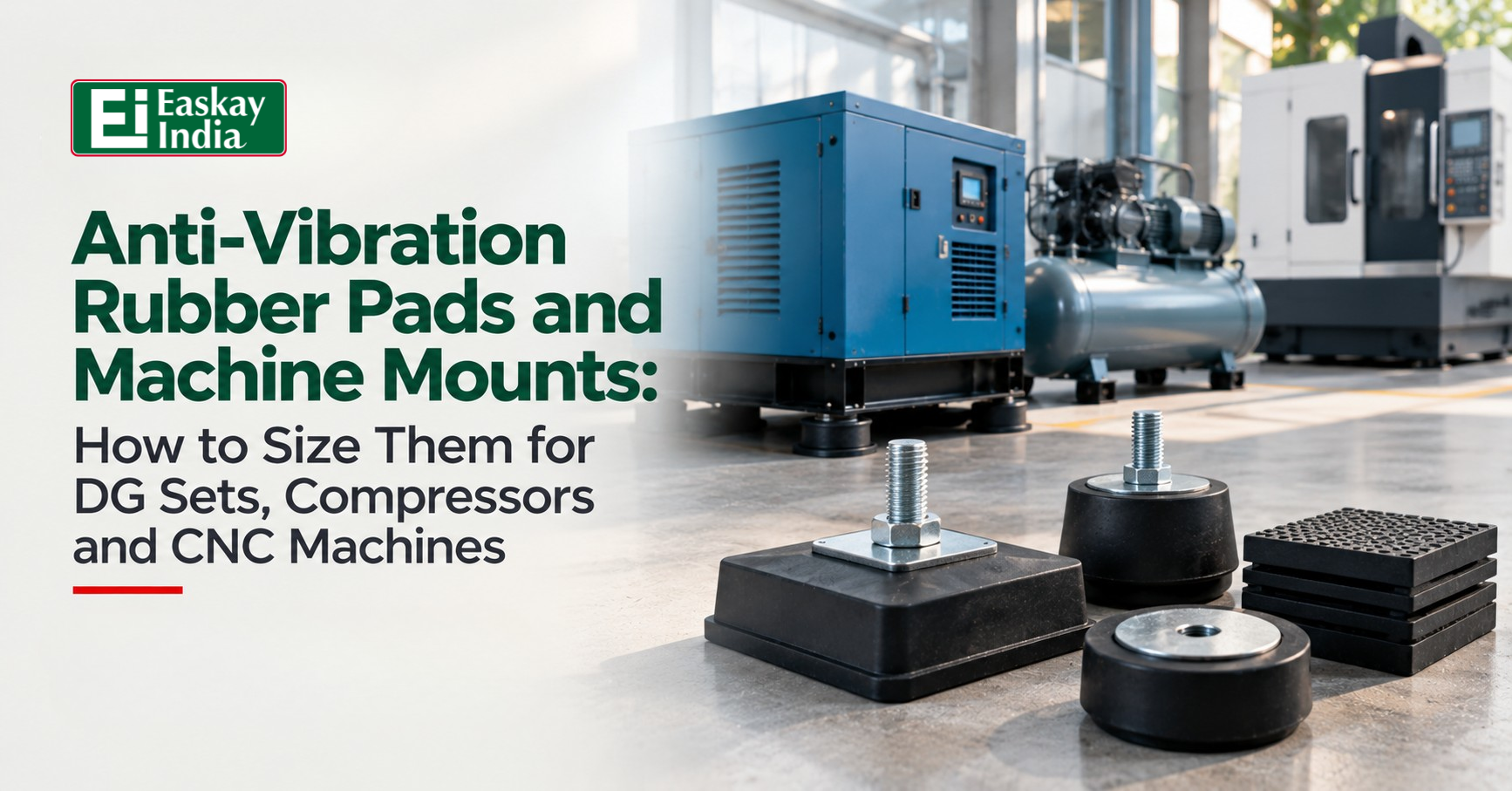
Anti-Vibration Rubber Pads and Machine Mounts: How to Size Them for DG Sets, Compressors and CNC Machines
Every machine with a motor shakes a little. A diesel generator, an air compressor, a CNC machining centre: each one sends vibration into its base, the floor, the building and every machine around it. The right anti vibration rubber pads stop most of that before it leaves the machine. The wrong ones either do nothing or make things worse.
Two trends make this a live question for Indian plants right now. India’s data centre capacity has reached 1,789 MW in the first half of 2026, with around 509 MW more under construction, and every one of those halls needs backup DG sets on proper mounts. At the same time, factories are running harder: the HSBC India Manufacturing PMI rose to 55.1 in September 2026, a seven-month high, and new compressors and machine tools are going in to meet festive demand.
Yet most buyers still choose pads by guesswork: “give me four pads for a generator”. This guide explains, in plain words, how to size anti vibration mounts for machines so they actually work.
How Anti-Vibration Pads Work (Without the Maths)
Think of a machine sitting on rubber pads as a weight on a spring. Every spring-and-weight system has a natural frequency, the speed at which it likes to bounce. The machine itself also has a frequency, set mainly by how fast it runs.
Here is the rule that matters:
- If the machine’s running frequency is close to the natural frequency of the pads, vibration gets amplified. This is resonance, and it is the most common reason a new set of pads makes things worse.
- If the machine’s running frequency is well above the natural frequency of the pads, vibration gets isolated. Isolation starts once the running frequency is about 1.4 times the natural frequency, and becomes useful at around 2.5 to 3 times.
The way you lower the natural frequency of a pad is by letting it deflect, or compress, more under the machine’s weight. A pad that squashes 4 mm under load has a lower natural frequency than one that squashes 1 mm. That is why load per pad, pad thickness and rubber hardness all matter together. If hardness is new to you, our plain-English guide to rubber hardness, elasticity and durability explains what Shore A actually measures.
So sizing a pad comes down to three questions: how heavy is each corner of the machine, how fast does it run, and how much deflection does that speed need?
Step 1: Work Out the Load on Each Pad
Start with the full operating weight, not the brochure weight. For a DG set, that means the engine, alternator, base frame, coolant, lube oil and, if the base has a built-in tank, a full tank of diesel. For a compressor, include the receiver if it sits on the same skid.
Then divide by the number of mounting points. A simple example:
- A DG set with its base frame and full fuel tank weighs 2,000 kg.
- It sits on 6 mounting points.
- 2,000 ÷ 6 = about 333 kg per point.
Now add a margin. Machines are rarely balanced evenly. On a generator, the engine end is usually heavier than the alternator end, so the pads under the engine carry more than their share. Adding 20 to 25 percent to the average is a sensible starting point: 333 kg × 1.25 = about 420 kg for the heaviest pad. Size every pad for that figure, or ask your supplier to grade the pads by position.
Step 2: Find the Running Frequency
The running frequency in hertz is simply the machine speed in rpm divided by 60.
| Machine | Typical running speed | Running frequency | Target pad natural frequency | Approx. static deflection needed |
|---|---|---|---|---|
| DG set (most Indian sets run at 1500 rpm) | 1500 rpm | 25 Hz | 10 Hz or lower | 2.5 mm or more |
| Screw compressor (motor speed) | 1500 to 3000 rpm | 25 to 50 Hz | 10 to 17 Hz or lower | 1 to 2.5 mm |
| Reciprocating compressor | 600 to 1000 rpm | 10 to 17 Hz | 4 to 7 Hz or lower | 5 to 15 mm (often beyond rubber) |
| CNC machine / VMC | Varies | Varies | Stability comes first (see Step 5) | Minimal |
These figures are starting points, not a fixed rule. The deflection column comes from the standard relationship between static deflection and natural frequency for a spring-mounted mass. Rubber behaves slightly stiffer under vibration than it does under a static load, so real-world isolation will be a little lower than the table suggests. Build in some headroom.
One honest note: for slow machines, rubber pads alone often cannot deflect enough without becoming unstable. If the table asks for more than about 10 mm of deflection, ask your supplier about spring mounts or a combined design.
Step 3: Choose Pad Area and Thickness
Once you know the load per pad, pad area is set by how much load the rubber can carry. Every pad compound has a rated load per square centimetre for a given hardness. Your supplier should give you this figure. Using an example rating of 4 kg per square cm:
- Heaviest pad load: 420 kg
- Area needed: 420 ÷ 4 = 105 square cm
- A pad of roughly 100 × 110 mm does the job.
Pad thickness controls how much the pad can deflect. As a rule of thumb, a rubber pad should deflect around 10 to 15 percent of its thickness under its rated load. Push it much further and it takes a permanent set; load it much less and it barely deflects at all.
So for the DG set above, which needs about 2.5 mm of deflection, a pad of roughly 20 to 25 mm thickness is a reasonable starting point. Many installers achieve this by stacking two thinner layers with a steel plate bonded or placed between them, which keeps the stack stable under a heavy machine.
Ribbed or waffle-pattern rubber pads for machinery are popular because the ribs give extra deflection for the same thickness and stop the machine from walking across the floor. For lighter equipment and appliances, moulded rubber feet are often simpler to fit.
Step 4: Pick the Hardness
Hardness and area work together. A softer compound deflects more for the same load but carries less load per square centimetre. A firmer compound carries more but deflects less.
General starting points for vibration damping rubber pads:
- Around 40 to 50 Shore A: lighter machines, higher running speeds, where isolation is the priority.
- Around 50 to 60 Shore A: medium to heavy machines such as most anti vibration pads for DG set installations and screw compressors.
- Around 60 to 70 Shore A: heavy, slow or impact-loaded equipment, and machines where stability matters more than isolation.
If the pads will sit near diesel, lube oil or coolant, say so when you order. An oil-resistant compound will last far longer in a genset room than a general-purpose one.
Step 5: Special Cases by Machine Type
DG sets
Most DG sets already have anti-vibration mounts between the engine-alternator and the base frame, fitted by the manufacturer. The anti vibration pads for generator base frames that you buy are a second stage: they protect the floor and the building from what the first stage lets through, and they stop the frame from walking. Size them using the steps above, and do not remove or replace the internal mounts without checking with the DG maker.
Compressors
For a screw compressor, size anti vibration pads for compressor skids the same way as a DG set, using the motor speed. Reciprocating compressors are harder: they run slower and shake more, so they often need deflection beyond what a simple pad can give. An air compressor anti vibration pad under a small reciprocating unit is still worth fitting to reduce noise and walking, but for large units, involve your supplier early.
CNC machines and VMCs
Machining centres are the exception. Their accuracy depends on a stable, level base, and a soft mount can let the machine rock during rapid axis moves. Always follow the machine builder’s foundation guidance first. Where pads are used, they are usually firmer grades, used with levelling bolts, mainly to stop the machine walking and to reduce vibration coming in from nearby presses or compressors. Think stability first, isolation second.
Installation Mistakes That Cause Pad Failure
Most “failed” pads were sized correctly and installed badly. Watch for these:
- Bolting straight through the pad and tightening hard. This squashes the rubber and creates a steel path for vibration. If the machine must be bolted down, use isolating rubber washers or bushes under the bolt head and do not over-tighten.
- Rigid connections bypassing the pads. A solid exhaust pipe, fuel line or cable tray bolted to the machine carries vibration straight into the building. Use flexible connections and rubber grommets where cables pass through panels.
- Uneven floor. If the floor is not level, one or two pads carry most of the load and the rest do nothing. Level the base before final placement.
- Mixing old and new pads. Old pads have taken a set. Replace the full set together.
- Oil and diesel contamination. Spills soften general-purpose rubber over time. Keep the area clean or specify an oil-resistant compound.
- Under-loaded pads. Pads that are too large or too hard for a light machine hardly deflect, so they give little isolation. Bigger is not always better.
For a wider look at how rubber components protect heavy equipment, see our article on why high-performance rubber bushings are essential for heavy machinery.
What to Send Your Supplier
To get rubber machine mounting pads sized properly the first time, share:
- Machine type, make and model
- Full operating weight, and where the heavier end is
- Number and size of mounting points, with a photo of the base frame
- Running speed in rpm
- Floor type and whether the machine must be bolted down
- Any oil, diesel or coolant exposure
Easkay India makes anti-vibration rubber pads in Gurugram and can customise size, thickness and hardness to your machine. You can see the full range on our rubber products manufacturer page, or send us your machine details for a recommendation.
Frequently Asked Questions
1. How do I calculate the size of anti-vibration pads for a machine?
Divide the full operating weight by the number of mounting points, add 20 to 25 percent for uneven loading, then divide by the pad’s rated load per square centimetre to get the pad area. Thickness is chosen so the pad deflects enough for the machine’s running speed.
2. Which anti-vibration pads are suitable for a DG set?
For most DG sets running at 1500 rpm, pads that deflect around 2.5 mm or more under load, in roughly 50 to 60 Shore A, are a common starting point. Remember that most sets already have internal mounts; the base pads are a second stage.
3. Can rubber pads be used under CNC machines?
Yes, but stability comes first. Follow the machine builder’s foundation guidance, and use firmer pads with levelling bolts mainly to stop walking and reduce vibration from nearby equipment.
4. Why is my machine vibrating more after fitting new pads?
The pads may be close to resonance with the machine’s running speed, too hard to deflect, or bypassed by a rigid bolt, pipe or cable. Check deflection under load and look for rigid connections.
5. How often should anti-vibration pads be replaced?
Inspect them at every major service. Replace the full set if pads are cracked, permanently flattened, swollen by oil, or if vibration or noise has increased noticeably.
Conclusion: Size for the Machine, Not the Catalogue
The right anti vibration rubber pads come from four numbers: the weight on each pad, the machine’s running speed, the deflection that speed needs, and the load the rubber can carry. Get those right, install the pads without rigid shortcuts, and you protect the machine, the floor and everyone working near it. If you are commissioning a new DG set, compressor or machining centre this season, send us the details before you order.
Recent Posts