O-Ring Selection Guide: How to Choose the Right Size, Material and Hardness
An O-ring is one of the simplest parts in any machine. A ring of rubber, round in cross-section, sitting in a groove. Yet it is also one of the most common reasons for leaks, downtime and repeat orders when it is chosen badly.
Most O-ring problems are not caused by poor quality. They are caused by the wrong choice: a size that is slightly off, a material that does not suit the fluid, or a hardness that cannot handle the pressure. The good news is that getting it right is not complicated once you know which questions to ask.
This guide walks through how to choose an O-ring step by step: how to measure it, how to read O-ring sizes, how to pick the material and hardness, and the groove and installation details that decide whether the seal actually holds. If you are new to O-rings, our introduction to what rubber O-rings are and why they matter is a good place to start.
How an O-Ring Actually Seals
An O-ring works by being squeezed. When it is fitted into its groove and the mating part is assembled, the ring is compressed slightly out of its round shape. That squeeze pushes the rubber against both surfaces and closes the gap between them.
When pressure is applied, the fluid pushes the O-ring against the side of the groove, which increases the sealing force even further. That is why a correctly sized O-ring often seals better as pressure rises, up to a point.
Everything in O-ring selection comes back to this idea. The ring must be squeezed enough to seal, but not so much that it is crushed, and it must be made of a rubber that stays elastic in the fluid and temperature it lives in.
Step 1: Measure the O-Ring Correctly
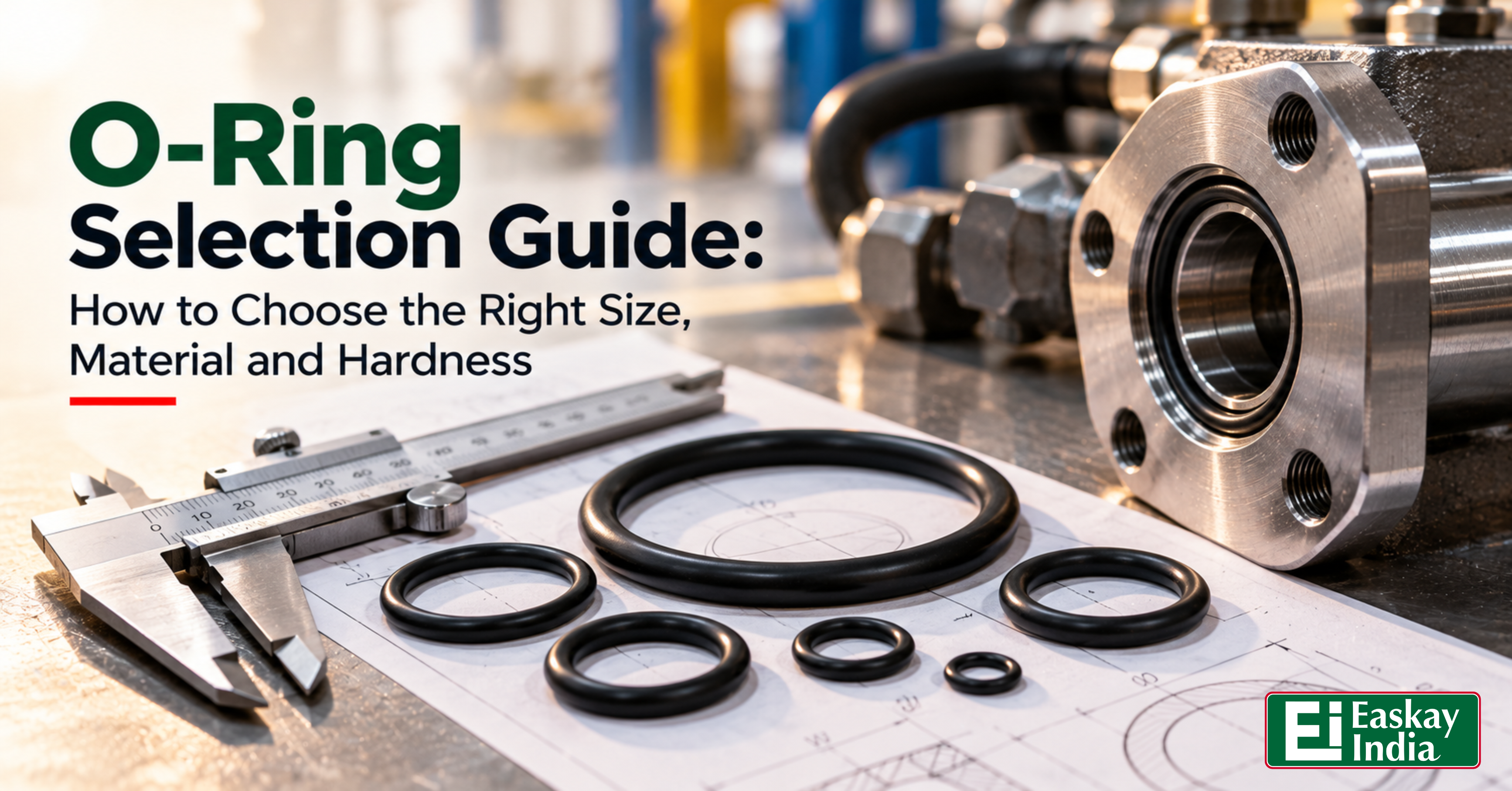
Every O-ring is defined by two dimensions:
- Inside diameter (ID): the diameter of the hole in the middle of the ring
- Cross-section (CS): the thickness of the ring itself, sometimes called the width or W
Together they describe the ring, for example “ID 20 mm x CS 2.5 mm”.
When you are learning how to measure an O-ring, a few habits prevent most mistakes:
- Do not stretch the ring while measuring. Rubber stretches easily, and even light pressure from a vernier can change the reading.
- Measure the cross-section in more than one place and take the average.
- Be careful with used O-rings. A ring that has been in service may have swollen, shrunk or flattened. Its size today may not be its original size.
For a used or damaged ring, it is often more reliable to measure the groove and the mating parts instead. The groove diameter, groove width and groove depth tell you what size the O-ring needs to be, regardless of what condition the old one is in.
Step 2: Understand O-Ring Size Standards
O-rings are made in standard sizes as well as custom sizes. The two families you will meet most often are:
- Inch sizes, commonly referred to by AS568 dash numbers, such as -010 or -214. These are widely used on equipment designed in the US.
- Metric sizes, such as those covered by ISO 3601, expressed directly in millimetres.
The important thing is not to mix the two. An inch O-ring and a metric O-ring can look almost identical but differ by a fraction of a millimetre, and that difference can be enough to cause a leak or make assembly difficult.
If your equipment does not use a standard size, or you are replacing a part on an older or imported machine, a custom size can be moulded to your drawing or sample. Many leaks in the field come from fitting the “nearest standard size” instead of the correct one.
Step 3: Choose the Right Material
This is the most important decision in O-ring material selection.The rubber has to stay elastic and stable in whatever it touches, at the temperatures it will see. A material that swells, hardens or softens in the fluid will lose its seal, no matter how well the size is chosen.
Here is where the common O-ring materials are typically used. The temperature ranges are general guides; exact limits depend on the specific grade.
NBR (Nitrile). The most widely used O-ring material for mineral oils, hydraulic oils, greases, water and many fuels. A typical working range is roughly -30°C to +100°C. It is the usual starting point for general hydraulic and pneumatic work.
EPDM. Well suited to water, steam, weather, ozone and glycol-based brake fluids, with a typical range of roughly -50°C to +150°C. EPDM should not be used with mineral oils or petroleum fuels, as it swells in them.
Silicone. Chosen for very wide temperature ranges, roughly -60°C to +200°C, and for clean applications. Silicone has lower tear and abrasion resistance than many other rubbers, so it is best suited to static seals rather than parts that rub or move.
Viton (FKM). Used where high temperatures and aggressive fluids meet, such as fuels, many chemicals and hot oils, with a typical range of roughly -20°C to +200°C.
Neoprene (CR). A good all-rounder for weather resistance, moderate oil resistance and refrigerant applications, typically from about -40°C to +120°C.
Polyurethane (PU). Where abrasion resistance and high pressure matter, PU O-rings offer excellent wear resistance and toughness in many hydraulic applications.
The simplest rule: choose the material for the fluid first, then confirm it handles your highest and lowest temperatures. If the fluid is unusual, a mixture, or a cleaning chemical, share its exact name with your supplier before ordering.
Step 4: Pick the Right Hardness
O-ring hardness is measured on the Shore A scale. Our guide to rubber hardness, elasticity and durability explains the scale in detail, but for O-rings the practical choices are fairly simple.
- Around 70 Shore A is the most common general-purpose O-ring hardness. It balances sealing ability, wear resistance and ease of installation, and suits most static and moderate dynamic applications.
- Softer grades, around 50 to 60 Shore A, seal better against rough or uneven surfaces and at low pressures, and are easier to stretch into place.
- Harder grades, around 80 to 90 Shore A, resist being pushed into the clearance gap under high pressure and wear better in some dynamic applications, but need more force to install and seal less well on rough surfaces.
Pressure and clearance work together here. Under high pressure, a soft O-ring can be forced into the small gap between the two metal parts and nibbled away, a failure known as extrusion. As a general guide, once pressures climb above roughly 100 bar, many designs move to a harder grade, tighter clearances, or anti-extrusion backup rings alongside the O-ring.
Step 5: Get the Groove and Squeeze Right
An O-ring is only as good as the groove it sits in. Three numbers matter most in O-ring groove design:
Squeeze. This is how much the cross-section is compressed when the parts are assembled, expressed as a percentage. As a widely used guide, static seals typically run with about 15 to 30 percent squeeze, while dynamic seals that move use less, often around 10 to 20 percent, to limit friction and wear. Too little squeeze and the ring may not seal at low pressure. Too much and it can crack, take a permanent set or make assembly very hard.
Stretch. When an O-ring is fitted onto a shaft or into an external groove, its inside diameter is usually stretched slightly so it sits snugly. Keeping this stretch small, generally within about 5 percent, avoids thinning the cross-section and losing squeeze.
Groove fill. The O-ring should not fill the groove completely. Leaving room, with the ring typically filling around 70 to 85 percent of the groove volume, allows space for the rubber to move under pressure and for any slight swelling from the fluid or heat.
If you are designing a new groove, your supplier can recommend the right O-ring size for your dimensions, or the right groove dimensions for a standard O-ring.
Step 6: Install It Without Damage
A surprising number of O-rings leak because they were damaged during fitting, not because they were the wrong part. A few habits make a big difference:
- Lubricate before fitting, using a lubricant compatible with the O-ring material and the system fluid.
- Protect the ring from sharp edges and threads. Cover threads with tape or a fitting sleeve, and make sure the parts have a smooth lead-in chamfer.
- Do not roll or twist the ring into the groove. A twisted O-ring can fail early, especially in moving applications.
- Never reuse an old O-ring after disassembly. Once it has been compressed in service, it has taken a set and will not seal the same way again.
Common O-Ring Problems and What They Tell You
When an O-ring fails, its condition usually points to the cause:
| What you see | Likely cause | What to change |
|---|---|---|
| Edges nibbled or frayed on one side | Extrusion under pressure | Harder grade, tighter clearance or backup ring |
| Flattened, does not spring back | Compression set from heat or over-squeeze | Material for higher temperature, check squeeze |
| Swollen, soft or sticky | Material not compatible with the fluid | Change material to suit the fluid |
| Cracked or brittle | Heat, ozone or ageing | Material with better heat or ozone resistance |
| Cuts or nicks | Damage during installation | Better lead-in chamfers, protect from threads |
| Twisted, spiral marks | Twisting in a moving application | Correct size, lubrication and installation |
Reading a failed O-ring this way often solves the problem faster than simply fitting the same part again.
Standard or Custom O-Rings?
Standard sizes work well when your equipment is designed around them and the material is available in the grade you need. Custom O-rings make sense when:
- The size is non-standard, or the original part is from an older or imported machine
- You need a specific material or hardness that is not available off the shelf
- The application has unusual temperatures, fluids or pressures
- You need consistent supply in larger quantities to a fixed specification
Easkay India manufactures rubber O-rings in NBR, EPDM, silicone, Viton, neoprene and other compounds, in standard and custom sizes, made to your drawing or sample. As an ISO 9001:2015 certified O-ring manufacturer in India since 1977, we can help you choose the right size, material and hardness for your application. Explore our full range of industrial rubber products or send us your O-ring requirement.
Frequently Asked Questions
1. How do I measure an O-ring size?
Measure the inside diameter (ID) and the cross-section (CS) without stretching the ring. For a used or deformed O-ring, measuring the groove and mating parts is usually more accurate than measuring the old ring.
2. What is the most common O-ring hardness?
Around 70 Shore A is the most common general-purpose hardness. Softer grades suit low pressures and rough surfaces, while harder grades, around 80 to 90 Shore A, are used for higher pressures and some dynamic applications.
3. Which O-ring material is suitable for hydraulic oil?
NBR (nitrile) is the usual choice for mineral-based hydraulic oils. For higher temperatures or more aggressive fluids, Viton (FKM) is often used. EPDM should not be used with mineral oils.
4. Why does my O-ring keep failing?
Repeated failure usually points to a wrong material for the fluid, the wrong hardness for the pressure, incorrect squeeze in the groove, or damage during installation. Examining the failed O-ring for swelling, nibbling, flattening or cuts helps identify the cause.
5. Can you make custom O-rings in non-standard sizes?
Yes. Easkay India manufactures custom O-rings in non-standard sizes and specific materials and hardness, made to your drawing, sample or groove dimensions.
Conclusion: The Right O-Ring Is a Set of Small, Correct Choices
Choosing an O-ring comes down to five things: the correct size, the right material for the fluid and temperature, a hardness that suits the pressure, a groove that gives the right squeeze, and careful installation. Get those right and a small rubber ring will seal reliably for a long time. If you are unsure about any of them, share your application details with us and we will help you select the O-ring that fits the job.
Recent Posts