Anti-Vibration Rubber Pads: How They Work, Where to Use Them and the Installation Mistakes That Cancel Them Out
A compressor that shakes the floor. A pump whose hum is heard three bays away. A generator that walks across its plinth a few millimetres every month. A machine tool whose finish gets worse every time the press next door runs. All of these are vibration problems, and in most plants the first and cheapest answer to them is a rubber pad under the machine.
Anti-vibration rubber pads are among the simplest components in industry. They are also among the most misapplied. A pad that is too hard passes vibration straight through. A pad that is too soft lets the machine rock. A pad fitted with the bolts torqued down through it is doing nothing at all. The physics is simple, but it has to be respected.
This guide explains how anti-vibration pads actually reduce vibration, where they are used, how to choose the right pad for a machine, how to install one so it works, and the signs that a pad has reached the end of its life.
How an Anti-Vibration Pad Works
Every machine that rotates or reciprocates generates vibration at a frequency tied to its speed. A motor running at 1,450 rpm vibrates at around 24 times a second. Bolt that motor rigidly to the floor and the floor vibrates at the same frequency, and so does everything attached to the floor.
A rubber pad changes that in two ways.
Isolation. The pad is a spring. The machine sitting on it has a natural frequency of its own, set by the machine’s weight and the pad’s stiffness. If that natural frequency is well below the machine’s running frequency, most of the vibration is not transmitted through the pad to the floor. The softer the pad and the heavier the machine, the lower the natural frequency and the better the isolation. This is why the same pad can work well under a heavy machine and badly under a light one.
Damping. Rubber also converts part of the vibration into heat as it flexes, which takes energy out of the system. Damping matters most when the machine passes through its natural frequency on start-up and shutdown, and it is why rubber pads are forgiving where metal springs can be violent.
The practical lesson is that an anti-vibration pad is not a cushion that “absorbs” vibration like a sponge. It is a tuned spring, and it has to be chosen for the load on it and the frequency it is isolating.
Where Anti-Vibration Pads for Machinery Are Used
-
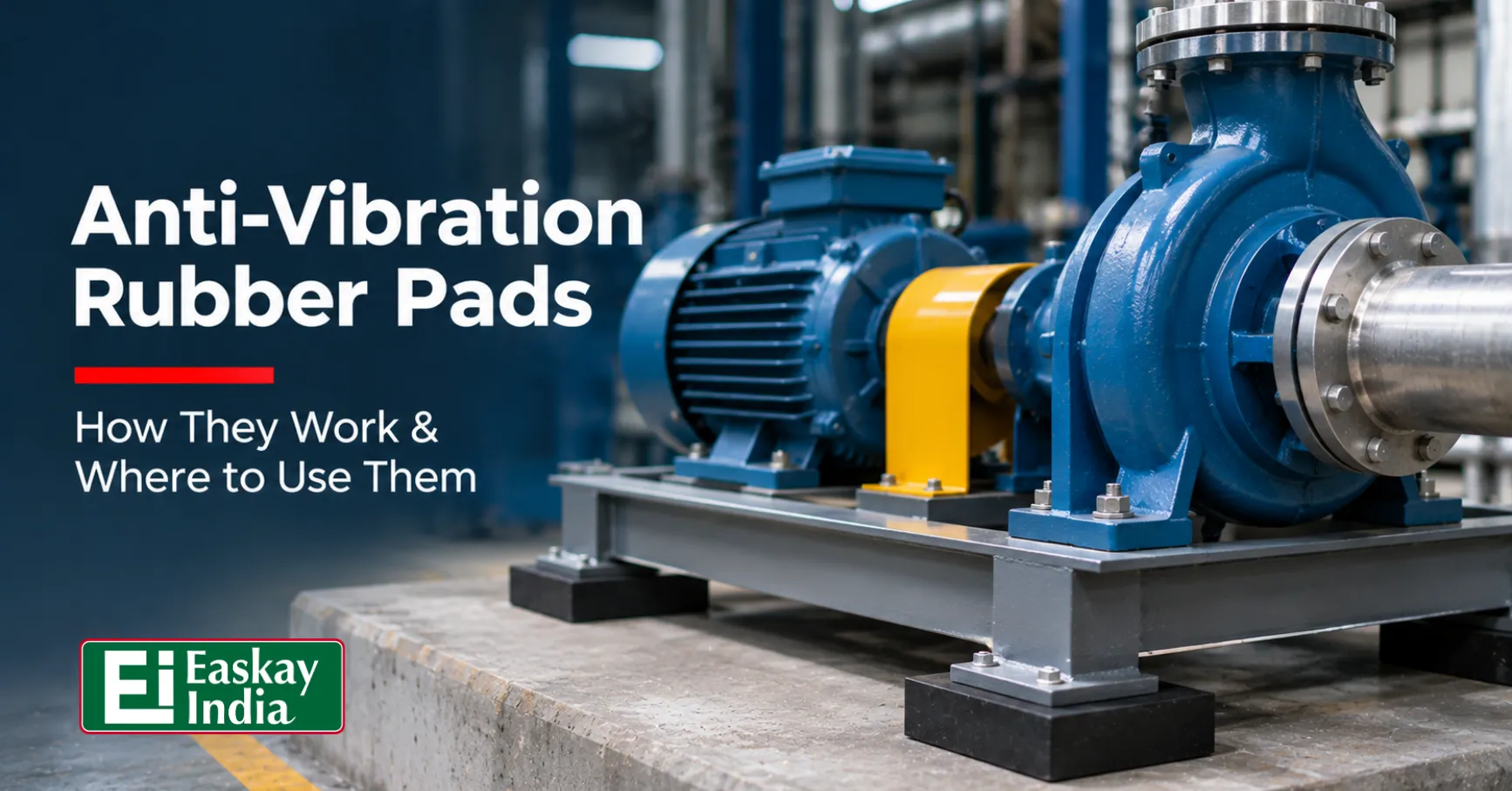
Motors and pumps, to stop running vibration reaching pipework, structures and neighbouring equipment
-
Compressors and generators, which combine heavy weight, reciprocating motion and long running hours
-
Machine tools and precision equipment, where incoming vibration from the surrounding floor affects accuracy and finish
-
HVAC equipment, fans and blowers, to reduce noise transmitted through building structures
-
Electrical equipment and panels, to protect components from shock and resonance
-
Material handling equipment, industrial trolleys and equipment supports, where pads cushion loads and reduce noise
In each case the pad does two jobs at once: it protects the surroundings from the machine, and it protects the machine from the surroundings.
Types of Anti-Vibration Pads
Pads are made in several forms, each suited to a different situation:
Plain flat pads. A solid rubber vibration damping pad, cut or moulded to size. Simple, suited to lighter machines, equipment feet and general cushioning, and easy to fit under a base or a foot.
Ribbed or patterned pads. Pads with ribs, grooves or a waffle pattern on one or both faces. The pattern reduces the contact area so that the pad deflects more under a given load, which gives better isolation, and it provides grip against the floor and the machine base.
Pads with bonded metal plates. Rubber bonded to steel plates on one or both faces, so that the pad can be bolted to the machine and the floor without crushing the rubber, and so that the rubber works in shear and compression rather than being squeezed by a bolt.
Custom moulded pads and blocks. Pads shaped to match a machine base, with holes, steps or recesses for mounting bolts, for machines where a standard pad does not fit. Anti-vibration rubber pads can be made as flat sheets, blocks, strips or custom-moulded shapes in rectangular, square, round or custom profiles.
Choosing the Right Pad
Working out how to choose anti-vibration pads is mostly a question of matching stiffness to load. Five things decide it.
1. The load on each pad
Add up the weight of the machine, including any load it carries in operation, and divide it among the pads. Account for an uneven centre of gravity: a motor at one end of a base puts more weight on the pads at that end. Pads are chosen so that each one sits within its working load range, neither barely loaded nor crushed.
2. The running speed
The machine’s speed sets the frequency to be isolated. Slow machines are harder to isolate than fast ones, because the pad’s natural frequency has to be lower still. A high-speed fan is easy; a slow reciprocating compressor needs a softer, more carefully chosen pad.
3. The pad hardness and thickness
Hardness, in Shore A, is the main lever for stiffness once the compound is fixed. Softer and thicker pads deflect more and isolate better, but allow more movement; firmer and thinner pads hold the machine steadier but transmit more. For most machinery, a medium hardness with enough thickness to deflect visibly under load is the starting point, and our guide to rubber hardness, elasticity and durability explains what the Shore A number means in practice.
4. The environment
The compound decides how long the pad lasts. Natural rubber gives excellent resilience and isolation for clean, indoor duty. NBR suits pads under machines that drip oil, such as compressors, gearboxes and machine tools. EPDM suits outdoor equipment, wet areas and anywhere exposed to sunlight and weather. Tell the supplier what the pad will sit in.
5. Movement and stability
Some machines must not move: machine tools, precision equipment and anything connected to rigid pipework. For these, the pad must be firm enough to limit rocking, and the machine may need to be restrained against sliding. Other machines, such as generators and compressors on their own skids, can tolerate more movement and benefit from softer pads.
When in doubt, send the supplier the machine weight, the number of mounting points, the running speed and the environment. A pad chosen from those four facts will usually be right. A pad chosen by size alone usually is not.
Installation Mistakes That Cancel the Pad Out
A correctly chosen pad can be made useless in five minutes at installation. These mistakes appear again and again:
1. Bolting straight through the pad and torquing down. The bolt clamps the machine rigidly to the floor through the pad. The pad is crushed solid, and the bolt forms a direct path for vibration. The pad is now decoration. Where bolts are needed, use pads with bonded plates, isolate the bolt with rubber washers and sleeves, or use a design that lets the rubber carry the load while the bolt only locates.
2. Bridging the isolation. A rigid pipe, a conduit, a cable tray or a guard that connects the machine to the structure carries vibration around the pad. Isolate every connection with flexible pipe sections, flexible conduit and loose cables, or the pad is wasted.
3. Overloading or underloading. Four small pads under a heavy machine are crushed and act like solid blocks. Four large pads under a light machine barely deflect and act the same way. Match the pad area to the load so that each pad deflects within its working range.
4. Uneven loading. A machine with its weight on three of four pads rocks on the fourth. Level the base, shim where needed, and check that every pad carries load.
5. Pads on a rough or oily floor. A pad on uneven concrete loads unevenly. A pad on an oily floor creeps. Clean and level the floor, or fit a steel plate under the pad.
6. Stacking pads to gain height. Two pads stacked can shift and walk. If more height or more deflection is needed, use a thicker pad or a different design.
7. Forgetting the machine moves. A machine on pads will move more than one bolted down. Leave clearance to guards, pipework and neighbouring equipment, and allow for it in flexible connections.
Done properly, pad installation takes a little longer than bolting a machine down. Done badly, it gives all the cost of the pads and none of the benefit.
Signs a Pad Needs Replacing
Rubber pads age, and a pad that has done its job for years will eventually stop. The signs:
-
Permanent sag. The machine sits visibly lower than when it was installed, and the pad does not recover when unloaded.
-
Cracks, especially at the edges and where the pad has bulged under load.
-
Hardened, glazed or crumbling rubber, from heat, ozone or age.
-
Oil-soaked, swollen or soft rubber, which means the compound is wrong for the environment.
-
Rubber separating from bonded plates.
-
Vibration and noise returning, or bolts that keep working loose as the pad relaxes.
-
Pads that have crept out from under the machine, leaving one corner carrying less load.
Replace pads as a set, not one at a time, so that the machine sits level on pads of the same age and stiffness.
Anti-Vibration Rubber Pads from Easkay India
Easkay India manufactures moulded anti-vibration rubber pads for industrial machinery, motors and pumps, compressors, generators, machine tools, HVAC and electrical equipment, material handling equipment and industrial trolleys. Pads are made in natural rubber, NBR, EPDM and other specified compounds, in the hardness, dimensions and shape the application needs, as flat sheets, blocks, strips or custom-moulded profiles with holes or recesses to match machine bases and mounting points.
Pads are developed from a drawing, CAD model, physical sample or specified dimensions, and the approved specification is kept on file for repeat orders. Related products include rubber pads, rubber feet for equipment, rubber blocks for industrial trolleys and rubber bushes for mounting assemblies. As an ISO 9001:2015 certified anti-vibration pad manufacturer in India since 1977, we can help you match pad hardness and size to your machine. Share the machine weight, mounting points, speed and environment and we will recommend a pad.
Frequently Asked Questions
1. How do anti-vibration rubber pads reduce vibration?
A pad acts as a spring and a damper. It gives the machine a natural frequency well below its running frequency, so most of the vibration is not transmitted to the floor, and the rubber converts part of the remaining vibration into heat as it flexes.
2. What hardness should an anti-vibration pad be?
It depends on the load and the machine speed. Softer, thicker pads isolate better but allow more movement; firmer pads hold the machine steadier but transmit more. For most machinery, a medium hardness that deflects visibly under the machine’s weight is the starting point, chosen from the load per pad and the running speed.
3. Can I bolt a machine down through an anti-vibration pad?
Not directly. A bolt torqued through the pad clamps the machine rigidly to the floor and bypasses the pad. Use pads with bonded metal plates, isolate the bolt with rubber washers and sleeves, or use a design where the bolt only locates the machine and the rubber carries the load.
4. Which rubber compound should I choose for machine pads?
Natural rubber for clean, indoor duty where isolation matters most. NBR under machines that drip oil, such as compressors and machine tools. EPDM for outdoor, wet or sunlit locations.
5. Does Easkay India make anti-vibration pads to a custom size or shape?
Yes. Pads are made from a drawing, CAD model, sample or specified dimensions, in the compound, hardness, thickness and shape the application needs, including custom profiles with mounting holes or recesses.
Conclusion
An anti-vibration pad is a tuned spring, not a sponge. Choose it for the load on each pad, the machine speed and the environment, fit it so that nothing rigid bridges it and no bolt crushes it, and replace the set when the rubber sags, cracks or hardens. Do that and the floor stops shaking, the neighbours stop complaining and the machine runs for longer. If you have a machine that shakes, share its weight, mounting points, speed and location with our team and we will help you quieten it.
Recent Posts