PVC Dip Coating Explained: How Metal Handles, Grips and Formed Parts Get a Soft, Protective PVC Finish
Pick up a pair of pliers, a wire basket, a metal hook or the handle of a trolley and there is a good chance the smooth, coloured, slightly soft surface under your hand is dip-coated PVC. PVC coated handles and grips are everywhere in industrial hardware. It is one of the most common finishes in industrial hardware, and one of the least understood by the people who specify it.
PVC dip coating gives a metal part a seamless plastic skin: no sharp edges, no rust, a comfortable grip, a colour, and a layer of protection against knocks, chemicals and weather. It is also a process with its own rules. Coating thickness, coverage boundaries, colour and adhesion are all decided before the part ever touches the tank, and most problems with dip-coated parts come from decisions that were never made.
This guide explains how the process works, what it gives you, where it is used, how to specify a dip-coated part correctly, and the defects to look for when parts arrive.
What PVC Dip Coating Is
The material used in plastisol dip coating is PVC plastisol: fine PVC resin dispersed in a liquid plasticiser, with stabilisers, pigments and other additives. At room temperature it is a thick liquid. When it is heated to its fusion temperature, the resin and plasticiser combine into a solid, flexible PVC.
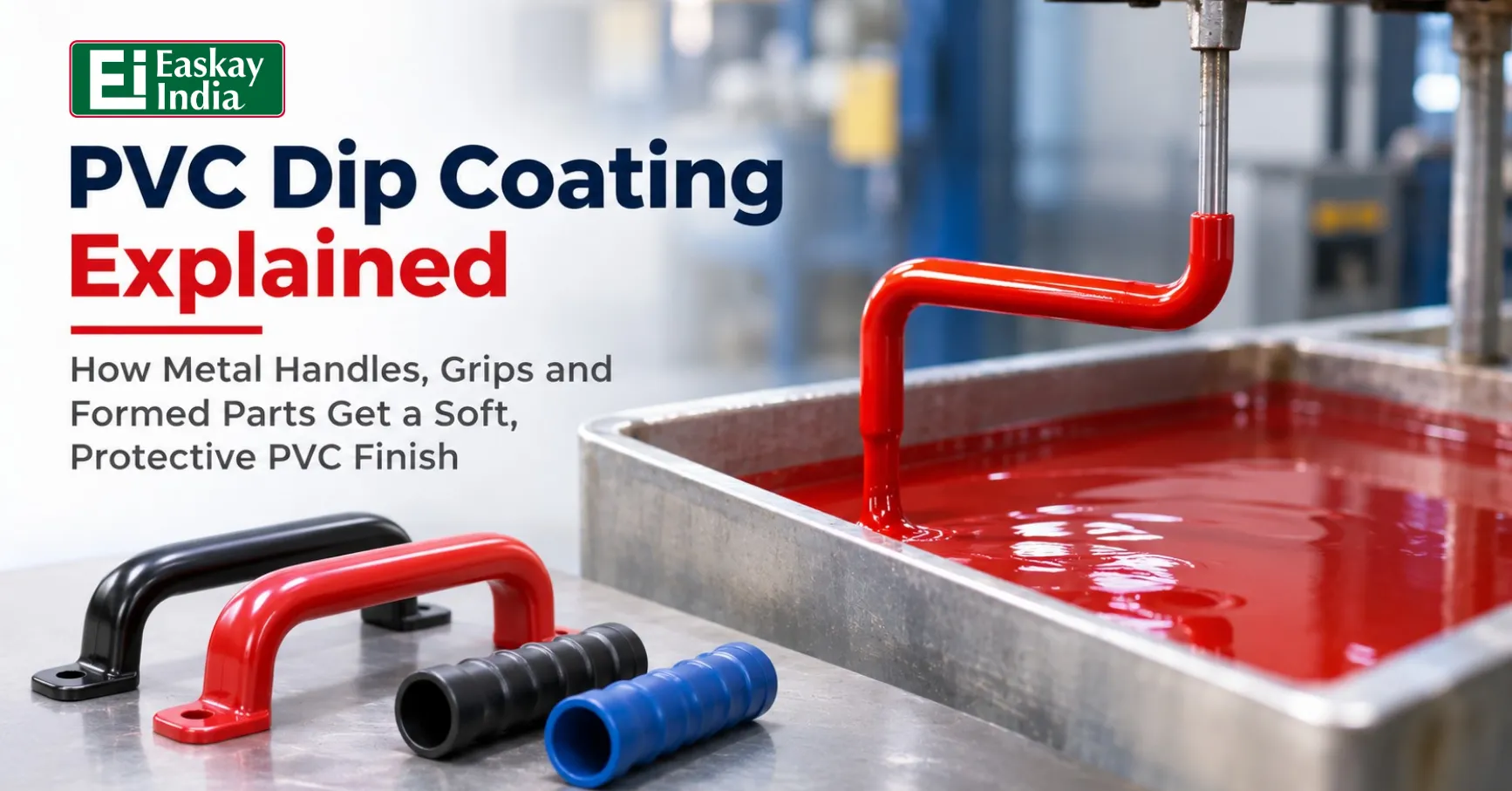
In dip coating, a metal part is heated, dipped into the plastisol, withdrawn, and then heated again so the coating fuses into a continuous skin bonded to the part. The coating stays on the part permanently. That is the difference from the related process of dip moulding, where PVC is formed on a mandrel and then stripped off to make hollow parts such as caps and sleeves. This article is about coating, where the metal and the PVC leave the factory together.
How the Process Works, Step by Step
1. Base part preparation. The metal part, usually steel, is cleaned and degreased. Oil, rust, scale and dust all stop the coating from adhering. Some parts are blasted for a better key, and some are primed, particularly where strong adhesion or a difficult base material is involved.
2. Fixturing. Parts are hung or held on fixtures. The fixture decides which area goes into the tank, how deep, and at what angle, and it leaves a small uncoated point where it holds the part. Areas that must stay bare, such as threads or mating faces, are masked.
3. Preheating. The part is heated in an oven. The temperature of the metal when it enters the plastisol is the main control on coating thickness: a hotter or heavier part gels more plastisol onto its surface.
4. Dipping. The part is lowered into the plastisol, held for a set time, and withdrawn at a controlled speed. Too fast and the coating is uneven; too slow and drips form at the lowest point.
5. Fusing. The coated part goes into an oven where the gelled plastisol fuses into solid PVC. Time and temperature here decide the final strength, flexibility and finish of the coating.
6. Cooling, trimming and inspection. Parts are cooled, drip points and masking are trimmed, and the coating is checked for thickness, coverage, colour and adhesion.
Each step leaves a mark on the finished part. Thickness comes from preheat, coverage from fixturing and dip depth, finish from withdrawal and fusing. When you understand that, specifying the part becomes much easier.
What Dip Coating Gives a Metal Part
-
A comfortable, non-slip grip on handles, levers and tools, with a softness that can be adjusted through the compound.
-
Corrosion protection, because the steel is sealed under a continuous skin.
-
Impact and scratch protection for both the part and whatever it touches, which is why wire racks and hooks are coated.
-
No sharp edges, as the coating rounds over cut ends and burrs.
-
Colour and identification, with colours matched to a reference and held across runs.
-
Electrical and thermal insulation for handles and covers, within the limits of the coating and the application; where a rated insulation is required, that must be specified and tested.
-
Chemical and weather resistance, which varies with the compound and should be matched to the exposure.
-
Noise reduction, since coated parts do not rattle against each other.
Where Dip-Coated PVC Components Are Used
-
Hand tool and equipment handles and grips
-
Trolley, cart and machine handles and levers
-
Wire baskets, racks, hooks and hangers
-
Clips, brackets and formed wire parts that touch finished goods
-
Covers for formed metal parts and protruding ends
-
Battery terminals, lugs and other electrical contact parts
-
Automotive assemblies, electrical equipment and general industrial hardware
Our range of dip PVC components covers handles and grips, protective coverings over formed parts, contact and handling parts and other industrial items, developed from a drawing, sample or specification.
How to Specify a Dip-Coated Part
Most of the decisions below are made at the enquiry stage. Making them explicitly avoids a round of samples that are nearly right.
Base material and condition
State the base metal and how it arrives: bare steel, plated, painted, aluminium or other. Each affects cleaning, priming and adhesion. If the part has welds, spatter or sharp burrs, say so, because they show through a thin coating.
Coated area and boundaries
Define exactly where the coating starts and stops, with a tolerance on the dip line. Mark any area that must stay bare: threads, mating faces, holes that must stay to size, contact surfaces. Decide where the fixture may hold the part, because that point will be uncoated or will need touching up.
Coating thickness
Dip coating thickness commonly ranges from well under a millimetre to a few millimetres, controlled mainly by preheat and dwell time. Specify a target and a tolerance, and remember that the coating adds to every dimension it covers: a bore gets smaller by twice the coating thickness, an outside diameter grows by the same amount. If a coated part must fit something, dimension it after coating.
Colour and finish
Give a colour reference such as a RAL or Pantone number, or a physical sample. Say whether the surface should be glossy, matte or textured. Colour is matched at the compound stage and held across repeat runs when the reference is on file.
Softness and feel
The plasticiser content sets how soft the coating feels. A tool grip may want a softer, higher-friction feel; a protective cover may want a firmer coating. Describe the application and ask for samples in two grades if the feel matters.
Environment
Tell the supplier about heat, sunlight, oils, cleaning chemicals and outdoor exposure. Standard compounds suit most indoor hardware; outdoor and chemical exposure may call for UV-stabilised or specific grades.
Quantity and samples
State the expected annual quantity. Trial quantities are normally made first, approved against the specification, and then followed by bulk runs to the same reference.
Design Points That Make Coating Easier and Better
A few small changes to the metal part improve the coated result:
-
Radius sharp edges. Coating thins over a sharp edge and thickens in a concave corner. A small radius gives an even skin.
-
Avoid blind holes and pockets in the coated area; they trap plastisol and drip.
-
Plan the hang point. Put it where an uncoated spot does not matter, or where it can be trimmed cleanly.
-
Plan the drip point. The lowest point of the part during withdrawal collects a drip; keep it away from the grip or sealing area.
-
Mask threads and fits. Coating on a thread is a rework job.
-
Keep wall sections consistent on wire forms, because heavier sections hold more heat and coat thicker.
Common Defects and What Causes Them
| Defect | Usual cause |
|---|---|
| Drips or runs at the lowest point | Withdrawal too slow, part orientation, plastisol too thin |
| Thin or bare spots on edges | Sharp edges, low preheat, uneven heating |
| Bubbles or pinholes | Air or moisture in the plastisol, trapped air in holes, fusing too fast |
| Poor adhesion, coating peels | Contaminated base, no primer where one was needed, under-fusing |
| Uneven thickness | Uneven preheat, heavy and light sections on the same part |
| Colour variation between lots | Compound batch not matched to reference |
| Tacky or soft surface | Under-fusing or plasticiser migration |
| Coating on areas that should be bare | Masking or dip line not specified |
Most of these can be read from the part itself, and each one points to a step in the process. A supplier who keeps records of preheat, dwell and fusing settings for your part can correct a defect quickly rather than guessing.
Checking Dip-Coated Parts on Arrival
A short incoming check catches most problems:
-
Coverage: coating starts and stops where the drawing says, with masked areas bare.
-
Thickness: measured at a few agreed points with a coating thickness gauge or a calliper, within tolerance.
-
Adhesion: a simple cut and peel check at a non-critical spot, or an agreed adhesion test for demanding parts.
-
Colour and finish: compared with the approved sample, not with memory.
-
Visual: no drips, bubbles, bare spots or trapped contamination.
-
Fit: if the part mates with something, a trial fit after coating.
Dip PVC Components from Easkay India
Easkay India manufactures dip coated PVC components over metal and other base materials for automotive, electrical and industrial use, including handles and grips, protective coverings over formed parts, contact and handling parts and niche industrial items. The coated area, colour, finish and finished dimensions are developed around your requirement, with masking or fixturing for areas that must stay bare, and coloured coatings are matched to your reference at the compound stage and held across repeat runs.
Alongside dip coating, our PVC range includes PVC caps, PVC dust caps, PVC terminal caps, PVC end caps and PVC moulded components. As an ISO 9001:2015 certified PVC components manufacturer in India since 1977, we develop parts from a drawing, a physical sample or a written specification, make trial quantities first, and move to bulk supply once the sample is approved. Send us your part drawing or sample with the coated area and colour you need, and we will confirm feasibility and quote.
Frequently Asked Questions
1. What is the difference between PVC dip coating and dip moulding?
In dip coating, the PVC skin stays bonded to the metal part, as on a coated handle or hook. In dip moulding, the PVC is formed on a mandrel and stripped off to make a hollow part such as a cap or sleeve. Both use PVC plastisol.
2. How thick is a PVC dip coating?
It commonly ranges from well under a millimetre to a few millimetres, controlled by the preheat temperature and dwell time. Specify a target thickness and tolerance, and remember that the coating adds to every dimension it covers.
3. Can part of a component be left uncoated?
Yes. Threads, mating faces and other areas are kept bare by masking or by fixturing the part so that only the required area enters the plastisol. Define the coated area and the dip line on the drawing.
4. Can the coating colour be matched to our standard?
Yes. Colours are matched to a RAL, Pantone or physical reference at the compound stage, and the reference is kept on file so that repeat runs match.
5. Does Easkay India make dip-coated parts from a sample?
Yes. Dip PVC components can be developed from a drawing, a physical sample or a written specification, with trial quantities made first and bulk production once the sample is approved.
Conclusion
A dip-coated part is simple to use and surprisingly easy to get wrong at the specification stage. Define the base material, the coated area, the thickness, the colour and the environment, design the part with a hang point and radiused edges, and check the first samples against those decisions. Do that and the coating does its job quietly for years, on every handle, hook and cover it protects. If you have a metal part that needs a PVC finish, share the drawing or sample with our team and we will help you specify it correctly.
Recent Posts