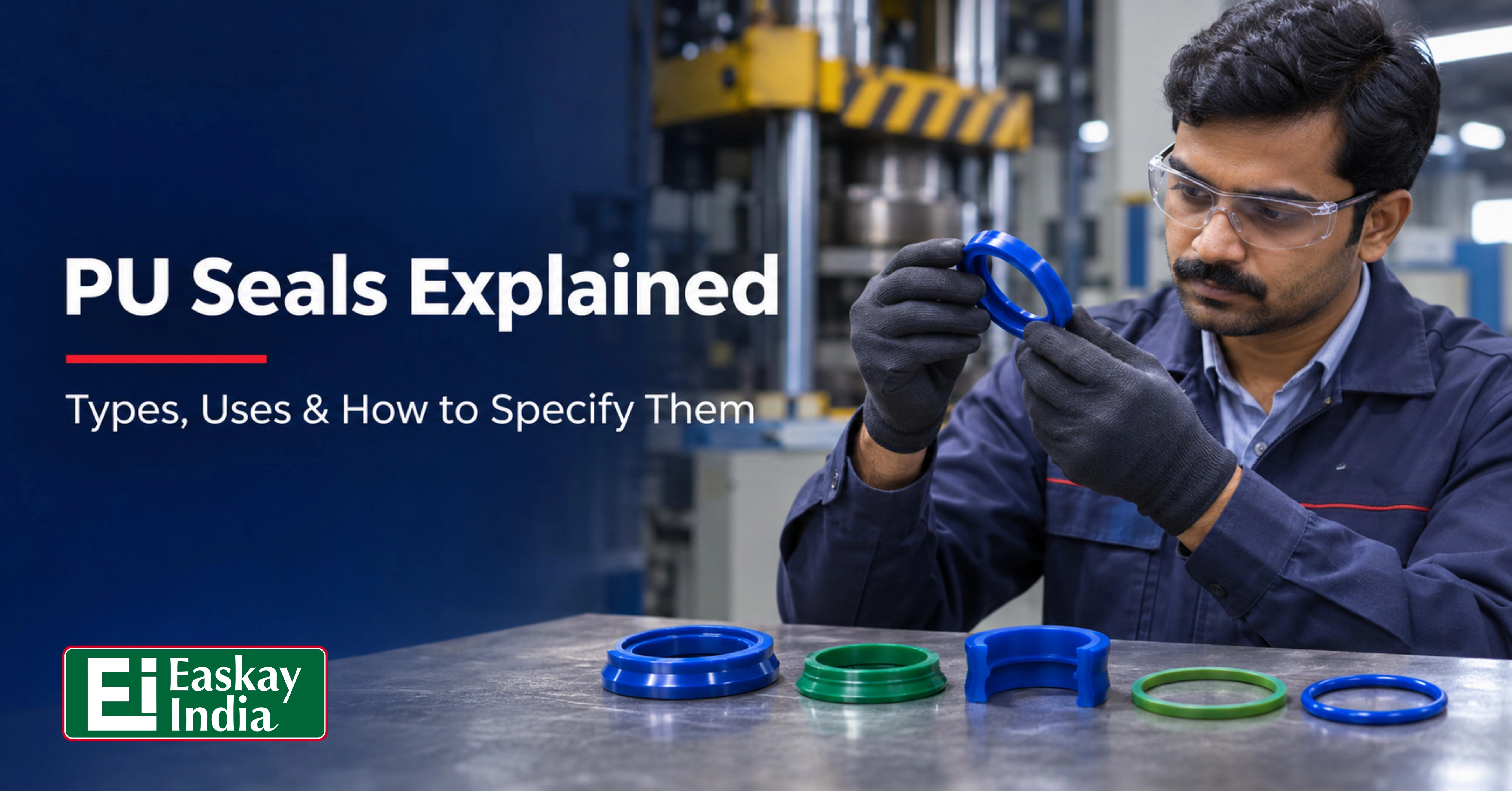
PU Seals Explained: Types, Where Polyurethane Seals Are Used and How to Specify Them
Open up a hydraulic cylinder on a press, a loader or a material handling machine and the seals you find on the rod and piston are very often polyurethane. The same is true of the wiper that keeps dirt out of the cylinder, the buffer seal behind the rod seal, and the backup ring that stops the main seal extruding under pressure. PU seals have become the default in a large share of hydraulic and pneumatic equipment, and for good reasons.
But polyurethane is not a single material, and a PU seal is not a single product. Hardness, profile, grade and dimensions all have to match the duty, and a seal chosen on the name alone can wear, extrude or harden long before it should.
This guide explains what polyurethane seals are and why they are used, the main types and what each one does, where they fit and where another material may suit better, how to specify one correctly, and the signs that a PU seal is failing and why.
What a PU Seal Is
A polyurethane seal is a sealing element moulded from a polyurethane elastomer, a material that combines the elasticity of rubber with much higher resistance to wear, tearing and extrusion. It is usually produced by moulding, with machining where a specific profile or tight dimension is needed.
The properties that make polyurethane seals useful in fluid power are:
-
Abrasion and wear resistance. A PU lip sliding on a rod for millions of cycles wears far more slowly than most general purpose elastomers.
-
Extrusion resistance. Under high pressure, a seal is pushed towards the clearance gap between rod and housing. PU resists being forced into that gap, which allows higher pressures with a given clearance.
-
Tear strength. A PU seal survives installation over edges and grooves that would nick a softer material.
-
A wide hardness range. Polyurethane is produced from soft grades around 60 Shore A to very hard grades in the mid-90s, so the same material family covers soft sealing lips and hard backup rings.
-
Good resilience and memory. The lip recovers its shape and follows the rod as pressure and position change.
Polyurethane also has limits, and knowing them is part of specifying it correctly. Standard grades are generally used up to moderate temperatures, commonly in the region of 80 to 100 degrees Celsius depending on the grade, and lose properties above that. Some PU grades are sensitive to hot water and humid conditions over long periods, and compatibility with water-based hydraulic fluids and certain chemicals should be confirmed with the supplier. Where temperature or chemistry goes beyond those limits, other elastomers such as FKM or specific rubber compounds are the right choice, and a good supplier will say so.
The Main Types of PU Seals
Rod seals
The PU rod seal sits in the cylinder head and seals between the stationary housing and the moving rod. It keeps the pressurised fluid inside the cylinder as the rod extends and retracts. It is the seal under the most demanding dynamic duty, and the one where PU’s wear and extrusion resistance matter most. Common profiles are U-cup and lip designs, with a sealing lip that is energised by the system pressure.
Piston seals
The piston seal sits on the piston and seals against the cylinder bore. It separates the two sides of the piston so that pressure on one side moves the piston rather than leaking past it. Piston seals may be single-acting, sealing in one direction, or double-acting, sealing in both. They see the same sliding duty as rod seals, against the bore rather than the rod.
Wiper seals
The PU wiper seal, also called a scraper, is the outermost seal on the rod. Its job is not to hold pressure but to remove dust, dirt, water and debris from the rod as it retracts, so that contamination does not reach the rod seal and the fluid. A failed wiper is one of the most common reasons a rod seal wears early. Many wipers are made in a firm PU grade for exactly this duty.
Buffer seals
A buffer seal is fitted ahead of the rod seal in high-pressure systems. It absorbs pressure peaks and shocks so that the rod seal sees a steadier load, and it holds back part of the system pressure, extending rod seal life.
Backup rings
A backup ring is a hard, non-sealing ring fitted behind an O-ring or a soft seal to close the extrusion gap. Hard polyurethane in the 90 to 95 Shore A range is widely used for backup rings because it supports the seal without damaging the rod or bore.
PU O-rings, washers and static seals
Where a static seal must survive high pressure, rough handling or repeated assembly, PU O-rings and PU washers are used in place of softer materials. They are also used as seals under bolt heads and fittings where a soft washer would extrude.
Where PU Hydraulic Seals Are Used
-
Hydraulic cylinders in industrial presses, injection moulding machines and machine tools
-
Mobile hydraulics on construction, agricultural and material handling equipment
-
Pneumatic cylinders and actuators
-
Fluid-handling equipment, pumps and valves
-
Lifting and positioning equipment
-
General engineering assemblies with sliding rods or pistons
In most of these, the seal is a small part of an expensive machine, and the cost of a seal failure is measured in downtime rather than in the seal itself.
How to Specify a PU Seal
A seal is specified by its duty as much as by its dimensions. When ordering or replacing, settle these points:
1. Seal type and position. Rod, piston, wiper, buffer, backup or static. Single-acting or double-acting for piston seals.
2. Dimensions. Rod or bore diameter, groove inside and outside diameter, groove width, and any chamfers or lead-ins. For a replacement, measure the groove, not the worn seal.
3. Pressure. Working pressure and peak pressure. Higher pressure calls for a harder grade, a smaller extrusion gap, or a backup ring behind the seal.
4. Speed and movement. Rod speed and stroke frequency. Fast, continuous duty generates heat at the lip and favours grades and profiles designed for it.
5. Temperature. The fluid temperature at the seal, including peaks, must sit inside the grade’s working range.
6. Fluid. Mineral hydraulic oil suits standard PU grades. Water-based fluids, bio-oils and other media need compatibility confirmed.
7. Hardness. PU seals are made from about 60 to 95 Shore A. Softer grades seal better at low pressure and follow the rod with less friction; harder grades resist extrusion at high pressure and suit wipers and backup rings. Our PU hardness guide explains the trade-offs across the range.
8. Surface finish of the rod or bore. PU lips need a smooth, hard, correctly finished surface. A rough or damaged rod wears any seal quickly.
9. Quantity and repeatability. Trial quantities first for a new profile, then bulk supply to the approved specification.
Where an existing seal is being replaced, send the old seal along with the groove dimensions. The wear pattern on it tells the manufacturer a great deal about the pressure, alignment and contamination the new seal will face.
Reading a Failed PU Seal
A failed seal almost always shows why it failed:
-
Nibbled or ragged edge on the pressure side: extrusion. The gap was too large for the pressure and hardness. Reduce the gap, go harder, or add a backup ring.
-
Even wear on the lip, lip flattened: normal end of life, or a rough rod accelerating it. Check the rod finish.
-
Scored or cut lip: contamination that got past the wiper, or a damaged rod. Check the wiper and the rod surface.
-
Hardened, cracked, brittle seal: heat, or hydrolysis from hot water or humidity over time. Confirm the temperature and fluid against the grade.
-
Swollen, soft seal: fluid incompatibility. Confirm the fluid.
-
Twisted or spiralled seal: installed with a twist, or rolling in a groove that is too wide.
-
Nick at a single point: damage at installation, usually from a sharp edge, thread or port.
Matching the symptom to the cause is the quickest route to a replacement that lasts.
Installation Notes
-
Lubricate the seal and the rod or bore with the system fluid before fitting.
-
Protect the lip when passing it over threads, ports and sharp edges with a sleeve or a smooth tape wrap.
-
Fit seals square, with the lip facing the pressure, and check the orientation of wipers and double-acting seals.
-
Never install a PU seal dry, and never force it with a screwdriver or a sharp tool.
-
Replace the wiper whenever the rod seal is replaced. A worn wiper will destroy a new rod seal.
PU Seals from Easkay India
Easkay India manufactures custom PU seals, including lip seals, wiper seals and profiles for rod and piston applications, for hydraulic, pneumatic, fluid-handling and industrial machinery. Seals are moulded in polyurethane from 60 to 95 Shore A, in blue and green as standard with other hardness grades and colours on request, with secondary machining where a profile or dimension calls for it. Profiles with lips, grooves, steps and contact faces are developed from your drawing, a physical sample or an existing seal, with trial quantities before bulk and OEM supply.
The PU range also includes PU O-rings, PU washers, PU bushes and PU moulded components. As an ISO 9001:2015 certified PU seals manufacturer in India since 1977, we can review your pressure, speed, temperature and fluid before you commit to a hardness and profile. Share your seal drawing or a sample and we will confirm the design and quote.
Frequently Asked Questions
1. Why are polyurethane seals used in hydraulic cylinders?
Polyurethane combines elasticity with high resistance to wear, tearing and extrusion, which suits the sliding, high-pressure duty of rod and piston seals. It is also made in a wide hardness range, so soft sealing lips and hard backup rings can come from the same material family.
2. What hardness should a PU seal be?
Most PU seals fall between 60 and 95 Shore A. Softer grades seal better at low pressure and with less friction; harder grades resist extrusion at high pressure and are used for wipers and backup rings. The right grade depends on pressure, speed and the clearance gap.
3. What is the difference between a rod seal and a wiper seal?
The rod seal holds the pressurised fluid inside the cylinder as the rod moves. The wiper sits outside it and removes dirt, dust and water from the rod on the return stroke so that contamination does not reach the rod seal. Both are usually replaced together.
4. Can PU seals be used with water-based hydraulic fluids or at high temperature?
Standard polyurethane grades suit mineral oils at moderate temperatures. Water-based fluids, hot water, high humidity and temperatures above the grade’s limit can shorten life, so compatibility should be confirmed with the supplier, and another elastomer may be recommended for those duties.
5. Does Easkay India make PU seals to a custom profile?
Yes. PU seals are developed from a drawing, a physical sample or an existing seal, in the hardness and profile the application needs, with trial quantities before bulk supply.
Conclusion
A PU seal does a hard job in a small space: holding pressure against a moving rod, cycle after cycle, with contamination on one side and hot fluid on the other. Choose the type for the position, the hardness for the pressure, and the grade for the temperature and fluid, fit it with care, and replace the wiper alongside it. Do that and the seal becomes the part of the cylinder nobody thinks about. If you are specifying seals for new equipment or replacing worn ones, share the details with our team and we will help you get the design right.
Recent Posts