Rubber Bushes Explained: Types, How They Work and How to Specify Them Correctly
A rubber bush is one of the quietest components in any machine. It sits between a bolt and a bracket, a shaft and a housing, or a mounting and a frame, and it does three jobs at once: it carries load, it allows a controlled amount of movement, and it stops vibration and shock from travelling from one part to the other. When it works, nobody notices it. When it wears out, the whole assembly starts to rattle, knock, misalign or crack.
Rubber bushes are used across automotive assemblies, industrial machinery, material handling equipment, pumps, agricultural machinery and general engineering, and they come in more shapes, compounds and constructions than most buyers realise. Specifying the wrong one is easy, because two bushes that look identical can behave very differently once a load is on them.
This guide explains how rubber bushes work, the main types and where each is used, which compound suits which environment, how to specify a bush so it lasts, and the signs that one needs replacing.
How a Rubber Bush Works
A rubber bush works by deflecting. When a load is applied, the rubber deforms a controlled amount and pushes back. That controlled deflection does several useful things at the same time:
-
It isolates vibration. A rigid joint passes vibration straight through. A rubber bush absorbs part of the movement and converts it to a small amount of heat, so less of it reaches the other side.
-
It absorbs shock. Sudden loads, such as a trolley hitting a threshold or a machine starting under load, are cushioned rather than transmitted as a hammer blow.
-
It allows misalignment. Parts that are not perfectly aligned, or that move relative to each other, can be connected through a bush without binding or wearing.
-
It needs no lubrication. A rubber bush for machinery has no sliding surface to grease, unlike a metal bearing. Instead, the movement happens inside the rubber itself.
-
It reduces noise. Metal-to-metal contact is replaced by rubber contact, which is quieter.
The amount a bush deflects under a given load is its stiffness, and stiffness is set by three things: the compound and its hardness, the shape and wall thickness of the bush, and how it is loaded (in compression, in shear, or twisting). Getting those three right for the application is what specifying a bush is really about.
The Main types of Rubber Bushes
Cylindrical bushes
The simplest form: a plain rubber sleeve with an inside and outside diameter, fitted between a pin or bolt and a housing. Used wherever a pivot or linkage needs to move slightly without metal contact, and as a general purpose vibration isolator.
Flanged bushes
A cylindrical bush with a lip or flange at one end, which sits against the face of the housing. The flange locates the bush, stops it being pushed through, and provides a cushioned face for the bolt head or washer. Common in mounting assemblies and panel fixings.
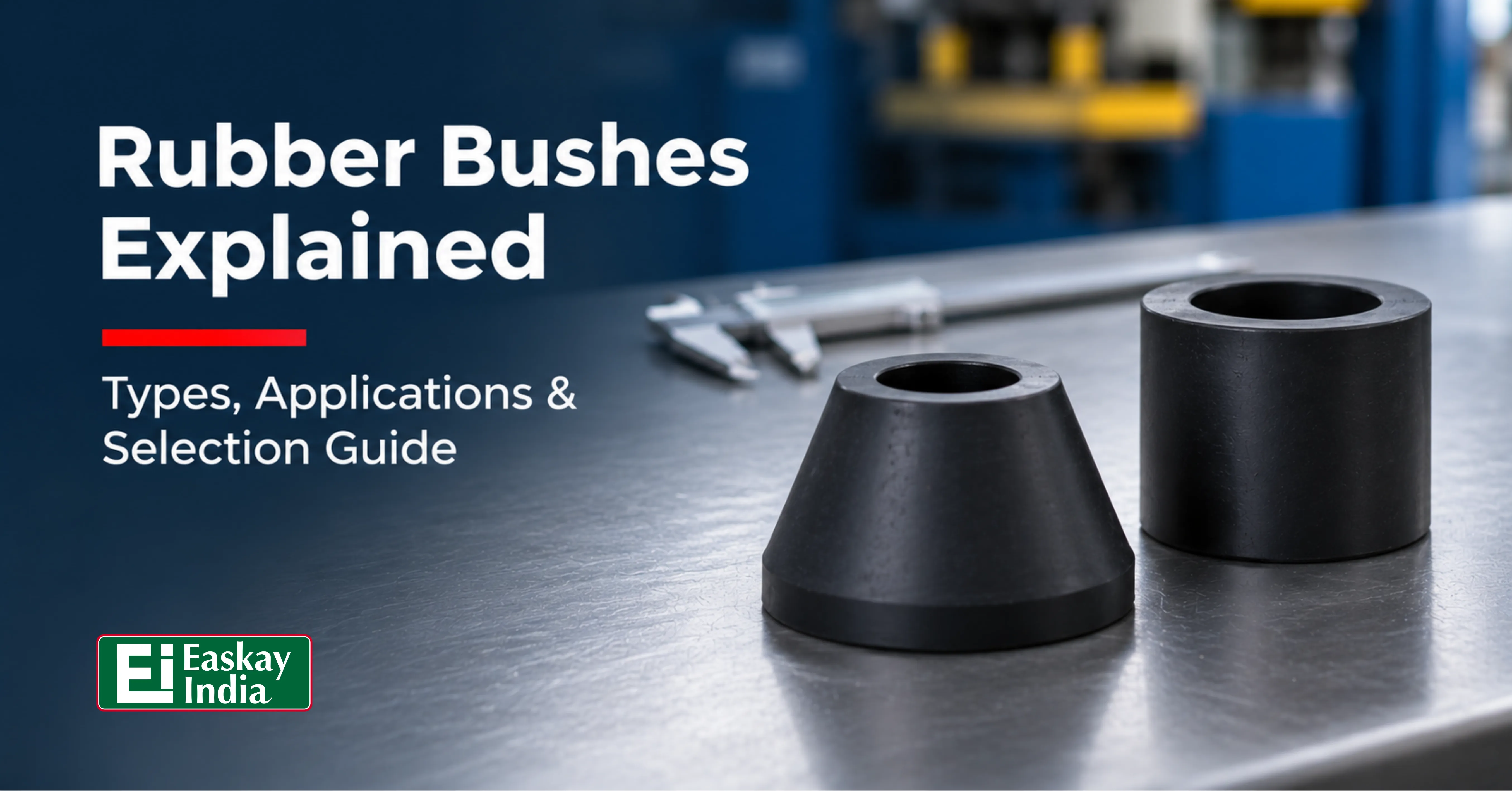
Conical bushes
A bush with a tapered outer profile. The taper gives a defined fit between mating parts, centres the assembly, and allows a controlled amount of movement while cushioning and reducing vibration. Conical rubber bushes are used in suspension and mounting systems, equipment supports, material handling equipment, automotive and mechanical assemblies and agricultural machinery, and can be made with steps, shoulders, grooves or a metal insert where the design calls for them.
Bonded bushes with metal inserts
For higher loads and longer life, the rubber is moulded and bonded to a metal inner sleeve, an outer sleeve, or both. The metal takes the clamping load of the bolt, so the rubber works only in shear and compression, and the bush can be pressed into a housing without the rubber being damaged. This construction is widely used in suspension arms, engine and machinery mounts, and anywhere a bush sees repeated heavy loading.
Vacuum and sealing bushes
Some bushes do a sealing job as well as a supporting one. A rubber vacuum bush sits between mating parts in vacuum equipment, pumps, fluid-handling and electrical equipment, keeping the seal under low pressure while cushioning the assembly and holding its position. Here, compression and wall thickness matter as much as stiffness.
Silicone bushes
Where a bush must work at higher temperatures or stay flexible through wide temperature swings, silicone bushes are used. They are common around heating equipment, electrical assemblies and anywhere a general purpose rubber would harden.
Choosing the Compound
The compound decides how long a bush lasts in its environment. The usual choices:
-
Natural rubber (NR) offers high elasticity, excellent shock absorption and good fatigue life, which makes it the common choice for vibration control and general mounting duty indoors.
-
Nitrile (NBR) is used where the bush will see oil, grease or petroleum-based fluids, such as engine compartments, gearbox mounts, machine tools and hydraulic equipment.
-
EPDM suits outdoor equipment and anywhere exposed to water, weather, ozone and sunlight.
-
Silicone suits higher temperatures and applications where flexibility must be kept across large temperature changes.
-
Other compounds are specified where particular chemical, flame or food contact requirements apply.
Tell the supplier what the bush will touch and how hot it will get. A natural rubber bush that performs well in a clean, cool assembly can swell in oil or crack in sunlight within months.
Hardness and Stiffness
Rubber bush hardness is measured in Shore A, and it is the main lever for stiffness once the compound and shape are fixed. Softer bushes deflect more, isolate vibration better and allow more misalignment, but carry less load and wear faster under heavy use. Harder bushes carry more load with less movement, hold alignment better, and transmit more vibration.
For the same hardness, a thicker wall deflects more than a thin one, and a longer bush carries more load than a short one. That is why hardness alone does not define a bush; it must be read together with the dimensions. Our guide to rubber hardness, elasticity and durability explains what the Shore A number does and does not tell you.
How to Specify a Rubber Bush
When you are working out how to specify a rubber bush, start with a drawing, a sample or a set of dimensions. Whichever you use, these are the points to settle:
-
Dimensions. Inside diameter, outside diameter, length or height, and wall thickness. For conical bushes, the taper angle and the diameters at each end. For flanged bushes, the flange diameter and thickness.
-
Fit. Is the bush pressed into a housing, clamped by a bolt, or a free fit? The fit decides the dimensional tolerance and whether a metal insert is needed.
-
Load and direction. How much load, and whether it acts in compression (squeezing the bush), in shear (sliding the inner and outer surfaces past each other) or in torsion (twisting). The same bush is much stiffer in compression than in shear.
-
Movement. How far and how often the bush must move or deflect. Repeated large movement calls for a compound with good fatigue life and a design that keeps rubber strain within limits.
-
Environment. Oil, water, chemicals, temperature range, sunlight and ozone. This decides the compound.
-
Hardness. Specified with a tolerance, commonly plus or minus 5 Shore A.
-
Construction. Plain rubber, rubber with a metal insert, or rubber bonded to inner and outer sleeves.
-
Quantity and repeatability. State the annual quantity, and ask for the approved specification to be kept on file so repeat lots match the first.
When replacing an existing bush, send the old part along with the drawing if you have one. A worn bush still shows its original profile, hardness range and the way it was loaded, and a manufacturer can read a great deal from it.
Signs a Rubber Bush Needs Replacing
Bushes rarely fail suddenly. They degrade, and the assembly tells you:
-
Knocking or rattling at the joint, as the worn bush allows metal-to-metal contact.
-
Visible cracks in the rubber, especially at the edges and around the bore.
-
Permanent deformation: the bush stays squashed, oval or off-centre when unloaded.
-
Rubber separating from the metal insert on bonded bushes.
-
Oil-soaked, swollen or soft rubber, a sign of the wrong compound for the fluid.
-
Hardened, glazed or crumbling rubber, from heat, ozone or age.
-
Misalignment of the parts the bush connects, or bolts that keep working loose.
Replacing bushes at the first of these signs costs a few rupees. Replacing the shaft, housing or bracket they were protecting costs a great deal more.
Rubber Bushes from Easkay India
Easkay India manufactures moulded rubber bushes for industrial machinery, material handling, automotive and mechanical assemblies, suspension and mounting systems, pumps and general engineering. The range includes conical rubber bushes, rubber vacuum bushes, silicone bushes and custom profiles with steps, shoulders, grooves or metal inserts, in natural rubber, NBR, EPDM, silicone and other specified compounds, with hardness, dimensions and colour as specified.
Bushes are developed from an engineering drawing, CAD model, physical sample or stated dimensions, and approved designs are kept on file for repeat production. Our range also includes PU bushes and PU flanged bushes for applications specified in polyurethane. As an ISO 9001:2015 certified rubber bush manufacturer in India since 1977, we can help you choose the type, compound and hardness for your application. Share your drawing or sample and we will confirm the design and quote.
Frequently Asked Questions
1. What is a rubber bush used for?
A rubber bush sits between two parts, such as a bolt and a bracket or a shaft and a housing, to carry load, allow a controlled amount of movement, absorb shock and stop vibration and noise passing from one part to the other.
2. Which rubber compound should I use for a bush exposed to oil?
Nitrile (NBR) is the usual choice for bushes in contact with oil, grease or petroleum-based fluids. Natural rubber suits clean, indoor vibration control, EPDM suits outdoor and water exposure, and silicone suits higher temperatures.
3. What is a conical rubber bush?
A conical bush has a tapered outer profile that gives a defined fit between mating parts, centres the assembly and allows controlled movement while cushioning and reducing vibration. It is common in suspension and mounting systems and equipment supports.
4. When does a rubber bush need a metal insert?
A metal insert is used where a bolt clamps through the bush, where the bush is pressed into a housing, or where loads are high and repeated. The metal takes the clamping load so the rubber works only in shear and compression.
5. Can Easkay India make rubber bushes to a custom size?
Yes. Rubber bushes are made from a drawing, CAD model, physical sample or specified dimensions, in the compound, hardness, profile and colour your application needs, and the approved specification is kept for repeat orders.
Conclusion
A rubber bush is a small part doing a demanding job, and it only does it well when the type, compound, hardness and dimensions are chosen together for the load, movement and environment. Settle those at the specification stage, check bushes for the early signs of wear, and replace them before the parts around them suffer. If you are specifying a bush for new equipment or replacing a worn one, share the details with our team and we will help you get it right.
Recent Posts