PVC Caps for Industrial Use: Dust Caps, End Caps, Terminal Caps and How to Specify Them
Every plant, workshop and assembly line uses hundreds of small protective caps, and almost nobody thinks about them until a box of the wrong ones arrives. They fall off the fitting in transit. They will not go onto the tube. They split at the corners of a square section. They go brittle on the outdoor rack and crack in a season. The cap cost a rupee and the part it was protecting cost a thousand, and the rupee was the one nobody specified.
PVC caps are the usual answer to a simple need: close an opening, cover an end, or insulate a terminal so that dust, moisture, paint, damage or fingers do not reach what is underneath. They are cheap, flexible, easy to fit and easy to remove, and they come in enough forms that choosing the right one is less obvious than it looks.
This guide covers what industrial PVC caps do, the three main types, how to size them so they grip without splitting, what to specify, and the mistakes that produce the wrong box.
What a PVC Cap Does
A cap is a closure that fits over the outside of something: a tube end, a threaded port, a connector, a terminal, a rod. It is the opposite of a plug, which fits into a bore. Most industrial PVC caps are push-fit, held by the grip of a flexible wall over the part, with no adhesive or fixing.
Within that, caps do several different jobs:
-
Keep contamination out. Dust, swarf, moisture and debris are kept off threads, ports, fittings and openings during storage, transport, handling and assembly.
-
Protect the part. A capped thread does not get nicked; a capped tube end does not get dented; a capped connector does not get bent pins.
-
Insulate. A cap over an electrical terminal keeps accidental contact, moisture and corrosion away from the connection.
-
Finish. An end cap on a tube, rail or profile gives it a closed, clean end on furniture, equipment, fabricated metal and handrails.
-
Identify. Colour-coded caps mark sizes, lines, stages or ownership at a glance.
The same push-fit PVC cap can do several of these at once, which is why a specification should start with what the cap is for.
Why PVC
PVC suits caps because it is flexible enough to stretch over a part and grip it, resists water, many chemicals, oils and UV, insulates electrically, takes colour well and costs little. Most protective caps are moulded in flexible grades that stretch and recover; firmer grades are used where the cap must hold its shape, such as a finishing end cap on a square profile.
PVC also has limits a specification should respect. It softens as temperature rises, so caps that will sit in hot environments, go through paint-curing ovens or sit on hot parts need the temperature stated, and for high-temperature masking during painting and powder coating the usual answer is silicone masking, which is made for that duty. Some solvents attack PVC. And a push-fit cap is a protective closure, not a pressure seal; it keeps dirt out, it does not hold fluid in.
The Three Main Types
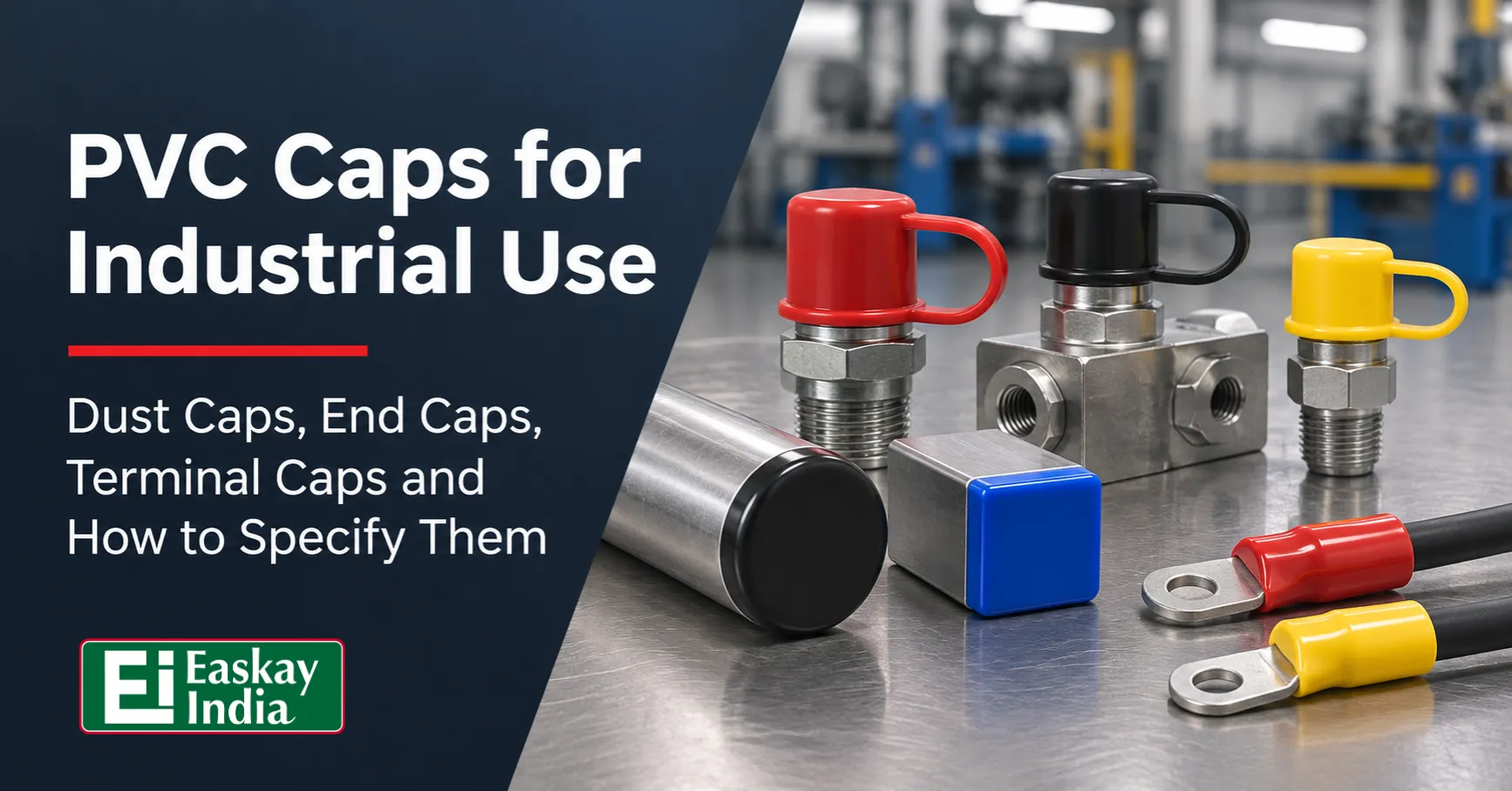
PVC dust caps
PVC dust caps cover exposed ports, fittings, connectors, valve openings and tube ends. They are the caps you find on hydraulic fittings when they arrive, on pneumatic ports before assembly, and on connectors in storage.
The fit depends on the internal diameter, the depth and the wall section, and on any retention features moulded into the inside: ribs, gripping rings or a retaining section that holds the cap on against vibration in transit. Caps that are removed and refitted often are made with a pull tab, with its length and position set at the development stage. PVC dust caps are made to the internal diameter, depth and wall thickness of the fitting, with plain or custom external profiles that clear surrounding components.
PVC end caps
PVC end caps close the open ends of tubes, pipes, rods, metal profiles and fabricated sections. They are made in round, square, rectangular and custom profiles, sized to the section they cover, and they do two jobs at once: they keep dust and moisture out of the hollow section, and they give the end a finished look on furniture, equipment frames, handrails and fabricated metal.
Because end caps are often visible, the external profile matters: a flush, square-cornered cap on a square tube, a domed cap on a round rail, a cap whose colour matches the finish. PVC end caps are made to the internal dimensions of the section, with an internal gripping profile that holds without adhesive, and a customised outer profile for a flush fit.
PVC terminal caps
PVC terminal caps cover electrical terminals, connection points and exposed conductor ends on panels, control gear, wiring assemblies, battery connections and machinery. They keep dust and moisture off the connection, reduce the risk of accidental contact, and colour-code terminals where that is useful.
Terminal caps are shaped to the terminal: a lug, a stud, a ring terminal, a battery post. The fitment follows the size, and the opening, wall thickness and shape are customised to the connection. PVC terminal caps are made from a drawing or a sample of the terminal, in the colour the panel standard calls for. Where the application has an electrical rating requirement, it should be stated so that the material specification can be checked against it.
Custom PVC caps
Many caps do not fall neatly into those three. A cap with extended side walls to cover a step, a cap with a custom external shape to clear a neighbouring component, a cap with a retaining feature for a vibrating assembly, a cap for an odd-shaped casting. These are developed as custom PVC caps from a drawing, a sample or the dimensions of the part, in round, square, rectangular or custom shapes.
Sizing a Cap So It Grips Without Splitting
Most wrong caps are wrong by a millimetre. The rules for getting the size right:
Measure the part, not the nominal. A "half-inch" fitting, a "25 mm" tube and an "M12" thread each have an actual outside dimension, and the cap fits that dimension, not the name. Measure the outside diameter or the outside dimensions of the section with a vernier, at the point where the cap will sit.
The cap's internal dimension is slightly smaller than the part. A push-fit cap grips because its wall is stretched a little over the part. Too little interference and the cap falls off in the box; too much and it is hard to fit, splits at the mouth, or works its way off as the stretched wall relaxes. The supplier sets the interference from the part dimension and the wall thickness; give the part dimension and say how firmly the cap must hold.
Depth matters. A cap that is too shallow does not cover the thread or the feature it is meant to protect; one that is too deep bottoms out before it seats, or fouls a shoulder. Specify the depth from the end of the part to where the cap must stop.
Square and rectangular sections need the corner radius. A square tube has rounded corners, and a cap moulded with sharp internal corners will not seat and will split at the corners. Give the outside dimensions and the corner radius, or send a short offcut of the section.
Wall thickness sets the grip and the look. Thin walls stretch easily, grip lightly and suit caps that are fitted and removed often. Thicker walls grip harder, hold their shape, and give a finished end cap its solid look.
Send a sample. A fitting, an offcut of tube, a terminal. A supplier can size a cap from a physical part faster and more accurately than from a description, and it removes the nominal-size problem entirely.
What to Specify
For the enquiry, the drawing or the purchase order:
-
What the cap is for: dust protection, end closure, terminal insulation, finishing, colour coding, or a combination
-
The part it fits: outside dimensions or diameter measured at the cap position, corner radius for square and rectangular sections, thread or feature to be covered
-
Depth: how far the cap must go onto the part, and anything it must clear
-
Wall thickness, or the grip required: light push-fit, firm, or retained against vibration
-
Retention and removal features: internal ribs or gripping sections, pull tab (with position), extended side walls
-
External profile: plain, flush, domed, or shaped to clear a neighbouring part
-
Colour, by reference or sample, and whether it must match a finish or a colour code
-
Environment: outdoor and UV, temperature, oils or solvents, electrical requirement for terminal caps
-
Quantity, trial samples before production, and whether the cap will be a repeat item
A supplier of custom PVC components can develop the cap from a drawing, a physical sample or stated dimensions, and once a sample is approved the specification should be held on file so that every reorder matches.
Mistakes That Produce the Wrong Box
Ordering by nominal size. The most common. A cap for a "25 mm tube" is made to whatever 25 mm means to the person reading the order. Measure the part.
Forgetting the depth. The cap arrives, fits the diameter, and covers half the thread.
Sharp corners on a square cap. It splits on fitting, or sits proud on the corners.
No pull tab on a cap that is removed daily. Operators pry it off with a screwdriver, and the cap, and sometimes the part, is damaged.
Using a dust cap as a seal. A push-fit cap keeps dirt out. It does not hold oil in or pressure back. A fitting that must be sealed in storage needs a threaded or sealing closure.
Ignoring the environment. Caps on an outdoor rack fade and go brittle unless the grade is UV-stabilised; caps on a hot part soften; caps near solvents swell. Say where the cap will live.
Changing the part and not the cap. A new tube supplier, a new thread standard, a new terminal lug, and the caps in stock no longer fit. When the part changes, the cap specification changes with it.
Signs a Cap Needs Replacing
Protective caps are often reused, and they do wear out. Replace a cap when it has split at the mouth or at a corner, when it has gone brittle, faded or chalky from sunlight, when it has stretched and no longer grips, when the pull tab has torn off, or when it has swollen or gone tacky from oil or solvent. A cap that falls off on its own is not protecting anything, and a box of parts that arrives with half the caps missing has been shipped without protection.
PVC Caps from Easkay India
Easkay India manufactures moulded PVC caps, PVC dust caps, PVC end caps and PVC terminal caps for industrial, electrical, fabrication, furniture and equipment applications, in round, square, rectangular and custom shapes, to the internal dimensions, depth, wall thickness and colour the part calls for, with push-fit retention, internal gripping features, pull tabs and custom external profiles where the application needs them.
Caps are developed from a drawing, a physical sample or stated dimensions, with tooling built around the profile for regular volumes and trial quantities available before production, and the approved specification is kept on file for repeat orders. Related products include PVC moulded components, dip PVC components for coated handles and formed ends, and silicone masking for high-temperature painting and coating. As an ISO 9001:2015 certified PVC cap manufacturer in India since 1977, we can size a cap from the part in your hand. Send us the part dimensions, a sample or a drawing and we will confirm the specification and quote.
Frequently Asked Questions
1. What is the difference between a PVC cap and a PVC plug?
A cap fits over the outside of a part, such as a tube end, a thread or a terminal, and grips its outer surface. A plug fits into a bore or an opening and grips the inside. Both protect the part; which one is used depends on whether the outside or the inside of the part is accessible and needs covering.
2. How do I measure a part for a PVC cap?
Measure the actual outside diameter, or the outside dimensions and corner radius of a square or rectangular section, at the point where the cap will sit, and the depth the cap must cover. Do not use the nominal size. Sending a sample of the part is the most reliable way to get the right fit.
3. Can PVC caps be used outdoors or at high temperature?
PVC caps resist water and UV well and suit outdoor use when a UV-stabilised grade is specified. PVC softens as temperature rises, so caps for hot environments or paint and powder-coating ovens should have the temperature stated; for high-temperature masking, silicone masking parts are usually the right choice.
4. Are PVC terminal caps electrically insulating?
PVC is an electrical insulator and PVC terminal caps are used to cover terminals and connections against dust, moisture and accidental contact. Where the application has a specific electrical rating or standard requirement, state it at the enquiry stage so that the material specification can be chosen and checked against it.
5. Does Easkay India make PVC caps in custom sizes and colours?
Yes. Caps are made to the internal dimensions, depth, wall thickness, shape and colour the part calls for, from a drawing, a sample or stated dimensions, with retention features, pull tabs and custom external profiles where needed, in trial and production quantities.
Conclusion
A PVC cap is the cheapest protection a part will ever get, and specifying it well takes five minutes: say what the cap is for, measure the part rather than trusting the nominal size, give the depth and the corner radius, choose the wall and the retention for how firmly it must hold, and state the colour and the environment. Do that once, keep the approved sample on file, and the right box arrives every time. If you have a fitting, a tube or a terminal that needs covering, send us the part and we will size the cap to it.
Recent Posts