Polyurethane Bushes: Types, Hardness, Applications and How to Specify a PU Bush
A bush is one of the oldest ideas in machinery: a sleeve that sits between a shaft or bolt and the housing around it, so that the two can move, align, cushion or wear against something other than each other. Bushes are made in bronze, steel, plastic and rubber, and each has duties it suits. Over the last few decades a fourth family has taken a large share of the cushioning, wear and load-bearing work: the polyurethane bush.
A PU bush is chosen where the duty asks for more than one thing at once. It needs to carry a high load without squashing, resist abrasion where it rubs, shrug off oil, hold a tight bore, and still give a little under shock. Polyurethane does that combination well, which is why PU bushes have spread from automotive suspension and shock-mount assemblies into material handling equipment, machinery mounts, conveyors, rotating equipment and general engineering assemblies.
This guide covers what a polyurethane bush is, the types made, how hardness is chosen, where PU bushes are used, what to specify, how to fit them, and the signs that a bush has reached the end of its life.
What a Polyurethane Bush Is
Polyurethane is an elastomer: it stretches and recovers like rubber. Unlike most rubbers, it also has very high tear strength, abrasion resistance and load-bearing capacity, and it can be made across a wide hardness range, from soft grades to grades that feel more like a hard plastic. A PU bush takes advantage of all of that in a simple sleeve.
The bush is either moulded, by casting the polyurethane into a mould to the required inside diameter, outside diameter and length, or machined from cast stock, or moulded and then machined where the tolerances are tighter than moulding alone can hold. Because polyurethane machines cleanly, bores and outside diameters can be held closer than on most rubber parts, which matters for bushes that must locate accurately.
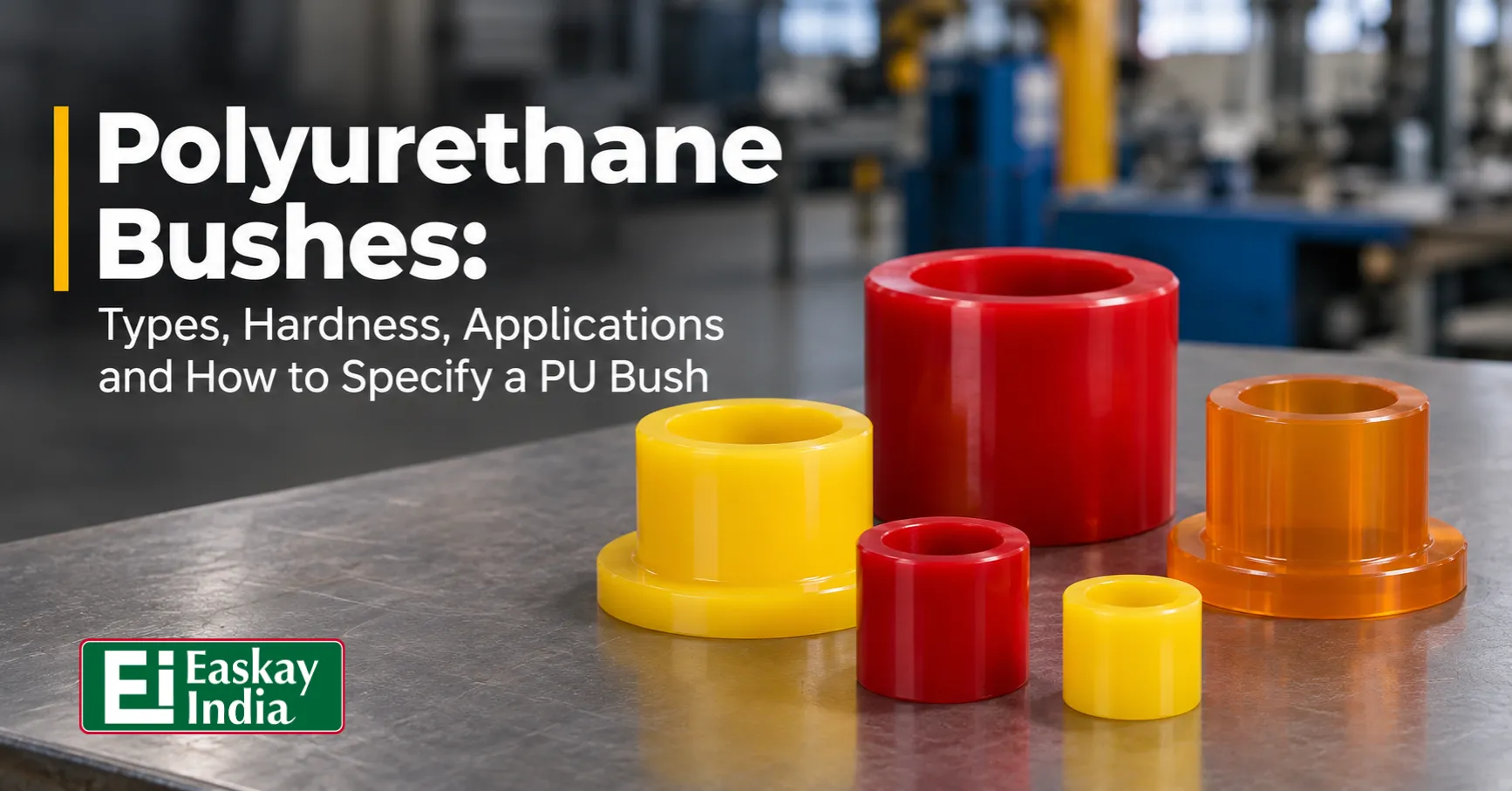
Polyurethane bushes are usually made in bright colours, red, green, yellow and orange being common, which has a practical use on the shop floor: different hardnesses can be colour-coded so that a 70 Shore A bush is never fitted where a 90 Shore A bush was specified.
Types of PU Bushes
Plain cylindrical bushes. A straight sleeve with a specified bore, outside diameter and length. The standard form for sleeves, guides, spacers, pivots and wear bushes, pressed into a housing or fitted over a pin.
Flanged bushes. A cylindrical bush with an integral flange at one end. The flange sits against the housing face and does two jobs: it stops the bush being pushed through the housing under axial load, and it provides a bearing face between the housing and whatever sits against it. A PU flanged bush is the usual choice in suspension, mounting and pivot assemblies where the bush must take load along the pin as well as across it. PU flanged bushes are made to a specified bore, body OD, flange OD and flange thickness.
Profiled bushes. Bushes with grooves, shoulders, steps, chamfers or tapers moulded or machined in, to locate in a housing, retain a circlip, carry a seal, or control where the bush deflects. Developed from a drawing or a sample.
Bushes with inserts. For some mounting duties the bush is moulded onto or around a metal sleeve, so that the metal takes the bolt load and the polyurethane does the cushioning. Specify this on the drawing if the assembly needs it.
Machined bushes. For one-offs, trials, prototypes and tight tolerances, bushes are machined from cast polyurethane rod or tube rather than moulded. This avoids tooling for small quantities and holds dimensions that moulding alone cannot.
Choosing the Hardness
Hardness decides whether a bush cushions, carries or wears. PU bush hardness is specified in Shore A, and most industrial bushes sit between 60 and 95 Shore A, with harder grades available where the duty calls for them.
60 to 70 Shore A. Soft enough to isolate vibration and absorb shock. Used for mounting bushes, anti-vibration bushes and cushioning sleeves where some movement is wanted. These grades deflect noticeably under load and should not be used where the bush must locate a shaft accurately.
75 to 85 Shore A. The general-purpose band. Firm enough to carry load and hold alignment, with enough give to absorb shock and seat against a pin. Used for suspension bushes, pivot bushes, machinery mounting bushes and most material handling duties.
90 to 95 Shore A. Firm, low-deflection grades for wear sleeves, guide bushes, heavy-load bushes and anywhere the bush must stay round under load. These feel closer to a hard plastic than to rubber, but still resist cracking and chipping under impact.
A bush that is too soft for its load deflects, lets the shaft move, and wears quickly at the loaded side. One that is too hard transmits shock and may crack a housing or loosen a bolt. Our guide to polyurethane hardness explains the Shore A and Shore D scales and how to choose a grade for load, impact and wear.
Where PU Bushes Are Used
Automotive assemblies. Suspension bushes, shock-mount bushes, stabiliser bar bushes, pivot bushes and cushioning sleeves where the bush must carry load, control movement and resist oil and road grit.
Machinery mounts and rotating equipment. Mounting bushes that isolate bolts and brackets from vibration, and sleeves that carry rotating or oscillating pins.
Material handling equipment. Bushes in trolleys, carts, conveyors, lifting equipment and pallet handling, as cushioning and protective interfaces between moving assemblies, and as wear bushes on pivots and guides.
Engineering assemblies. Spacer and alignment bushes where accurate fit and controlled movement are needed, guide bushes on sliding and reciprocating parts, and bushes that carry a seal or locate a component.
Wear and contact duties. Sleeves on pins, posts and guides that rub against metal, where a polyurethane bush wears slowly and protects the mating part.
When the Duty Calls for Polyurethane
Every bush material has its place, and the choice is made by the duty, not by preference. A PU bush is usually chosen when one or more of the following apply:
-
High load for the size. Polyurethane carries more load per unit area than most rubbers without taking a permanent set, so a PU bush can be smaller, or last longer at the same size.
-
Abrasion. Where the bush rubs against a pin, a guide or a housing, or where grit and dust get into the joint, polyurethane's wear resistance keeps the bore round for longer.
-
Oil and grease. Polyurethane resists mineral oils, greases and many fuels, so it suits bushes in lubricated or oily assemblies.
-
Tear and cut resistance. Bushes with thin walls, sharp loading or impact benefit from polyurethane's very high tear strength.
-
Tighter tolerances. Because PU bushes can be machined, bores and outside diameters can be held closer than on moulded rubber parts.
-
A specific hardness in the 60 to 95 Shore A range, colour-coded for identification.
A rubber bush is the right choice for other duties: where a softer grade and higher damping are wanted for vibration isolation, where the operating temperature is higher than polyurethane is rated for, where the bush sits in hot water or steam, or where a specific rubber compound is called for by the fluid. Many assemblies use both, a rubber bush where isolation matters and a PU bush where load and wear matter, and a supplier who makes both will recommend by the duty rather than the material.
Dimensions, Fit and Tolerances
A bush drawing needs four dimensions and a note on fit.
Bore (ID). The diameter the pin or shaft runs in. Specify whether it is a clearance fit, where the pin rotates or slides freely, or an interference fit, where the bush grips the pin.
Outside diameter (OD). The diameter that sits in the housing. Most PU bushes are pressed into the housing with an interference, so that the bush is held by the housing and does not rotate in it. Specify the housing bore and the interference wanted, or let the supplier set the OD from the housing bore.
Length. The overall length, and for flanged bushes the body length under the flange, the flange diameter and the flange thickness.
Wall thickness. The difference between OD and bore, which sets how much the bush can deflect. Thin walls locate accurately and deflect little; thick walls cushion and isolate.
Two things change when a PU bush is pressed in. The bore closes up slightly as the OD is compressed, so a bush that must run a pin at a precise clearance is specified with the bore after fitting, not before. And a soft bush pressed in with too much interference bulges at the ends and can be pushed out under load. Tell the supplier the housing bore and the pin diameter, and the bush will be sized to work between them.
Tolerances should follow a standard for elastomer parts where the bush is moulded, and can be tighter where it is machined. Mark the functional surfaces on the drawing, usually the bore and the OD, so that tolerance and inspection effort go where they matter.
Environment and Service Conditions
Oil, grease and fuel. Polyurethane generally resists these well, which is one of the main reasons it is chosen for bushes.
Water and humidity. Some polyurethane grades soften over time in continuous hot water, steam or very humid conditions. If the bush will sit in water, outdoors in the wet, or in a washdown area, say so, and the supplier will choose a grade suited to it.
Temperature. Polyurethane bushes are used across normal industrial temperatures. Where the bush runs continuously hot, near an engine, a dryer or a hot process, give the temperature at the bush, not the ambient, so that the grade can be checked against it.
Load and speed. State the load on the bush and whether the pin rotates, oscillates or slides, and how fast. Continuous high-speed rotation generates heat in a polyurethane bush; oscillation and slow rotation do not.
Chemicals and sunlight. Polyurethane resists most dilute chemicals and sunlight well; strong acids, alkalis and some solvents need a grade check.
Fitting a PU Bush
-
Chamfer the housing and the bush. A lead-in chamfer on both lets the bush press in squarely without shaving the OD.
-
Press, do not hammer. Use an arbor press or a bolt-and-washer puller so that the bush goes in straight. A hammered bush goes in crooked and the bore ends up out of line with the pin.
-
Light lubricant on the OD. A smear of a compatible lubricant or soapy water eases the press fit; do not use oils that the grade is not rated for.
-
Check the bore after fitting. The bore closes up on pressing. Check the pin fits as intended, and tell the supplier if it does not; the next batch can be sized for it.
-
Align the pin. A bush cannot correct a pin that is out of line with the housing. Misalignment loads one side of the bush and wears it oval.
-
Flange against the face. On a flanged bush, make sure the flange seats flat against the housing face and the load that it is meant to take actually goes through it.
Signs a PU Bush Needs Replacing
-
Bore worn oval or enlarged, so that the pin rattles or the assembly has play
-
Bush pushed out of the housing or walked along the pin, which points to too little interference or too much axial load for a plain bush where a flanged bush was needed
-
Cracked or chipped flange from axial loads beyond the grade's capacity
-
Softened, tacky or crumbling polyurethane, usually from prolonged hot water or humidity on a grade not suited to it
-
Extruded or bulged ends, from a bush too soft for the load or pressed in with too much interference
-
Glazed, hardened or cracked surface from heat above the grade's rating
Replace bushes in a pair or a set, so that a pivot or a mounting runs on bushes of the same age, grade and bore.
How to Specify a PU Bush
For the enquiry, the drawing or the purchase order:
-
Type: plain cylindrical, flanged, profiled, with insert, moulded or machined
-
Bore, outside diameter and length, with the housing bore and pin diameter if the bush is to be sized for a fit
-
For flanged bushes: flange OD and flange thickness
-
Hardness in Shore A with a tolerance, and the colour if it is used for identification
-
Load on the bush and the movement: rotating, oscillating, sliding or static, and the speed
-
Environment: oil, water or humidity, temperature at the bush, chemicals, outdoor exposure
-
Tolerances on the functional surfaces, and whether machining is required to hold them
-
Quantity, trial samples wanted, and whether the part will be a repeat item
Send a drawing, a CAD model, a physical sample or the dimensions, and a manufacturer of custom PU components can develop the bush from any of them, with the approved specification held on file so that repeat orders match the first.
PU Bushes from Easkay India
Easkay India manufactures polyurethane bushes and PU flanged bushes for automotive assemblies, industrial machinery, material handling equipment, machinery mounts, conveyors, rotating equipment and engineering assemblies, in Shore A 60 to 95 with other hardnesses on request, in red, green, yellow, orange and other specified colours. Bushes are made as cylindrical and custom-profile sleeves with grooves, shoulders and flanges, moulded, machined, or moulded and then machined where tighter tolerances are needed, to the bore, OD and length on your drawing.
Parts are developed from a drawing, CAD model, physical sample or stated dimensions, in trial and production quantities, with dimensional and visual inspection and repeat production against the approved specification. Related products include PU washers, PU pads, PU rollers and PU moulded components, and rubber bushes where the duty calls for them. As an ISO 9001:2015 certified PU bush manufacturer in India since 1977, we can help you match hardness, dimensions and fit to the load on the bush. Share the drawing, the housing and pin sizes and the operating conditions and we will confirm the specification and quote.
Frequently Asked Questions
1. What is a PU bush used for?
A polyurethane bush is a sleeve fitted between a pin or shaft and a housing to cushion, isolate vibration, carry load, locate a component or protect the mating parts from wear. It is used in automotive suspension and shock-mount assemblies, machinery mounts, material handling equipment, conveyors, rotating equipment and engineering assemblies.
2. What hardness should a polyurethane bush be?
Most PU bushes are between 60 and 95 Shore A. Softer grades, 60 to 70, cushion and isolate; the general-purpose band, 75 to 85, carries load while absorbing shock; firm grades, 90 to 95, suit wear sleeves, guide bushes and heavy loads where the bush must stay round. Choose by the load and whether the bush must locate accurately.
3. When is a PU bush the right choice, and when is a rubber bush?
A PU bush is chosen where the duty needs high load capacity, abrasion resistance, oil resistance, high tear strength or tighter tolerances. A rubber bush is chosen where a softer grade and higher damping are wanted for vibration isolation, at higher temperatures, in hot water or steam, or where a specific rubber compound suits the fluid. Many assemblies use both.
4. Why is the bore of a PU bush smaller after fitting?
When a bush is pressed into a housing with an interference fit, the outside diameter is compressed and the bore closes up slightly. Bushes that must run a pin at a precise clearance are specified with the bore after fitting, or sized by the supplier from the housing bore and pin diameter.
5. Does Easkay India make PU bushes to a custom size?
Yes. PU bushes and flanged bushes are made to the bore, OD, length, flange dimensions and hardness on your drawing or sample, moulded or machined, in trial and production quantities, with the approved specification kept on file for repeat orders.
Conclusion
A polyurethane bush is a sleeve that carries load, resists wear and still gives a little under shock, and specifying one means matching the hardness to the load, the dimensions to the housing and pin, and the grade to the environment. Choose the type for the axial load, chamfer and press it in straight, check the bore after fitting, and replace bushes as a set when the bore goes oval or the ends extrude. If you have a bush that wears out early, a pivot with play, or a new assembly to design, share the drawing and the duty with our team and we will specify a PU bush that fits and lasts.
Recent Posts