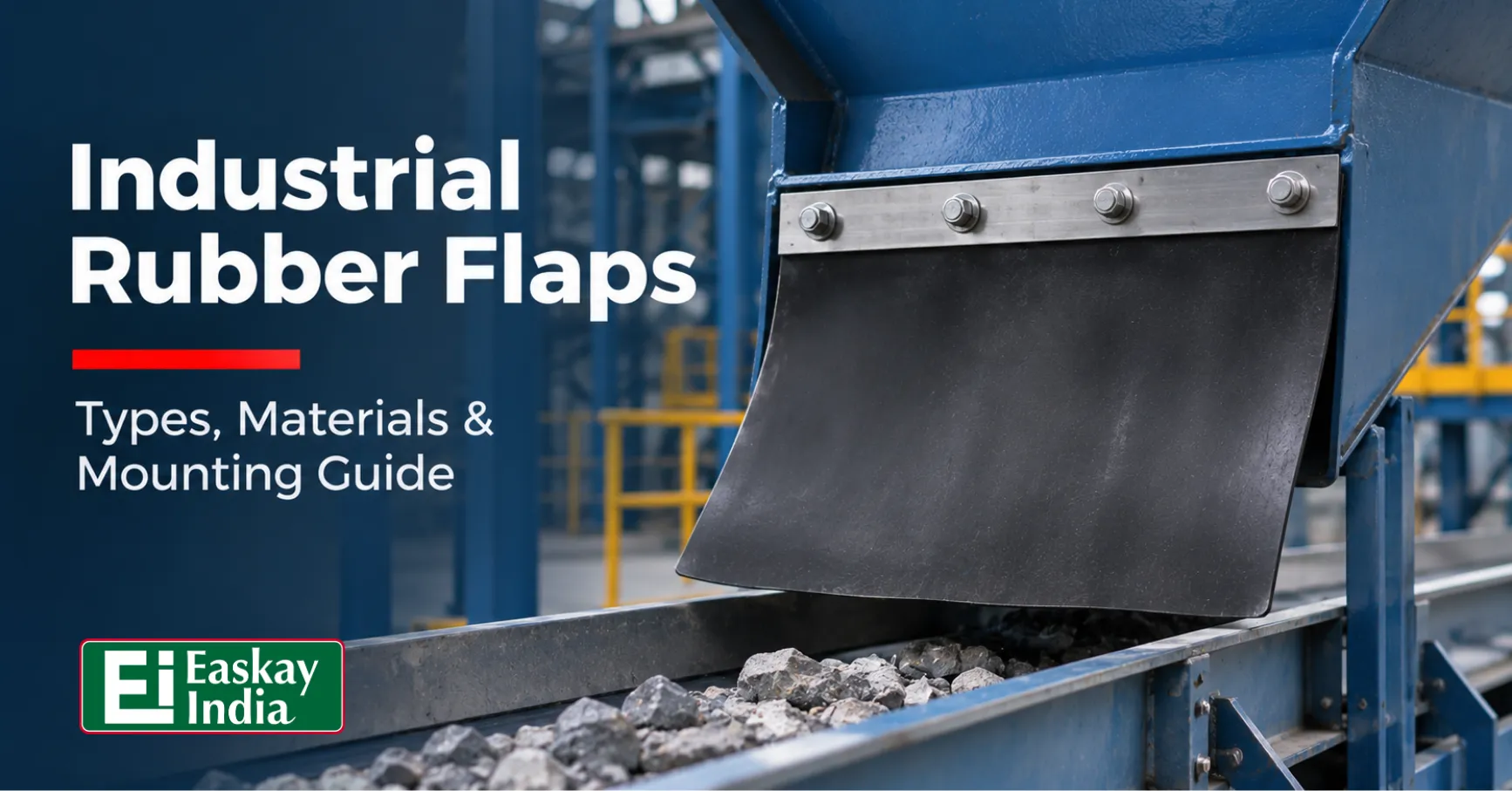
Rubber Flaps for Industrial Equipment: Types, Materials, Mounting and How to Specify Them
Walk along any conveyor, past any hopper discharge, or up to any machine guard with a gap in it, and you will find a strip of rubber hanging there, doing a job nobody specified very carefully. It stops dust escaping at a chute inlet. It lets material fall through a discharge opening and closes behind it. It covers the gap between a guard and a moving part. It cushions a door that would otherwise bang shut.
That strip is a rubber flap, and it is one of the most useful and least considered components in a plant. Because it looks simple, it is usually bought by size alone: “flap, 6 mm, black”. Then it folds under the material load, or stiffens in the cold and stops sealing, or peels off the surface it was stuck to, and someone is cutting a replacement from whatever sheet is lying in the store.
This guide is for maintenance engineers, OEM designers and purchase teams who want the flap to work the first time. It covers what a rubber flap actually does, where industrial rubber flaps are used, the types available, how to choose material, thickness and hardness, the mounting options including Self-adhesive rubber flaps, the installation mistakes that cause early failure, and what to put on the purchase order.
What a Rubber Flap Does
A rubber flap is a flexible barrier. Unlike a gasket, which is clamped between two fixed surfaces, a flap has one edge fixed and the rest free to move. That free edge is the whole point. It allows the flap to:
-
Seal a gap that changes or moves. A belt that flexes, a door that opens, a chute mouth that passes lumps of different sizes. A rigid plate cannot follow these; a flap can.
-
Let material through in one direction. A discharge flap lifts under the weight or flow of material and drops back when the flow stops, which limits dust and spillage without blocking the opening.
-
Contain dust and spillage. Hanging flaps at a transfer point form a curtain that slows air and knocks down airborne fines.
-
Guard and cover. A flap over a gap in a guard or enclosure keeps fingers, tools and debris out while allowing access or movement.
-
Cushion and protect. A flap on a door edge, a stop or a landing surface absorbs impact and protects the equipment behind it.
In every one of these cases the flap is working as a spring. Its thickness, hardness and free length decide how much it bends under a given load, and that is what selection comes down to.
Where Industrial Rubber Flaps Are Used
Conveyors and transfer points. Dust curtains at chute inlets and outlets, flaps at the head and tail of enclosed sections, and rubber flaps for conveyors that close the gap between a chute and the belt where a fixed skirting rubber strip would be too rigid.
Loading and discharge systems. Check flaps on hopper and silo discharge points, flaps on truck and wagon loading spouts, and flexible closures on bagging and filling equipment.
Equipment covers and guards. Flaps over gaps in machine guards, around moving arms and shafts, and at access points where a solid cover would obstruct operation.
Panels, enclosures and doors. Flaps that fill the gap under a door or between panels, protect cable entries, and act as weather or dust seals on access covers.
Mining, aggregate and cement equipment. Flaps on crushers, screens, feeders and dust extraction hoods, where the material is abrasive and the duty is heavy.
General engineering. Edge protection on trolleys and fixtures, cushioning on stops and landing points, and flexible barriers on process equipment.
Types of Rubber Flaps
Rubber flaps are made in a handful of forms, and the choice between them depends on how the flap is fixed and what it has to do.
Plain flat flaps. A rectangle of rubber cut from sheet or moulded to size, fixed along one edge by a clamp bar or bolts. The simplest form and the right one for most dust curtains, guard covers and discharge closures. Available in any thickness and hardness the duty needs.
Moulded and profiled flaps. Flaps moulded to a specific shape: a thickened or stepped clamping edge that resists tearing at the fixings, a tapered free edge that seals more gently, pre-formed holes or slots, curved or angled profiles that follow a chute or guard. These are developed from a drawing or a sample and are the answer when a plain strip does not fit the geometry.
Slotted or strip curtains. A wide flap cut into vertical strips so that lumps can pass through while the strips fall back together behind them. Used at chute mouths and transfer points where a solid flap would be pushed open and stay open.
Self-adhesive rubber flaps. A moulded strip with an adhesive backing on one side, supplied as rolls, strips or cut lengths. Fixed directly to a clean surface without fasteners, which makes them quick to fit on panels, enclosure edges, door frames and light covers. Self-adhesive rubber flaps are the usual choice where drilling is not possible or where the flap will be replaced often.
Flaps with mounting features. Flaps with bonded or moulded-in reinforcement at the clamping edge, eyelets, or metal strips, for heavy duties where the fixing edge carries a high load.
Choosing the Material
The compound decides how long the flap lasts in its environment. Three cover most industrial duties:
Natural rubber (NR). High elasticity, good flexibility and good abrasion resistance, which makes it the usual choice for flaps that are flexed constantly or that take impact from material. Suited to dry, indoor duty and to abrasive but non-oily materials.
Nitrile (NBR). Chosen where the flap meets oil, grease, fuel or petroleum-based materials, on machinery, in workshops and around lubricated equipment.
EPDM. Chosen for outdoor flaps, wet areas and anywhere exposed to sunlight, ozone and weather, where natural rubber would crack over time.
Other compounds, including silicone for high temperature and specialised grades for chemical exposure, are used where the duty calls for them. Tell the supplier what the flap will touch, how hot it will run and whether it is indoors or out, and the compound follows.
Choosing Thickness, Hardness and Size
Because a flap is a spring, three dimensions set its behaviour.
Thickness. Thicker flaps are stiffer, resist folding under a material load and last longer against abrasion. Thinner flaps are more flexible, seal more closely against uneven surfaces and are easier to fix with adhesive. For dust curtains and light guards, a few millimetres is often enough; for discharge flaps and heavy transfer points, thicker sections are needed to resist the weight of material. If a flap is folding or flapping open in service, it is too thin for its free length; if it is not sealing, it is too thick or too hard.
Hardness. Hardness, in Shore A, sets stiffness for a given thickness. Softer grades conform and seal; firmer grades hold shape and resist cutting. Most flaps sit in the medium range, with softer grades for sealing duties and firmer grades for abrasive, lumpy material. Our guide to rubber hardness, elasticity and durability explains what the Shore A number means in practice and how to specify it with a tolerance.
Free length and overlap. The free length is the part of the flap beyond the clamp. Longer free lengths flex more and seal lower, but fold more easily. Specify the free length to the surface the flap must reach, plus a small overlap so that the flap presses against it rather than hanging just short. For discharge flaps, specify the overlap on each side of the opening so that the flap seats on the frame when closed.
Width. Specify the full width to be covered, plus the overlap with adjacent flaps or structure, so that there are no gaps at the ends.
Mounting Methods
How a flap is fixed decides how it is made, so settle it before ordering.
Clamp bar. A metal strip bolted through the flap’s fixed edge, spreading the load along its length. The most common method for conveyor and chute flaps, and the one that holds heavy flaps securely. The flap needs enough clamping edge, usually a plain margin, and may need a thickened edge for heavy duties.
Bolting. Bolts through pre-punched or moulded holes directly into the structure. Suitable for lighter flaps and for flaps that are removed often. Holes should be specified on the drawing, with washers to spread the load.
Slot fitting. The flap’s edge slides into a channel or slot in the structure. Used on guards and covers where a clean, fastener-free appearance is wanted. The edge is often profiled to lock into the slot.
Adhesive backing. A self-adhesive flap is pressed onto a clean, dry, smooth surface. Quick, with no drilling, and ideal for panels, frames and enclosures. The adhesive must be chosen for the surface, the temperature and the holding strength required, and the flap must be light enough and the duty gentle enough for the adhesive to carry it. Adhesive flaps are not the answer for heavy flaps, oily surfaces or constant high-load flexing, where a clamp bar is the right method.
Installation Mistakes That Cause Early Failure
A correctly specified flap fails early for one of a few reasons, and they are all avoidable.
1. Fitting against the flow. A discharge or transfer flap must hang so that material pushes it open in the direction of travel and gravity closes it. Fitted the wrong way, it is forced back against its fixings and tears at the clamp.
2. Too much free length. A flap that hangs well past its sealing surface folds under load, traps material behind it and wears on the fold. Trim or specify the free length to the surface plus a small overlap.
3. Uneven clamping. A bent clamp bar or unevenly tightened bolts press hard in some places and lift in others. The lifted sections leak and the pressed sections tear. Fit the bar straight, tighten evenly and re-check after the first days of running.
4. No reinforcement at the fixings. Thin flaps bolted directly without a clamp bar or washers tear at the holes. Use a clamp bar or large washers, and specify a thickened clamping edge on heavy flaps.
5. Adhesive on a dirty or cold surface. Self-adhesive flaps fitted to a dusty, oily, wet or cold surface peel off within days. Clean and degrease the surface, fit at a moderate temperature, press firmly along the full length and allow the adhesive to set before loading the flap.
6. Wrong compound for the environment. Natural rubber outdoors or in oil, or a general grade in heat, hardens or swells. Match the compound to the environment, not to what is in the store.
7. Ignoring the structure around the flap. On conveyors, a flap or skirting strip cannot seal against a belt that sags between idlers or a chute whose wear liner has gone. Support the belt, with closer idler spacing or impact rubber rings for idler rollers, and fix the liner before fitting new rubber. Our conveyor skirting rubber selection guide covers this in more depth.
Signs a Flap Needs Replacing
-
The free edge is worn thin, ragged or torn, and no longer reaches the sealing surface
-
Cracks along the fold line or at the fixings
-
Hardened, glazed or crumbling rubber from heat, sunlight or age
-
Swollen or soft rubber from oil or chemical exposure, which means the compound is wrong for the duty
-
A self-adhesive flap lifting at the ends or along the edge
-
Dust or spillage returning at a point that was clean when the flap was new
Replace flaps in a transfer point or curtain as a set, so that they hang evenly and wear together.
How to Specify a Rubber Flap
For the enquiry, the drawing or the purchase order:
-
Application and what the flap does: dust curtain, discharge closure, guard cover, door seal, cushion
-
Compound: natural rubber, NBR, EPDM or other, with the environment stated (oil, outdoor, temperature, abrasive material)
-
Thickness in millimetres
-
Hardness in Shore A with a tolerance
-
Width and total length, including free length and overlap
-
Shape: plain flat, profiled, slotted, or custom, with a drawing or sample for profiled parts
-
Mounting: clamp bar, bolting (with hole positions and sizes), slot fitting or adhesive backing
-
For adhesive flaps: the mounting surface, its condition and the operating temperature
-
Quantity, and whether the part will be a repeat item
A supplier of custom industrial rubber components can develop the flap from a drawing, a CAD model, a physical sample or stated dimensions, and once a sample is approved the specification should be held on file so that every replacement matches the first.
Rubber Flaps from Easkay India
Easkay India manufactures moulded rubber flaps and self-adhesive rubber flaps for conveyor and material handling equipment, loading and discharge systems, industrial machinery, mining and aggregate equipment, cement and bulk material systems and general engineering. Flaps are made in natural rubber, NBR, EPDM and other specified compounds, in the thickness, hardness, width and length the duty needs, as flat, profiled or custom shapes, for clamping, bolting, slot fitting or adhesive mounting.
Flaps are developed from a drawing, CAD model, physical sample or stated dimensions, and the approved specification is kept on file for repeat and regular supply. Related products include industrial rubber skirting, rubber sheets for cutting your own strips, rubber pads, rubber feet and rubber grommets. As an ISO 9001:2015 certified rubber flap manufacturer in India since 1977, we can help you match the compound, thickness and mounting to your application. Share the application, dimensions and operating conditions and we will confirm the specification and quote.
Frequently Asked Questions
1. What is a rubber flap used for?
A rubber flap is a flexible barrier fixed along one edge and free along the rest. It is used to seal gaps that move, let material pass in one direction at discharge points, contain dust at conveyor transfer points, cover gaps in guards and enclosures, and cushion doors, stops and edges.
2. Which rubber is used for industrial flaps?
Natural rubber for flexibility and abrasion resistance in dry duty, NBR where the flap meets oil or grease, and EPDM for outdoor, wet or sunlit locations. Other compounds such as silicone are used for high temperature or special exposures.
3. How thick should a rubber flap be?
It depends on the free length and the load. Thin flaps flex and seal closely but fold under heavy material; thick flaps hold their shape and resist abrasion but seal less closely. A flap that folds open in service is too thin for its length; one that does not seal is too thick or too hard. Share the application and we will recommend a thickness.
4. When should I use a self-adhesive rubber flap instead of a clamped one?
Use a self-adhesive flap for light duties on clean, smooth, dry surfaces where drilling is not possible or the flap is replaced often, such as panels, enclosures and door frames. Use a clamp bar or bolts for heavy flaps, abrasive or oily duty and constant high-load flexing.
5. Does Easkay India make rubber flaps to a custom size or shape?
Yes. Flaps are made from a drawing, CAD model, sample or stated dimensions, in the compound, thickness, hardness and shape the application needs, including profiled edges, holes and slots, with or without adhesive backing, and the approved specification is kept for repeat orders.
Conclusion
A rubber flap is a spring with one fixed edge, and choosing it means matching thickness, hardness and free length to the load it carries, the compound to the environment, and the mounting to the structure. Fit it with the flow, clamp it evenly, trim it to the surface plus a small overlap, and fix the belt or liner around it before blaming the rubber. Do that and the flap does its quiet job for its full service life. If you have a flap that keeps failing, or a new transfer point, guard or enclosure to seal, share the dimensions and conditions with our team and we will specify one that stays put.
Recent Posts