Labyrinth Seals for Conveyor Idler Rollers: How They Work and Why They Decide Roller Life
Walk along any belt conveyor and count the idler rollers. On a long plant conveyor there can be thousands of them, and each one has two bearings. Those bearings are the most numerous moving parts on the entire system, and when an idler fails, it almost always fails at the bearing.
What is less often noticed is why the bearing fails. In most cases it is not fatigue or overload. It is contamination: fine dust, water and fines working their way past the seal, mixing with the grease, and grinding the bearing to a stop. The component standing between that contamination and the bearing is the seal, and on most modern rollers that seal is a abyrinth seal.
This guide explains what a conveyor idler roller labyrinth seal is, how it protects the bearing without adding friction, what goes wrong when it is poorly made or wrongly chosen, and what to check when you specify or replace one.
What Is a Labyrinth Seal?
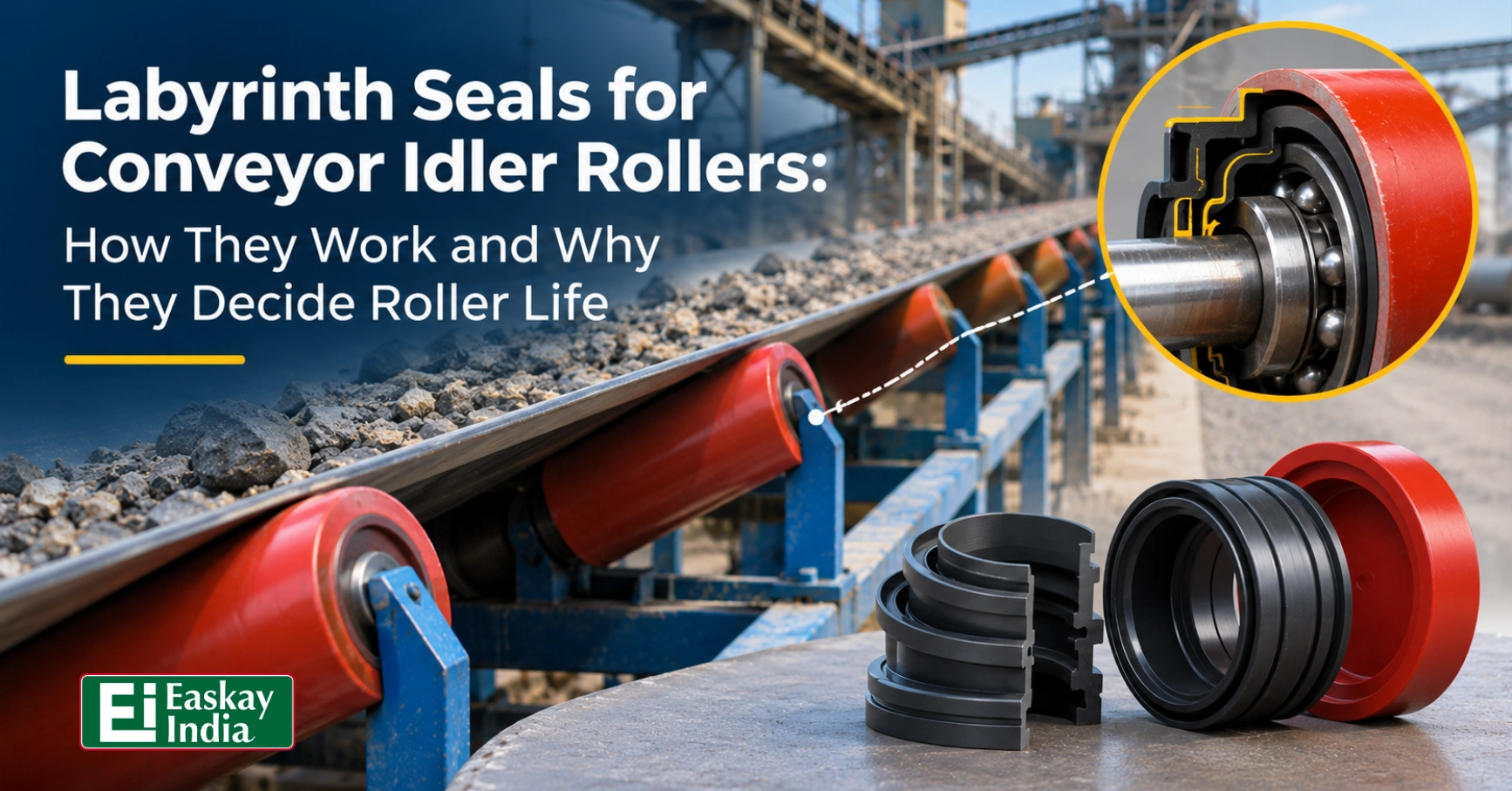
A labyrinth seal is a non-contact seal. Instead of a rubber lip pressing against a rotating shaft, it uses two or more interlocking parts with a series of grooves and ridges that fit closely together without touching. The gap between them forms a long, winding path, the labyrinth, that dust and water have to travel through to reach the bearing.
Each turn in that path slows the contamination down and gives it a chance to drop out. Many designs add a grease-filled cavity along the route, so that any fine dust that does get in is trapped in grease before it reaches the bearing. The result is a seal that keeps contamination out while the rotating and stationary parts never actually rub against each other.
On conveyor idlers, these seals are usually made as moulded plastic components, fitted at each end of the roller tube in front of the bearing. A typical dler roller seal set includes an inner labyrinth seal, an outer dust cover or deflector, and in many designs a bearing housing or retaining cap that locates the whole assembly.
Why Non-Contact Matters on a Conveyor
The choice of a non-contact seal is deliberate, and it comes down to three things that matter on every conveyor.
Low rolling resistance. A contact seal presses on the shaft and creates drag. Multiply that drag by thousands of rollers and it becomes a measurable share of the power needed to drive the belt. A labyrinth seal adds almost no drag, so the roller turns freely and the conveyor uses less energy.
No frictional heat and no seal wear. Because nothing rubs, nothing heats up and nothing wears away. A contact lip gradually loses its sealing force as it wears; a well-made labyrinth keeps the same geometry for the life of the roller.
Tolerance of harsh conditions. Dust, grit and water are exactly the conditions a contact lip struggles with, because abrasive particles wear the lip and the shaft. A labyrinth handles them by design.
The trade-off is that a labyrinth seal depends entirely on its geometry. The grooves must be the right depth, the gaps the right width, and the parts the right fit in the tube and on the shaft. That is why the quality of moulding and the consistency between pieces matter so much.
What Goes Wrong Without a Good Seal
When the seal on an idler roller is missing, damaged, poorly fitted or badly made, a predictable chain of events follows:
-
Dust and fines enter the bearing cavity. On bulk material conveyors handling cement, coal, ore, aggregates or grain, the air around the belt is full of abrasive particles.
-
The grease is contaminated. Grease mixed with fine dust becomes an abrasive paste rather than a lubricant.
-
Water adds corrosion. Outdoor conveyors and washdown areas introduce water, which corrodes raceways and washes grease out.
-
The bearing wears, heats and roughens. The roller becomes harder to turn and starts to run noisily.
-
The roller seizes. A seized idler does not turn with the belt. The belt slides over it instead, wearing a flat on the roller shell and abrading the belt cover. The friction generates heat, and on conveyors carrying combustible material a seized idler is a recognised fire risk.
-
Replacement under pressure. The roller is changed during a stoppage, often with the belt loaded, and often several rollers at a time.
Against this chain of events, a correctly specified plastic idler roller seal is one of the cheapest forms of insurance on the whole conveyor.
Anatomy of an Idler Roller Seal Set
Designs vary between roller manufacturers, but most idler end assemblies include some combination of the following parts:
-
Bearing housing or end cap. Pressed or welded into the roller tube, this locates the bearing and provides the stationary half of the labyrinth.
-
Inner labyrinth seal. The rotating and stationary halves with interlocking grooves that form the winding path.
-
Grease retention cavity. A space between the bearing and the labyrinth that holds grease, acting as a second barrier.
-
Outer dust cover or deflector. A cap or disc on the outside that throws off falling material and spray before it reaches the labyrinth.
-
Retaining circlip or clip. Holds the assembly in place on the shaft.
Many roller designs combine two or more of these functions into one moulded part. Whatever the design, the parts must fit together closely and consistently. A seal set that is dimensionally correct on one roller and loose on the next defeats the purpose.
Choosing or Replacing Labyrinth Seals: What to Specify
Whether you are a roller manufacturer specifying seals for production, or a plant replacing seals on refurbished rollers, these are the points to settle.
1. Bearing size and shaft diameter
Idler rollers commonly use deep groove ball bearings in sizes such as 6204, 6205, 6305 and 6306, on shafts of 20 mm, 25 mm or 30 mm. The seal set must match the bearing bore, outer diameter and the shaft it sits on. Give the supplier the bearing number and the shaft diameter as a minimum.
2. Roller tube diameter and wall thickness
The outer parts of the seal assembly fit inside the roller tube, so the tube’s inside diameter decides the outer dimension of the housing or seal. Tube wall thickness affects how the housing is pressed in.
3. Operating environment
Tell the supplier what the conveyor carries and where it runs. Dry, dusty material, wet or washdown conditions, outdoor exposure, high ambient temperature and chemical exposure each affect the material and the seal design. For outdoor conveyors, UV resistance of the plastic matters.
4. Material
Idler seals are typically moulded in engineering plastics chosen for toughness, dimensional stability and resistance to the grease and environment. Ask the supplier which material grade is used and confirm it suits your temperature and exposure. Material consistency between batches is as important as the grade itself.
5. Fit and tolerance
Because a labyrinth works by close clearances, dimensional tolerance is the heart of the specification. Parts should be made from a drawing with agreed tolerances, or against an approved sample, and every batch should be checked against it.
6. Drawing or sample
If you are replacing seals on an existing roller design, the most reliable way to specify them is to send the supplier a complete end assembly from a roller, along with the bearing number and tube size. A manufacturer who makes custom labyrinth seals can match the geometry rather than offering a near fit.
Installation and Maintenance Points
A good seal can still be let down by how it is fitted and maintained:
-
Press seals and housings in square. A housing pressed in at an angle leaves a gap on one side of the labyrinth.
-
Use the right amount of grease. Too little leaves the cavity empty; too much can push grease out through the labyrinth when the roller warms up, taking the grease barrier with it.
-
Replace seals as a set. Mixing a new inner seal with a worn outer cover, or parts from different designs, rarely gives the intended clearances.
-
Inspect during roller changes. When a roller comes out, look at the seal. Dust packed in the labyrinth or grease weeping from the outer cover tells you how the seal is performing in that part of the conveyor.
-
Keep spares matched to roller types. A plant with several roller designs should store seal sets by roller type and bearing size, not in one mixed bin.
Signs an Idler Roller Seal Is Failing
Walking a conveyor, these signs point to seal and bearing trouble before the roller seizes:
-
A roller that is noticeably warmer than its neighbours
-
Grinding, rumbling or squealing from the roller end
-
Grease marks or a dark wet ring around the end cap
-
A ring of packed dust at the end of the roller
-
A roller that wobbles, or turns slowly and stops when the belt is lifted
-
A visible flat spot or shiny band on the roller shell
Catching these early allows a planned replacement rather than an emergency one.
Plastic Conveyor Idler Roller Labyrinth Seals from Easkay India
Easkay India manufactures plastic conveyor idler roller labyrinth seals and bearing protection components for roller manufacturers and conveyor users. Seal sets are made to your drawing, sample or dimensional specification, matched to your bearing size, shaft and tube, and the approved specification is kept on file so that repeat batches match the first.
For the rest of the idler and conveyor system, our range also includes impact rubber rings for idler rollers for loading zones, industrial rubber skirting for transfer points, and plastic bushes and wear parts for conveyor assemblies. As an ISO 9001:2015 certified labyrinth seal manufacturer in India since 1977, we supply roller manufacturers and plants across the country. Share your seal drawing or a sample assembly and we will confirm fit and quote.
Frequently Asked Questions
1. What does a labyrinth seal do on a conveyor idler roller?
It protects the roller bearing from dust, water and fines. It does this with a winding, non-contact path between interlocking parts, often combined with a grease barrier, so that contamination is stopped before it reaches the bearing without adding friction to the roller.
2. Why are idler roller seals made of plastic?
Moulded engineering plastics give the close, consistent dimensions a labyrinth needs, do not corrode, are light, and can be produced in large quantities with the same geometry on every piece. They are also easy to press-fit into roller tubes.
3. How do I specify a replacement labyrinth seal for my rollers?
Provide the bearing number, shaft diameter, roller tube inside diameter and, ideally, a complete end assembly from an existing roller as a sample. Also describe the operating environment, such as dust, water, outdoor exposure or high temperature.
4. Can a labyrinth seal be replaced without changing the roller?
In many designs, yes, during roller refurbishment. The roller is stripped, the bearings and seals are replaced as a set, and the roller is regreased and reassembled. Replacing seals and bearings together is recommended, because a contaminated bearing will not be saved by a new seal.
5. Does Easkay India make labyrinth seals to custom designs?
Yes. Easkay India makes plastic conveyor idler roller labyrinth seals and related bearing protection parts to your drawing, sample or specification, for roller manufacturers and conveyor operators.
Conclusion
On a belt conveyor, the smallest components often decide the biggest costs. A labyrinth seal weighs a few grams and costs very little, but it stands between abrasive dust and the bearing that keeps the roller turning. Specify it to the bearing, shaft and tube, insist on consistent dimensions, fit it correctly, and the roller runs quietly for years. Get it wrong, and the conveyor tells you, usually at the worst possible time. If you are reviewing seals for new rollers or a refurbishment programme, share your details with our team and we will help you get the fit right.
Recent Posts