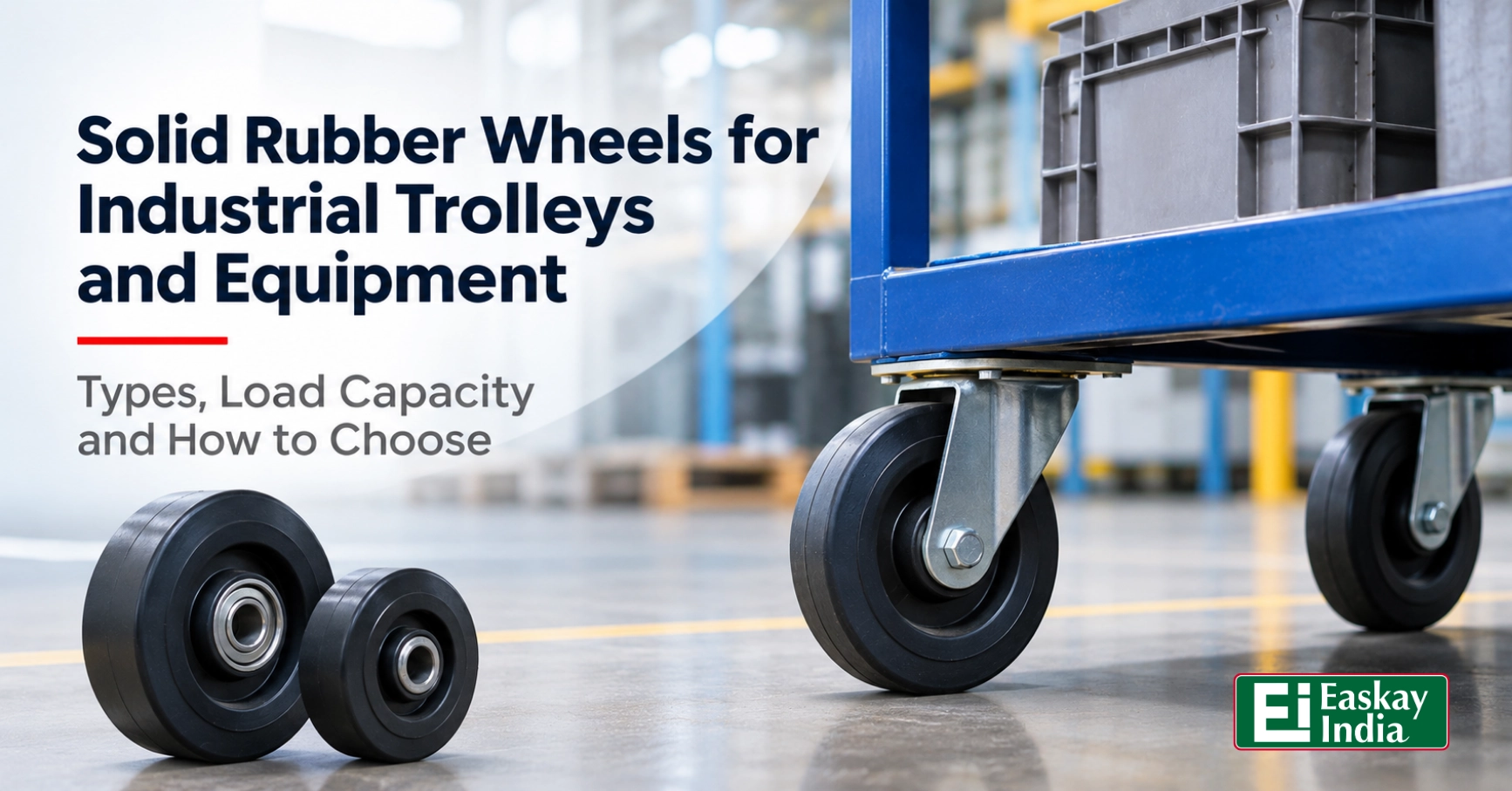
Solid Rubber Wheels for Industrial Trolleys and Equipment: Types, Load Capacity and How to Choose
Every factory, warehouse and workshop runs on wheels that nobody thinks about. Tool trolleys, platform trucks, component carts, movable racks, test stands and inspection fixtures all roll on small wheels, and when one of those wheels fails, the trolley stops, the floor gets scratched, and someone ends up dragging a loaded cart across the shop.
Solid rubber wheels are the workhorse of this category. They do not puncture, they do not need inflation, they run quietly, and they are forgiving of uneven floors and thresholds. But “solid rubber wheel” covers a wide range of sizes, hardnesses, compounds and constructions, and the wrong choice shows up as flat spots, chunking, noise or a wheel that will not roll under load.
This guide explains how industrial rubber wheels are built, where they are used, how to work out the load each wheel must carry, what hardness and compound to ask for, and the signs that a wheel needs replacing.
What Is a Solid Rubber Wheel?
A solid rubber wheel is a wheel whose running surface is a solid section of moulded rubber rather than an air-filled tyre. The rubber may be moulded as a complete wheel with a bore for the axle, or moulded onto a central hub that carries the bore and any bearing. Either way, there is no air inside, so there is nothing to puncture and no pressure to maintain.
The rubber section does three jobs at once. It carries the load, it cushions the trolley and its contents from bumps, and it provides grip on the floor. Because it is moulded under controlled conditions, a well-made wheel has consistent dimensions and a uniform running surface, which is what makes it roll true.
Where Solid Rubber Wheels Are Used
Rubber trolley wheels appear anywhere equipment has to be moved by hand or at low speed indoors and around the plant:
-
Industrial trolleys and platform trolleys
-
Factory carts and component bins on wheels
-
Warehouse and stores equipment
-
Movable racks, tool cabinets and workbenches
-
Equipment stands, test rigs and inspection fixtures
-
Material handling equipment and general engineering assemblies
They suit duties where the floor is reasonably good, the speed is walking pace, and quiet, puncture-free running matters more than very high speed.
How Solid Rubber Wheels Differ From Each Other
Two wheels that look the same can behave very differently. The main points of difference are below.
Construction
-
Fully moulded solid rubber wheels are one piece of rubber with a moulded bore. Simple, light and economical for lighter duties.
-
Rubber on a hub has the rubber section moulded around a central hub, which may be metal or a rigid plastic. The hub carries the axle load and allows a bearing to be fitted, which suits heavier duties and longer use.
Rubber compound
The compound decides how the wheel behaves in service:
-
Natural rubber (NR) gives good elasticity, impact absorption and general abrasion resistance, which makes it a common choice for general trolley and cart duty.
-
Nitrile rubber (NBR) is used where the wheel will see oil, grease or fuel on the floor, such as machine shops and maintenance areas.
-
Other compounds are specified where heat, chemicals, outdoor exposure or non-marking requirements call for them.
Tell the supplier what is on your floor. Oil, coolant, chemicals and outdoor weather all affect which compound lasts.
Hardness
Hardness, measured in Shore A, sets the balance between cushioning and load capacity. Softer wheels grip better, roll more quietly, protect floors and ride over cracks and debris more comfortably. Harder wheels carry more load with less deflection and roll with less effort on smooth floors. Industrial rubber wheels are commonly made in a medium to firm range, and the right point depends on the load and the floor. If you are unsure, our guide on rubber hardness, elasticity and durability explains what the Shore A number means in practice.
Tread profile
-
Flat treads put the full width on the floor, which spreads the load and suits smooth, hard floors.
-
Crowned or rounded treads make turning easier and suit trolleys that are steered often.
-
Custom profiles, such as grooves for grip or a specific shape for a guide track, can be moulded where the application needs them.
Bore, hub and bearing
The wheel must match the axle. Bore diameter, hub length and the type of bearing, whether a plain bore, a bush or a rolling bearing, all need to be specified. A plain bore is simple and suits light, occasional use. A bearing reduces rolling effort and wear on heavier or frequently moved equipment.
Working Out the Load Per Wheel
The most common mistake in choosing solid rubber wheels for trolleys is sizing them to the payload alone. Work it out properly:
-
Add up the total load. Weight of the trolley or equipment itself, plus the heaviest payload it will carry.
-
Do not divide by all the wheels. On an uneven floor, a four-wheeled trolley often has only three wheels carrying the load at any moment. A common practice is to divide the total load by three for a four-wheel trolley, so each wheel is rated for a third of the total.
-
Add a margin for shock. Thresholds, lift edges, dropped loads and pushing over debris all create short peaks well above the static load. A margin of around 25 to 30 percent above the calculated figure is a reasonable starting point for general duty, more for rough use.
-
Specify that figure as the load per wheel. Give it to the supplier along with the diameter you want, and let the design be matched to it.
A wheel sized this way runs cooler, keeps its shape when the trolley is parked loaded, and lasts far longer than one chosen by diameter alone.
Choosing Wheel Diameter and Width
Diameter decides how easily the wheel rolls over obstacles and how much effort it takes to start a loaded trolley moving. A larger diameter rolls over cracks, cable covers and thresholds more easily and needs less push. A smaller diameter keeps the trolley lower and is lighter and cheaper.
Width spreads the load over more floor area. Wider wheels reduce pressure on soft or finished floors and carry more load for the same rubber hardness, at the cost of slightly more effort when turning.
As a rule, if trolleys are pushed over rough or uneven floors, thresholds or outdoor yards, go up in diameter. If they run on smooth concrete and are turned often, a modest diameter with a crowned tread is easier to steer.
Floor, Environment and Duty
Three questions settle most of the remaining choices:
What is the floor like? Smooth sealed concrete, rough concrete, tiles, epoxy, steel plate or outdoor paving each favour a different hardness and diameter. Softer wheels protect finished floors; firmer wheels roll more easily on smooth hard ones.
What is on the floor? Oil, coolant and chemicals point to NBR or another resistant compound. Metal swarf and debris point to a firmer, abrasion-resistant wheel. Wet areas call for a tread that keeps grip.
How is the equipment used? A trolley moved a few times a day and parked loaded for long periods needs a wheel that resists flat-spotting. A cart in constant motion needs a bearing and an abrasion-resistant compound. Equipment that must not mark floors needs a non-marking compound specified from the start.
Signs a Solid Rubber Wheel Needs Replacing
Walk round the trolleys in your plant and look for:
-
Flat spots. A wheel that thumps as it rolls has taken a set from standing loaded too long, or is overloaded.
-
Cracks in the rubber, especially at the shoulder, from age, ozone or overloading.
-
Chunking or torn rubber on the tread, usually from debris, sharp edges or rough floors beyond the wheel’s duty.
-
Rubber separating from the hub on hub-type wheels.
-
Wobble or play on the axle, which points to a worn bore or bearing.
-
Noise or roughness when rolling, from a dry or damaged bearing.
Replacing wheels at the first of these signs is cheaper than replacing a trolley, a floor finish or a load that fell off a cart.
Simple Care That Extends Wheel Life
-
Do not exceed the load per wheel the trolley was designed for.
-
Avoid parking heavily loaded trolleys in one spot for weeks; move them or unload them.
-
Keep bearings lubricated where the design has them, and keep plain bores clean.
-
Remove string, tape, swarf and wire wrapped around axles.
-
Check axle nuts and castor fixings periodically.
-
Keep spare wheels of the right size and bore in stores so a damaged wheel is changed, not tolerated.
Solid Rubber Wheels from Easkay India
Easkay India manufactures solid rubber wheels for industrial trolleys, factory carts, material handling equipment, movable racks and general engineering use. Wheels are moulded in natural rubber, NBR and other specified compounds, in the diameter, width, bore, hub configuration, hardness and tread profile your application needs, and can be developed from a drawing, CAD model, sample or dimensional specification. Approved designs are kept on file for repeat and bulk supply.
For trolley and material handling builders, our range also includes rubber blocks for industrial trolleys, PU trolley blocks, rubber feet for equipment and anti-vibration rubber pads. As an ISO 9001:2015 certified solid rubber wheel manufacturer in India since 1977, we supply equipment builders and plants across the country. Share your wheel dimensions and load per wheel and we will recommend a suitable design.
Frequently Asked Questions
1. How do I work out the load capacity I need per wheel?
Add the weight of the trolley to its heaviest payload, divide by three for a four-wheel trolley to allow for uneven floors, and add a margin of around 25 to 30 percent for shocks and thresholds. Specify that figure as the required load per wheel.
2. Which rubber compound should I choose for a solid rubber wheel?
Natural rubber suits general trolley and cart duty where elasticity and impact absorption matter. NBR suits floors with oil, grease or fuel. Other compounds are used for heat, chemicals, outdoor exposure or non-marking requirements. Describe your floor and environment to the supplier.
3. What hardness should an industrial rubber wheel be?
It depends on the load and the floor. Softer wheels grip better, run quietly and protect floors; firmer wheels carry more load and roll more easily on smooth surfaces. Share your load per wheel and floor type and the hardness can be matched to them.
4. Why has my rubber wheel developed a flat spot?
Flat spots usually come from a loaded trolley standing in one place for a long time, or from a wheel that is too soft or too small for the load. Moving or unloading parked trolleys and sizing wheels to the real load per wheel both help.
5. Can Easkay India make solid rubber wheels to a custom size or bore?
Yes. Solid rubber wheels are made to your drawing, CAD model, sample or dimensions, including custom bore, hub, width and tread profile, and in the compound and hardness your application needs.
Conclusion
A solid rubber wheel is a small part with a large effect on how easily equipment moves, how quiet a plant is and how long floors and trolleys last. Work out the real load per wheel, match the diameter to the floor, choose the compound for what is on that floor, and specify the bore and bearing the duty deserves. Do that once, and the wheels go back to being the part nobody thinks about, which is exactly where they belong. If you are specifying wheels for new equipment or replacing worn ones, send us your details and we will help you get the design right.
Recent Posts