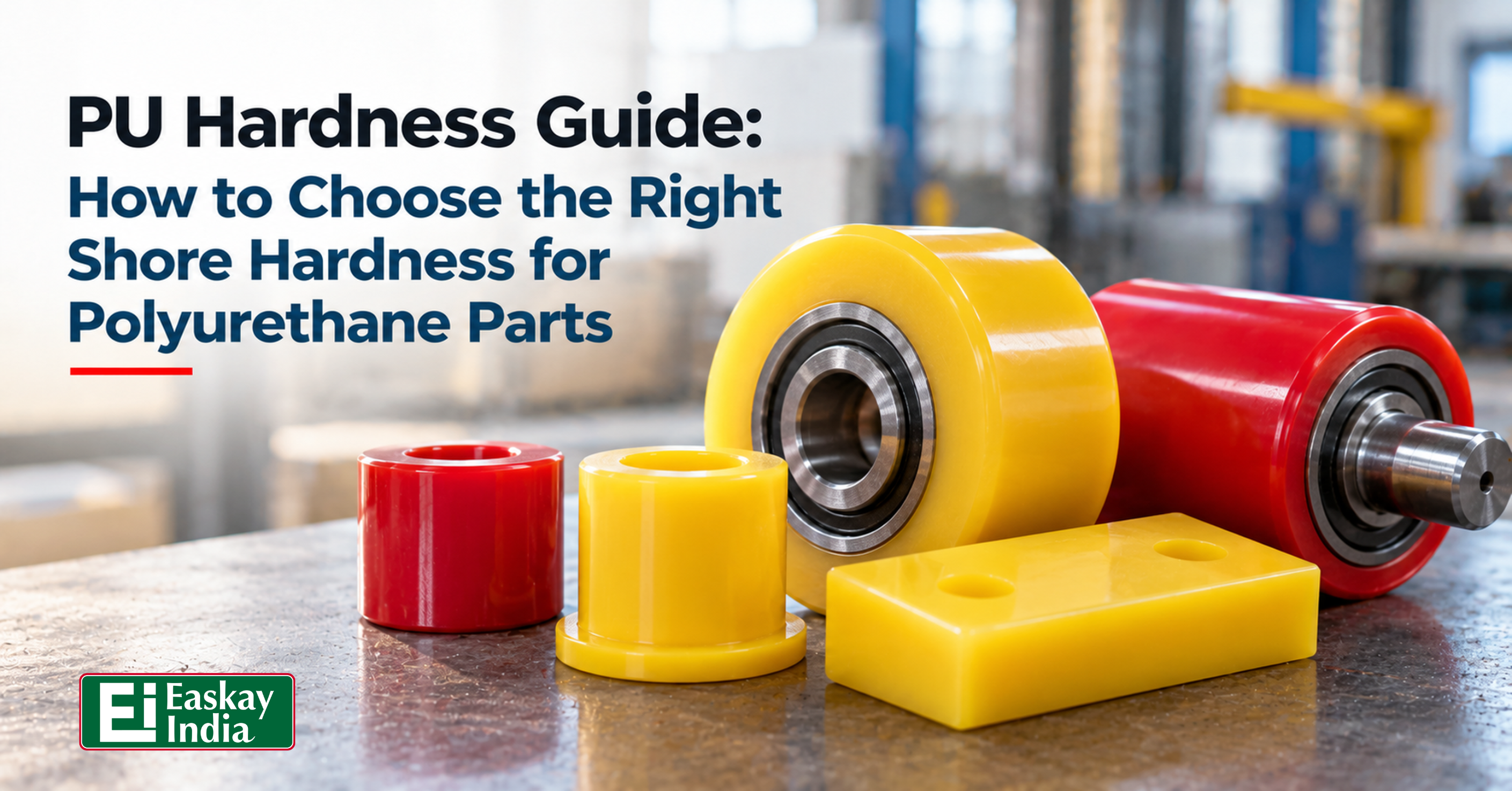
PU Hardness Guide: How to Choose the Right Shore Hardness for Polyurethane Parts
Ask a buyer what they need from a polyurethane part and the answer is usually “something tough that lasts”. That is fair, because toughness is exactly why PU is chosen. But there is one specification that decides, more than any other, whether a PU roller, wheel, bush or pad actually performs: its hardness.
Polyurethane can be made soft enough to cushion a delicate surface or hard enough to carry heavy loads with very little deflection. That range is PU’s biggest strength. It is also why choosing the wrong hardness is one of the most common reasons a PU part wears out early, runs hot, cracks or simply does not do its job.
This guide explains PU hardness in plain terms: how it is measured, what changes as polyurethane gets harder or softer, and how to choose the right polyurethane Shore hardness for rollers, wheels, bushes, pads and other industrial parts.
How PU Hardness Is Measured
Hardness is measured with a durometer, which presses a small indenter into the surface and reads how much it resists. For polyurethane, two scales are commonly used:
- Shore A for softer to medium-hard grades
- Shore D for very hard grades
The two scales overlap around the hard end of Shore A, so a grade in the mid-90s on Shore A is already a firm material, and Shore D picks up from there for harder compounds.
What makes polyurethane unusual is how wide its range is. Industrial PU parts are commonly made anywhere from soft grades around 60 Shore A to very hard grades in the Shore D range. Very few materials cover such a wide spread while keeping good toughness and wear resistance.
If hardness scales are new to you, our guide on understanding rubber hardness, elasticity and durability explains how durometer readings work in more detail.
What Changes as PU Gets Harder or Softer
Hardness is not just a number on a data sheet. It changes how the part behaves in your machine. Here is what typically happens as you move along the scale.
Softer PU (lower Shore A):
- Grips better and conforms to surfaces
- Absorbs impact and vibration well
- Protects delicate or finished surfaces
- Carries less load before it deflects
- Builds up more heat when it is loaded and flexed repeatedly at speed
Harder PU (higher Shore A and Shore D):
- Carries higher loads with less deflection
- Rolls with lower resistance, which saves effort on wheels and rollers
- Holds tight dimensions better and machines more cleanly
- Grips less and transmits more vibration and noise
- Absorbs less impact, so it is less forgiving on rough surfaces
Neither end is “better”. The right hardness is the one that balances these effects for your load, speed and surface.
PU Hardness by Application: A Quick Reference
The ranges below are typical starting points used across industry. Exact choices depend on the design, so treat this as a guide rather than a rule.
| Application | Typical hardness | Why |
|---|---|---|
| Cushioning and anti-vibration pads | Around 60 to 75 Shore A | Absorbs shock and conforms to the surface |
| Rollers handling delicate or finished material | Around 60 to 80 Shore A | Better grip and surface protection |
| Trolley wheels on uneven floors | Around 80 to 90 Shore A | Quieter, rides over cracks, protects floors |
| Heavy trolley wheels on smooth floors | Around 90 to 95 Shore A or Shore D | Higher load, lower rolling resistance |
| Bushes | Around 90 to 95 Shore A or harder | Load support and wear resistance |
| Seals and scrapers | Around 90 to 95 Shore A | Resists extrusion and wears slowly |
| Impact zones such as chutes and hoppers | Mid-range, around 75 to 90 Shore A | Resilience to absorb falling material |
| Wear strips and high-load parts | Shore D grades | Stiffness with minimal deflection |
If your application is not listed, start around 85 to 95 Shore A and move softer for grip, cushioning or surface protection, or harder for load capacity and dimensional stability.
A Closer Look at Common PU Parts
PU Rollers
Rollers have their own hardness considerations, from grip and surface protection to load and speed. Our complete guide to polyurethane rollers covers roller hardness and load capacity in detail, and you can explore our range of PU rollers for industrial use.
PU Wheels and Trolley Blocks
On trolleys and material handling equipment, the floor matters as much as the load. Softer wheels roll more quietly, protect floors and cope better with cracks and uneven surfaces. Harder wheels carry heavier loads and roll more easily on smooth floors. For heavily loaded trolleys on smooth concrete, firmer grades are common; on rough or mixed floors, a slightly softer grade often lasts longer and runs more smoothly. PU trolley blocks are chosen on the same logic.
PU Bushes
Bushes need to support load while absorbing some shock and movement. Firmer grades, often in the 90 to 95 Shore A range or harder, are common where load and wear resistance come first. Slightly softer grades are used where the bush must absorb more vibration or allow a little flexibility. Our PU bushes can be made in the hardness that suits your load and movement.
PU Pads and Cushioning Parts
Pads that protect, cushion or reduce vibration usually sit in the softer range. The right grade depends on the weight they carry: too soft and they compress too far, too hard and they stop absorbing shock. PU pads are often selected by testing a sample under the real load.
PU Seals and Scrapers
Seals and scrapers in hydraulic, pneumatic and handling equipment are typically firm grades, because they must resist being pushed into gaps under pressure and wear slowly while sliding. Too soft, and they extrude or wear quickly; too hard, and they stop following the surface.
Five Factors That Should Decide Your PU Hardness
When you are working out how to choose PU hardness, these five questions do most of the work.
1. How much load does the part carry? Higher loads generally need harder grades, so the part does not deflect too much or overheat.
2. How fast does it move, and for how long? Parts that flex repeatedly at speed, such as rollers and wheels, generate internal heat. Softer grades build up more heat under the same conditions, so high-speed, high-load duty usually calls for a firmer grade.
3. What does it touch? Delicate, painted or finished surfaces and uneven floors favour softer grades. Smooth, hard surfaces and heavy loads favour harder ones.
4. Is the wear from sliding or from impact? This is often overlooked. Where material slides across the surface, harder grades usually wear better. Where material strikes the surface, as in chutes, hoppers and impact zones, a softer, more resilient grade often outlasts a harder one, because it absorbs the energy instead of chipping.
5. What is the operating environment? Temperature, water and chemicals all matter. PU becomes noticeably harder in cold conditions and softer as it warms up, so a part’s working temperature affects how it behaves. Moisture and certain chemicals also influence which PU type should be used, which brings us to the next point.
Beyond Hardness: The PU Type Matters Too
Hardness is not the only choice. Polyurethanes are made from different base chemistries, and the two families you will hear about most are polyester-based and polyether-based PU.
- Polyether-based PU generally offers better resistance to water and humidity, and stays more resilient, which makes it a common choice for wet or outdoor applications.
- Polyester-based PU generally offers strong resistance to oils, abrasion and cutting, which suits many dry, oily or heavy-wear applications.
So two parts with the same Shore hardness can behave differently depending on the PU type. When you share your application with a supplier, mention any exposure to water, steam, oil or chemicals so both the hardness and the type can be chosen correctly.
Signs Your PU Part Has the Wrong Hardness
If a PU part is not lasting as long as it should, its condition often points to a hardness mismatch:
- Melting, cracking or crumbling from the inside on rollers or wheels often points to heat build-up, a sign the grade may be too soft for the load and speed.
- Chunking or chipping on impact surfaces can mean the grade is too hard to absorb the impact.
- Excessive flattening or deflection under load suggests the grade is too soft.
- Poor grip, slipping or noise can mean the grade is harder than the application needs.
- Marks or damage on the product or floor suggest a softer grade may protect better.
Looking at a worn part this way is often the quickest route to a longer-lasting replacement.
Get the Hardness Right with Easkay India
Easkay India manufactures polyurethane components including PU rollers, bushes, flanged bushes, sheets, blocks, pads, rods, seals, O-rings, trolley blocks and custom PU moulded components. Parts are made in the hardness and PU type that suit your load, speed, surface and environment, to your drawing or sample.
As an ISO 9001:2015 certified PU products manufacturer in India since 1977, we can help you choose the right grade before you commit to production. Explore our full range of PU products or send us your application details for a recommendation.
Frequently Asked Questions
1. What is the most common hardness for industrial PU parts?
Many industrial PU parts fall in the range of about 85 to 95 Shore A, which balances toughness, wear resistance and load capacity. Softer grades are used for cushioning and grip, and Shore D grades for very high loads.
2. Is harder polyurethane always more wear resistant?
Not always. Harder PU usually resists sliding wear better, but for impact wear, such as material falling onto a surface, a softer and more resilient grade often lasts longer because it absorbs the impact.
3. What PU hardness is best for trolley wheels?
It depends on the load and the floor. Firmer grades suit heavy loads on smooth floors, while slightly softer grades roll more quietly, protect floors and cope better with uneven surfaces.
4. Why did my PU roller crack or melt from the inside?
This often happens when the grade is too soft for the load and speed, causing heat to build up inside the roller. A firmer grade or a different PU type may solve the problem.
5. Can you make PU parts in a specific hardness?
Yes. Easkay India manufactures PU components in the hardness that suits your application, made to your drawing, sample and operating conditions. Share your load, speed and environment and we will recommend a suitable grade.
Conclusion: Hardness Is Where PU Performance Starts
Polyurethane’s wide hardness range is what makes it so useful, and also what makes the choice so important. Start with the load, speed, surface and type of wear, consider the temperature and environment, and the right hardness usually becomes clear. When it is chosen well, a PU part quietly outlasts expectations. If you are unsure which grade suits your application, share the details with our team and we will help you select it.
Recent Posts